
Four reasons to reconsider your global passive exposure


Key takeaways
- The US accounts for 71.9% of the MSCI World index, while 10 of its largest companies make up more than a quarter of its market capitalisation.
- This market now looks expensive in aggregate and some of the largest index positions may be about to face a new set of headwinds.
- There are abundant investment opportunities in the US – particularly among the beneficiaries of AI spending – but you are unlikely to gain sufficient exposure to them through a passive North American or global fund.
It has been difficult to argue against the case for a fire-and-forget investment in a global passive fund over the past 15 years: the MSCI World index is up by 475.6% over this time1, equivalent to annualised returns of more than 12%.
Driven by a handful of US tech companies generating profits and cashflows on a hitherto unimaginable scale, few active managers have been able to deliver returns anywhere close to this figure.
One of the only ways to beat the global market over this time would have been to take a more concentrated view on the US, with the MSCI North America index up 648.3% over the same period2.
But as you are no doubt tired of hearing, past performance is not a guide to future returns.
The US now accounts for 71.9% of the MSCI World index, while 10 of its largest companies make up more than a quarter of the market capitalisation3. Eight of these are concentrated in the tech industry.
Hence, putting all your money in a global tracker fund doesn’t just mean you are overexposed to a single sector in a single country, it means you are betting exactly the same investment trends that defined the post-Global Financial Crisis era will continue to run in perpetuity.
There are four main reasons why we don’t think this will be the case.
1. The ‘true’ valuation of the US looks expensive
Most warnings about the US market centre on how expensive it is. The oft-quoted earnings weighted P/E ratio for the index currently sits at 20.8x4, which looks high, but is admittedly below the average of the past two years.
However, we think a more accurate measure of P/E for index investors is the market-cap weighted version, as this reflects how each pound or dollar of investment is allocated from a P/E perspective. Looking at this measure, it is much higher at 27.6x5.
This is significant as although earnings growth has been responsible for much of the US market’s strong performance over the past 15 years, the valuation re-rating has also played a major role. If you start on a high valuation, ask yourself whether it is more likely to continue creeping ever higher in the long term, or fall back towards average levels?
2. Overvalued IPOs
The US market is currently being force-fed some enormous IPOs, with talk of OpenAI, Anthropic and SpaceX being allowed to bypass profitability rules so they can be fast-tracked into the Nasdaq/S&P 500 this year. This would force passive investors to take on two companies that are currently unprofitable and burning cash (OpenAI and Anthropic) and another that will likely trade on 94x revenue (SpaceX).
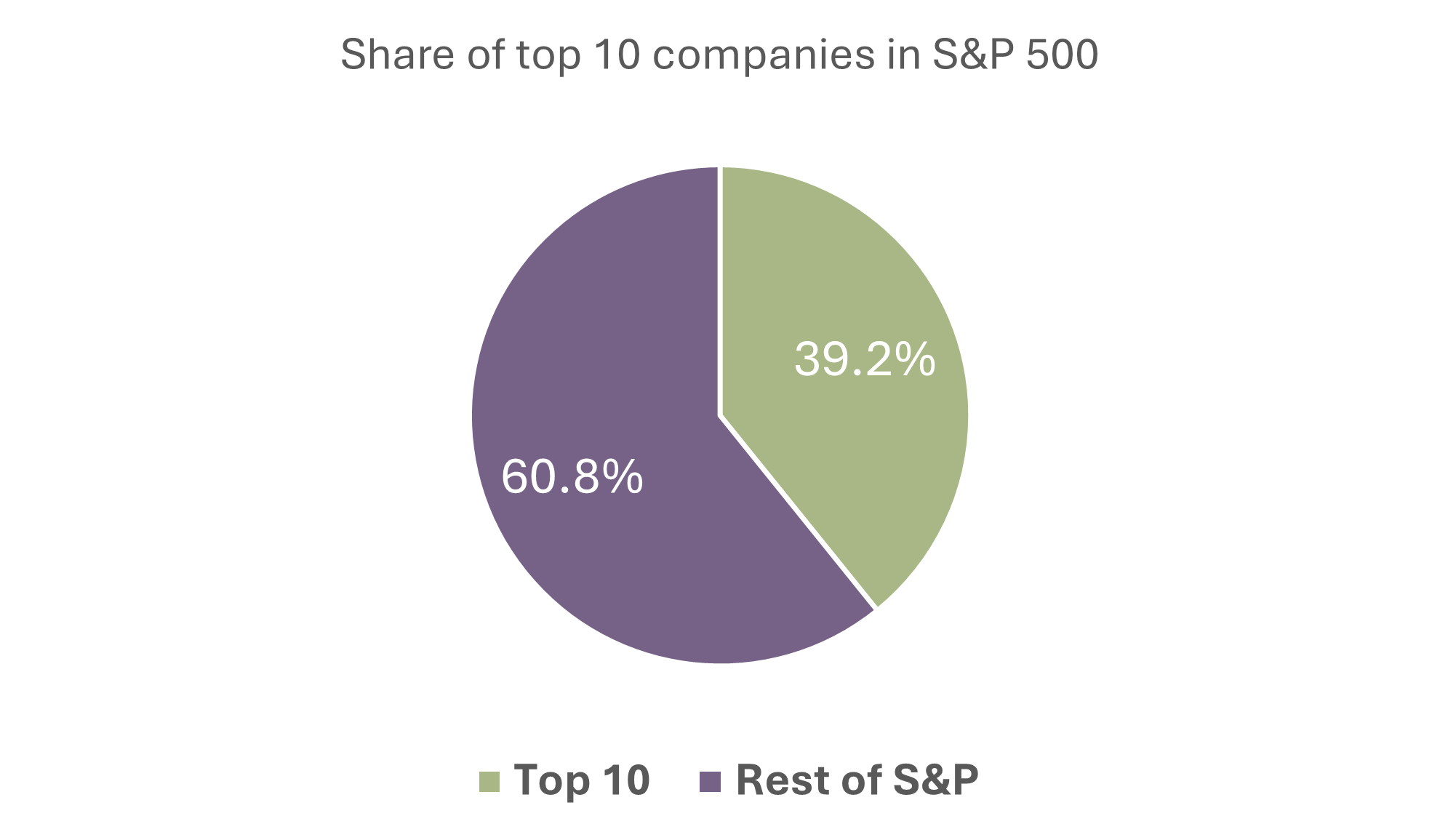
Aside from pushing the 10 largest companies in the S&P 500 from about 40% to 50% of the index6, it will further concentrate the index in the theme of AI – an area where there are still major question marks over what sort of return the hundreds of billions of dollars being invested in this technology will actually deliver for investors.
The 10 biggest companies in the S&P 500 make up almost 40% of the index
Source: Bloomberg, Apollo Chief Economist
3. Falling number of share buybacks
Buybacks have helped to support share prices in the US market for most of the past 15 years, with this corporate action concentrated in the largest, most cash-generative index constituents.
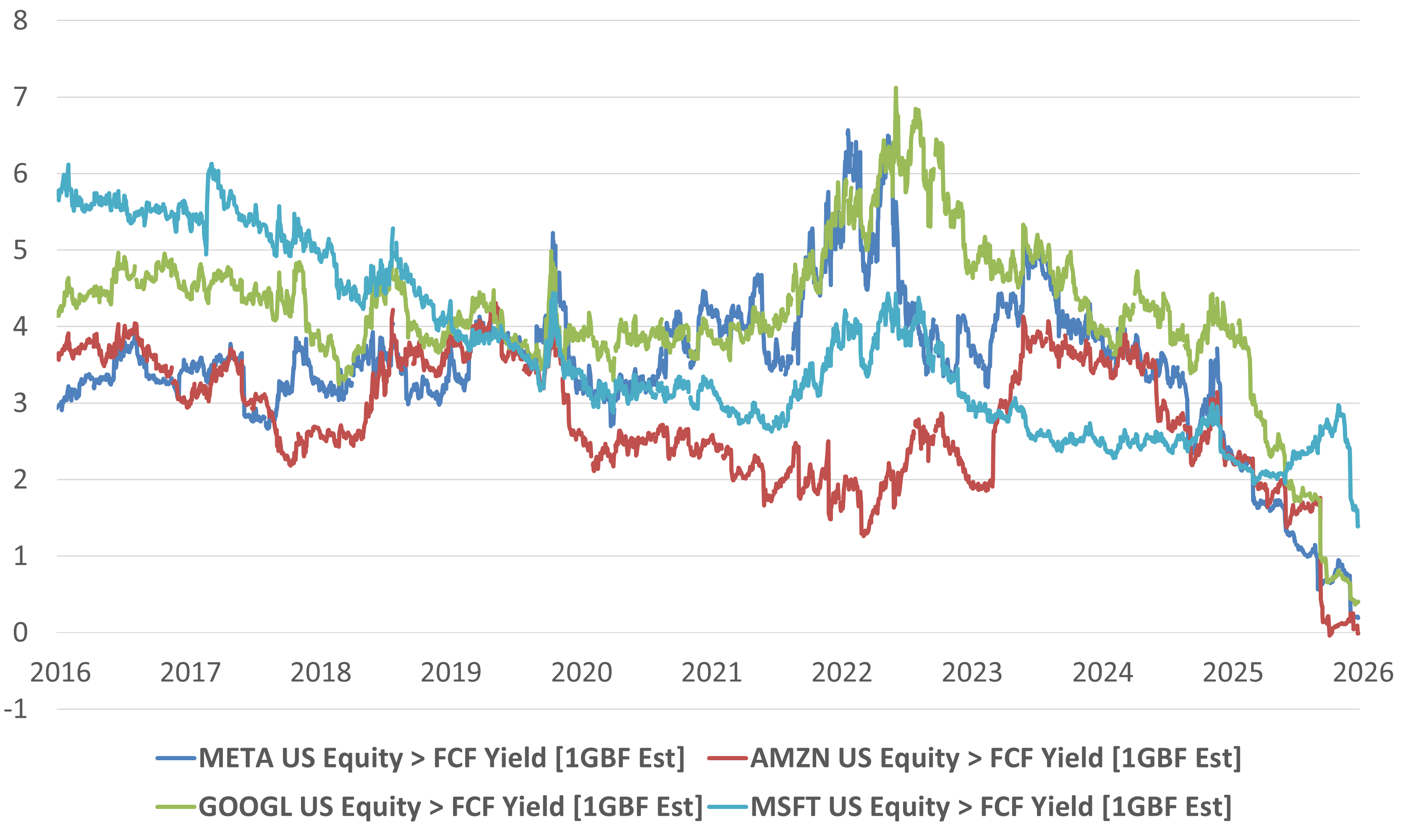
But this trend now looks under threat. As mentioned above, the tech companies that have dominated the US index for the past couple of decades are throwing incredible amounts of money at AI infrastructure to avoid getting left behind. They are now expected to invest $725bn this year, up from $150bn in 20237. Some analysts expect this figure to reach $1trn a year by the end of the decade.
This enormous amount of capex has led to a collapse in free cashflow yields, reducing the tech giants’ capacity to purchase their shares in the short term. With little visibility about how this investment will affect profits, it is unclear whether they will be able to resume a similar level of buybacks in the long run, either.
Estimated forward free cashflow yields (%)
Source: Bloomberg
4. Shifting demographics
One of the simplest explanations for what drives up share prices is a higher number of buyers than sellers. A lack of demand is not something that investors in the US have had to worry about in recent memory, with the flow of capital only going in one direction.
However, this may not always be the case. Of $163.1tn of total US household assets, just over half is concentrated in the hands of the Baby Boomers – those born between 1946 and 19648.
While the wealth owned by this demographic has been supportive to flows into retirement accounts (401ks) over the past decade, this could be about to go into reverse. With the pace of drawdowns picking up at 73 (required minimum distributions start at this age) and a current average age of 71 among this cohort9, the shift in direction could begin sooner than later.
Redemptions are projected to rise from $250bn today to $1trn in the early 2030s and net buying through this avenue is due to turn net negative in 202810.
Of course, the money removed from the US stock market in this way should quickly find its way back in as the Boomers overwhelmingly spend it in the domestic economy.
However, the companies they redeem their money from are unlikely to be the beneficiaries of their spending. For example, Microsoft currently makes up 4.9% of the S&P 50011. It is unlikely to account for 4.9% of a retiree’s pension expenditure.
To be clear, we are not saying the US is a bad place to invest. We currently see plenty of opportunities, with the companies set to benefit from the billions of dollars spent on AI infrastructure of particular interest. The point is that investors in a global tracker fund will have little exposure to this potential. They cannot afford to limit themselves to the single region or sector that has worked in the past, especially at a time when alternatives such as emerging markets look so exciting. As we enter a brave new world, you can’t rely on the same old strategies.
Notes and references
1. https://www.msci.com/documents/10199/178e6643-6ae6-47b9-82be-e1fc565ededb
2. https://www.msci.com/documents/10199/46aa6590-4ca0-4bfb-bc51-3ca9c297c4ff
3. https://www.msci.com/documents/10199/178e6643-6ae6-47b9-82be-e1fc565ededb
4 & 5. Absolute Strategy Research
6. Bloomberg/Apollo Chief Economist
7. https://www.ft.com/content/b3dfaba9-17a2-4fac-90fe-4ab3ca7c9494?syn-25a6b1a6=1
8, 9 & 10. UBS Global Wealth Report 2025
11. https://www.msci.com/documents/10199/46aa6590-4ca0-4bfb-bc51-3ca9c297c4ff
FOR PROFESSIONAL INVESTORS AND/OR QUALIFIED INVESTORS AND/OR FINANCIAL INTERMEDIARIES ONLY. NOT FOR USE WITH OR BY PRIVATE INVESTORS.
CAPITAL AT RISK. All financial investments involve taking risk and the value of your investment may go down as well as up. This means your investment is not guaranteed and you may not get back as much as you put in. Any income from the investment is also likely to vary and cannot be guaranteed.
This is a marketing communication. Before making any final investment decisions, and to understand the investment risks involved, refer to the fund prospectus (or in the case of investment trusts, Investor Disclosure Document and Articles of Association), available in English, and KIID/KID, available in English and in your local language depending on local country registration, available in the literature library.
Important information
The intention of Artemis’ ‘investment insights’ articles is to present objective news, information, data and guidance on finance topics drawn from a diverse collection of sources. Content is not intended to provide tax, legal, insurance or investment advice and should not be construed as an offer to sell, a solicitation of an offer to buy, or a recommendation for any security or investment by Artemis or any third-party. Potential investors should consider the need for independent financial advice. Any research or analysis has been procured by Artemis for its own use and may be acted on in that connection. The contents of articles are based on sources of information believed to be reliable; however, save to the extent required by applicable law or regulations, no guarantee, warranty or representation is given as to its accuracy or completeness. Any forward-looking statements are based on Artemis’ current opinions, expectations and projections. Articles are provided to you only incidentally, and any opinions expressed are subject to change without notice. The source for all data is Artemis, unless stated otherwise. The value of an investment, and any income from it, can fall as well as rise as a result of market and currency fluctuations and you may not get back the amount originally invested.