
Does the small-cap effect still work globally?


CAPITAL AT RISK. All financial investments involve taking risk and the value of your investment may go down as well as up. This means your investment is not guaranteed and you may not get back as much as you put in. Any income from the investment is also likely to vary and cannot be guaranteed.
This is a marketing communication. Before making any final investment decisions, and to understand the investment risks involved, refer to the fund prospectus (or in the case of investment trusts, Investor Disclosure Document and Articles of Association), available in English, and KIID/KID, available in English and in your local language depending on local country registration, available in the literature library.
Key takeaways
- Smaller companies (also known as ‘small caps’) have significantly outperformed larger ones in the UK since 19551, while the same trend has been observed at a global level over the past 44 years1.
- This trend has gone into reverse at both a country and global level since the start of 2020, and smaller companies are now cheaper than larger ones2.
- If smaller companies end up outperforming larger ones from this point, we believe the current discount could represent a significant buying opportunity.
The ‘small-cap effect’ refers to the notion that smaller companies tend to outperform large ones over the long term. But does it still hold true today?
We are currently in the second longest drawdown (when an asset or stockmarket fails to return to its previous high) for UK small caps since the mid 1950s1 and the underperformance isn’t confined to these shores. This helps to explain why global smaller companies now trade at a significant valuation discount versus large caps2.
Global smaller companies' valuation premium/discount versus global large caps
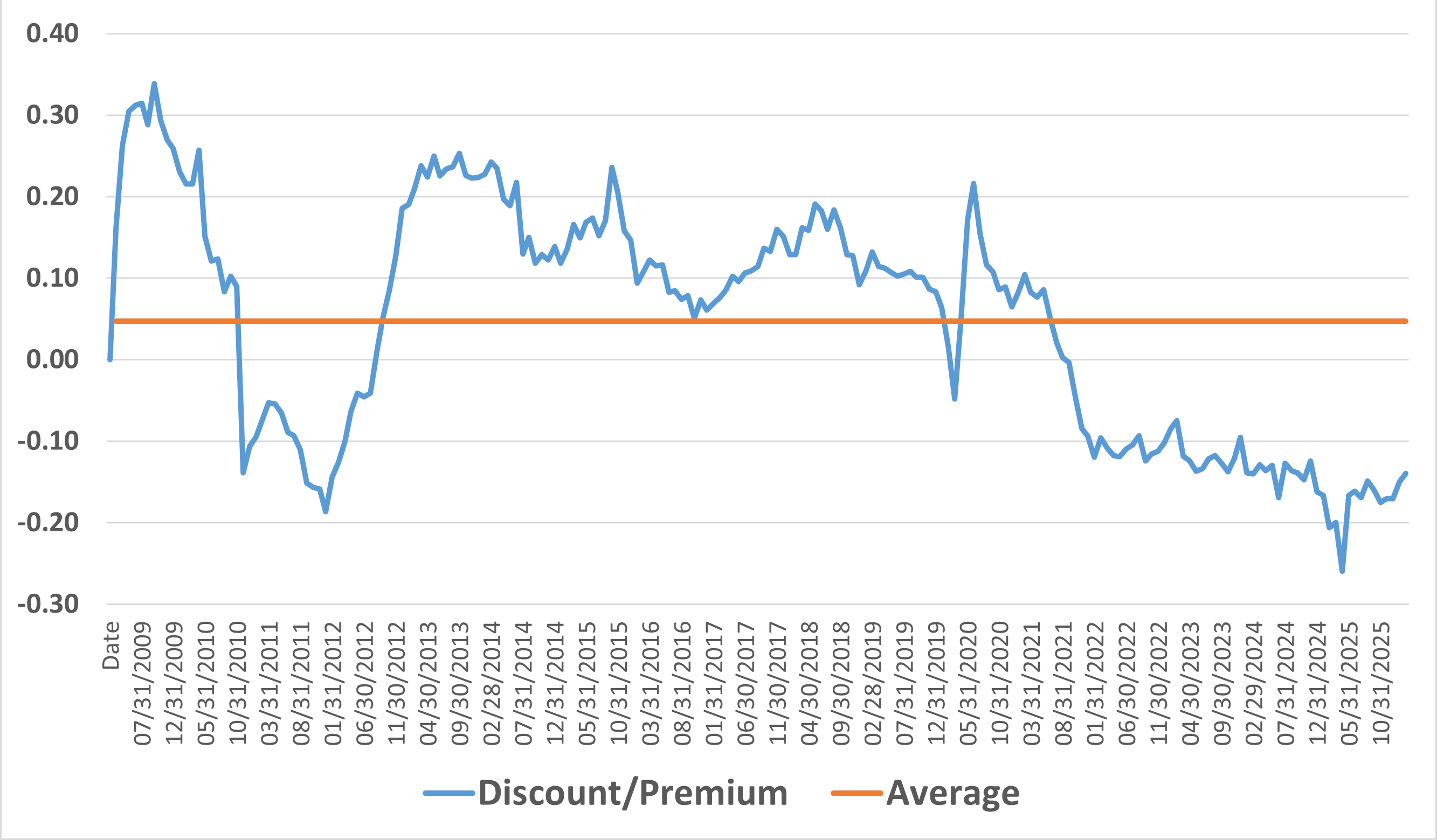
Source: Bloomberg as at 2 February 2026
And yet, just like in the UK, global smaller companies have outperformed over the long term, on average delivering an additional 3.2 percentage points per year of returns over large caps from 2000 to the end of 20243.
Annualised small-cap premium (%) around the world, 2000-2025
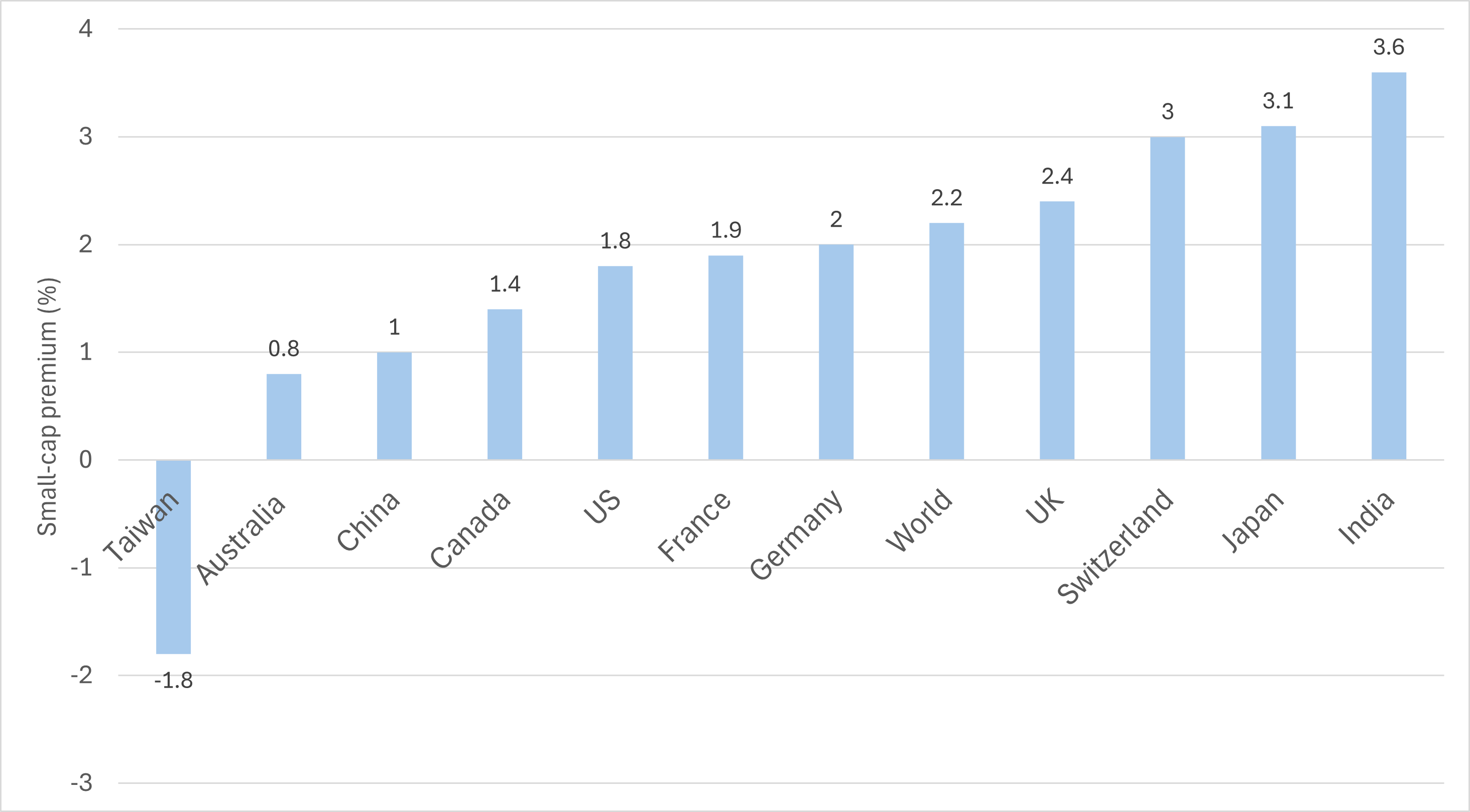
Source: MSCI, Scott Evans and Paul Marsh, Deutsche Numis
Small-cap investors who have focused on ‘value’ (companies that are cheaper than the stockmarket) rather than ‘growth’ (companies growing faster than the stockmarket) have benefited from a further boost to long-term returns4.
Value investing has worked in small caps
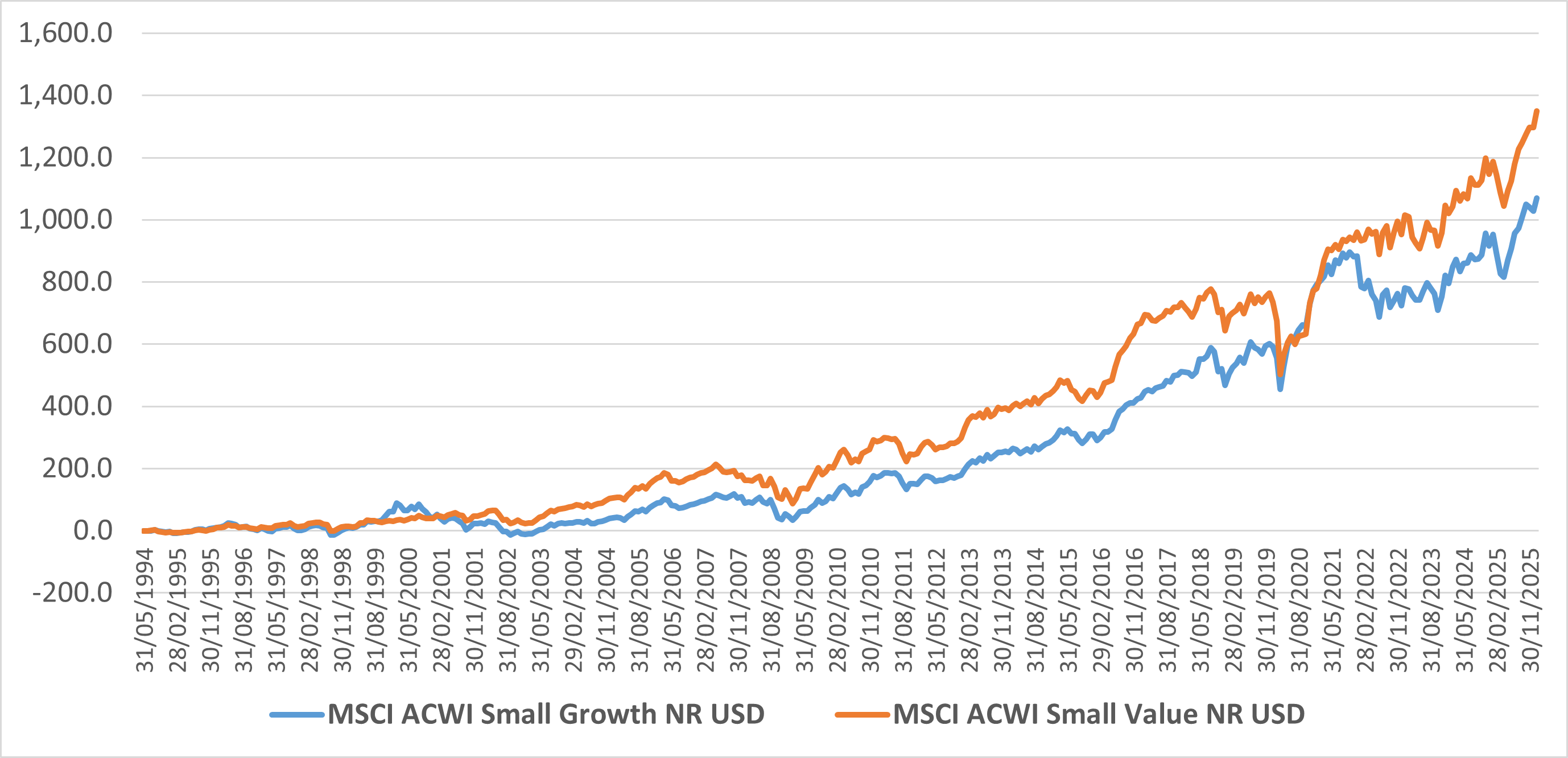
Source: Morningstar as at 31 January 2026. Net return in dollars.
So why the recent lacklustre performance of smaller companies, or rather – and this distinction is important – of their share prices?
What we have seen in the past few years is a surge in popularity of the mega caps (companies with a market capitalisation above $200bn), particularly those in the US. The Magnificent Seven (Alphabet, Amazon, Apple, Meta, Microsoft, Nvidia and Tesla) tech companies represent more than a quarter of the MSCI World index5 and the US more than 73%6. We believe this concentration of money into a handful of companies means many other areas – including small caps – have been overlooked. Share prices have suffered as a result.
The relative performance of small caps tends to move in cycles7, so given they have trailed large caps since 2020, now would seem like a good time to invest, in our view.
Diversification benefits of small caps
Aside from the valuation argument in favour of small caps, we think they also offer some important diversification benefits.
In a global context, we regard any company with a market value of less than $15bn as a small cap. This leaves us with a potential investable universe of about 5,000 names8, giving us plenty of options in our search for cheap companies with attractive growth prospects and low levels of debt.
We think this is especially important in today’s environment. A defining feature of the 47th US presidency, as with the 45th, is the steady advance of anti-globalisation (the reversal of global interdependence). This heightens the appeal of smaller companies on several fronts. Perhaps most obviously, many such businesses around the world tend to have a domestic focus – which potentially reduces the impact of global tariffs.
As Canadian prime minister Mark Carney pointed out at Davos recently: “We are in the midst of a rupture, not a transition.”
New trading coalitions will have to be engineered, in our view. We are seeing this in Asia: China’s exports to the US have shrunk considerably in the past year9. According to the International Monetary Fund, more than half of Asian trade doesn’t leave the continent10, with governments recognising the need for greater integration.
Smaller companies can adapt to change
We think that one of the historical reasons for the small-cap premium is that smaller companies tend to be more adaptive: radical change demands flexibility and a willingness to innovate. Smaller companies also have more room to grow – it’s easier for a $15bn company to double in size than a $150bn one.
But being smaller doesn’t necessarily mean being leaner and faster. The dispersion of returns in the small-cap arena is much greater than among large caps11.
The challenge is to identify the winners – tomorrow’s large-cap companies. And here lies another opportunity. These companies are subject to much less analyst coverage and more market inefficiency. This means that, if you have the process and the skills, there is greater opportunity to unearth good companies at attractive valuations.
Is small-cap underperformance just a blip?
We are at a point where I suspect people are starting to doubt whether the small-cap premium still works, after an extended period of relative underperformance. The question is: is this a permanent feature or a blip – a blip that has lasted a long time? My belief is that it is the latter.
I believe that if you are disciplined about the sorts of companies you are looking for – those with depressed share prices but attractive growth prospects – then you can deliver good long-term outcomes.
Investing now may seem counter-intuitive, but if you think the US’s dominance of the global stockmarket has peaked, that the huge amounts of capital the mega caps are throwing at artificial intelligence risk tarnishing their profitability, and that investors’ portfolios are too concentrated, then global small caps may represent an attractive diversification play.
Notes and references
1 Deutsche Numis UK Smaller Companies index (excluding investment trusts) relative to the FTSE All-Share from 1 January 1955 to 31 December 2025, sourced from Bloomberg and Artemis
2 Bloomberg as at 2 February 2026. Based on forward price-to-earnings (P/E) ratios
3 The UBS Global Investment Returns Yearbook (Dimson, Marsh and Staunton, 2025) quoted in Deutsche Numis Indices’ 2026 Annual Review, published on 15 January 2026
4 Morningstar as at 31 January 2026
5 & 6 Source: MSCI to 30 January 2026
7 Artemis, Bloomberg, referring to the relative performance of the MSCI ACWI Large Cap and Small Cap indices in USD from 31 December 1999 to 31 January 2026
8 Artemis
9 https://www.just-style.com/news/us-imports-decline-in-december-on-china-lag/
10 https://www.imf.org/en/news/articles/2025/03/05/sp030525-md-asias-next-growth-frontier
11 Source: Bloomberg to 31 July 2025
Risks specific to Artemis SmartGARP Global Smaller Companies Fund
- Market volatility risk The value of the fund and any income from it can fall or rise because of movements in stockmarkets, currencies and interest rates, each of which can move irrationally and be affected unpredictably by diverse factors, including political and economic events.
- Currency risk The fund’s assets may be priced in currencies other than the fund base currency. Changes in currency exchange rates can therefore affect the fund's value.
- Charges from capital risk Where charges are taken wholly or partly out of a fund's capital, distributable income may be increased at the expense of capital, which may constrain or erode capital growth.
- Emerging markets risk Compared to more established economies, investments in emerging markets may be subject to greater volatility due to differences in generally accepted accounting principles, less governed standards or from economic or political instability. Under certain market conditions assets may be difficult to sell.
- Smaller companies risk Investing in small companies can involve more risk than investing in larger, more established companies. Shares in smaller companies may not be as easy to sell, which can cause difficulty in valuing those shares.
Important information
The intention of Artemis’ ‘investment insights’ articles is to present objective news, information, data and guidance on finance topics drawn from a diverse collection of sources. Content is not intended to provide tax, legal, insurance or investment advice and should not be construed as an offer to sell, a solicitation of an offer to buy, or a recommendation for any security or investment by Artemis or any third-party. Potential investors should consider the need for independent financial advice. Any research or analysis has been procured by Artemis for its own use and may be acted on in that connection. The contents of articles are based on sources of information believed to be reliable; however, save to the extent required by applicable law or regulations, no guarantee, warranty or representation is given as to its accuracy or completeness. Any forward-looking statements are based on Artemis’ current opinions, expectations and projections. Articles are provided to you only incidentally, and any opinions expressed are subject to change without notice. The source for all data is Artemis, unless stated otherwise. The value of an investment, and any income from it, can fall as well as rise as a result of market and currency fluctuations and you may not get back the amount originally invested.