How Odysseus could save investors from the stockmarket’s excesses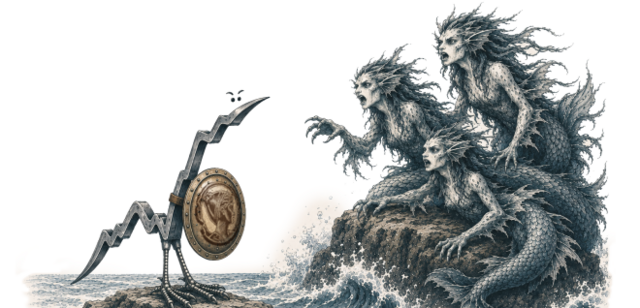

CAPITAL AT RISK. All financial investments involve taking risk and the value of your investment may go down as well as up. This means your investment is not guaranteed and you may not get back as much as you put in. Any income from the investment is also likely to vary and cannot be guaranteed.
This is a marketing communication. Before making any final investment decisions, and to understand the investment risks involved, refer to the fund prospectus (or in the case of investment trusts, Investor Disclosure Document and Articles of Association), available in English, and KIID/KID, available in English and in your local language depending on local country registration, available in the literature library.
Key takeaways
- The story of Odysseus and the sirens has a lot to teach investors about FOMO, emotional decision-making and euphoria
- Artemis’ SmartGARP® team has, in a way, signed its own ‘Ulysses Pact’ (Ulysses being the latinised version of Odysseus)
- Our investment process places greater weight on objective financial data than on prevailing market sentiment
- Investing in companies and industries when they are out of favour can be rewarding, especially when earnings are improving but share prices have not yet caught up with the good news
After watching Christopher Nolan’s new telling of ‘The Odyssey’ on the big screen, I’ve been pondering what its hero might be able to teach us about investing – at a time when markets, in my view, are overheating.
When share prices are rising at what seems like a remorseless pace, it can be tempting to wade in and buy, for fear of missing out.
In the classic Greek legend, Ulysses is determined to hear the song of the sirens but knows it will hypnotise him into acting irrationally, leading to his doom.
He makes what has become known as a ‘Ulysses pact’ with his crew. They strap him to the ship’s mast and then block their ears with wax. Ulysses is able to hear the sirens’ alluring though deadly singing but the crew sails to safety – for a short while, anyway.
So how do you resist the siren temptation of markets and psychological biases?
My response was to sign my own Ulysses Pact by creating an investment process that is 80% based on data and 20% subjective.
Artemis’ SmartGARP stock-screening tool analyses criteria such as growth, whether share prices are expensive or not, and changes in earnings forecasts. It essentially mimics what most fund managers say they do (although I often wonder whether they actually do so, in practice).
SmartGARP sifts through a vast amount of data to offer us some fairly simple choices: between investing in a fast-growing company or one with slower growth; between a cheaper share or a more expensive one; and between businesses generating good or bad news. In each example, we would pick the first company and to us, that appears to be an obvious answer.
So why do our SmartGARP funds – which aim to consistently make choices such as these – differ so much from their peers?
The majority of European equity funds managed by other asset managers own higher-priced shares than we do1.
By contrast, we look for companies with cheaper share prices whose financial characteristics are improving.
Over the past five years, some companies that used to be considered high quality (with high share prices to match) have come unstuck.
For example, I recall that four years ago, luxury goods company LVMH was much-admired and widely owned. Yet over the past three or four years, there has been a steady drip, drip, drip of bad news2.
The pharmaceutical company Novo Nordisk is a similar case. If you take the period from 2020 to 2024, Novo Nordisk was a hugely popular stock. Fund managers seemed to love it. We bought it early and enjoyed the benefits. As the earnings went up, the stock price went through the roof3. The story made a lot of sense: Novo Nordisk had a duopoly on weight loss drugs in an era when obesity levels were rising globally.
In August 2024 the first cracks began appearing in the story. The company cut its earnings forecasts4 as sales of Ozempic missed expectations, due to competition from US pharmaceutical company Eli Lilly and supply constraints. SmartGARP said sell. We did. The share price subsequently collapsed and profits continued to fall5.
Following the sirens can mean you are blinded to opportunities as well as risks. After the global financial crisis, banks were cheap and their earnings kept falling. Fund managers around the world became increasingly negative. Even when earnings started to recover after the Covid pandemic, banks remained unloved.
However, European banks have performed strongly for the past couple of years6. Their earnings are still rising and share prices have been following. Management teams seem to be doing sensible things – buying back shares and avoiding crazy acquisitions.
Some banks score better within SmartGARP than others. The Artemis SmartGARP European Equity Fund’s top 10 holdings feature France’s BNP Paribas and Societe Generale, Spain’s Banco Santander and Banco Bilbao Vizcaya Argentaria and Italy’s BPER Banca7.
We have owned different banks at different times, as prices have caught up with the improving story.
We have been doing the same thing in the healthcare sector, where we sold Novartis recently – after its share price rose by more than 30% in the past year8 – and bought Sanofi. Over the past decade, Novartis’ earnings have grown much faster than Sanofi’s, but in the past year, Sanofi’s earnings have been higher9. We also think Sanofi’s shares offer better value10.
In other sectors, such as travel, airlines, food/beverage and telecoms, analysts have been downgrading their earnings expectations for a range of companies. We’d rather sail around these rocks.
The call of the sirens is strong. Our impulses and emotions can get in the way of smart thinking. To counteract this, we try to focus on the data and to buy shares that are cheaper than the market, but growing a bit faster. Experience has shown us that doing so, time and again, can help to stack the odds in our favour.
Notes and references
1. Source: Factset/Artemis as at 30 June 2026, peer group is Morningstar EAA Fund Europe ex-UK Equity, funds >£100m
3. https://global.morningstar.com/en-gb/stocks/is-novo-nordisk-stock-buy-after-its-share-price-collapse
5. https://uk.finance.yahoo.com/news/novo-nordisk-stock-sinks-17-114233688.html
7. Source: Artemis as at 31 August 2026
8, 9, & 10. Source Artemis as at 10 July 2026
Risks specific to Artemis SmartGARP European Equity Fund
- Market volatility risk The value of the fund and any income from it can fall or rise because of movements in stockmarkets, currencies and interest rates, each of which can move irrationally and be affected unpredictably by diverse factors, including political and economic events.
- Currency risk The fund’s assets may be priced in currencies other than the fund base currency. Changes in currency exchange rates can therefore affect the fund's value.
- Charges from capital risk Where charges are taken wholly or partly out of a fund's capital, distributable income may be increased at the expense of capital, which may constrain or erode capital growth.
Important information
The intention of Artemis’ ‘investment insights’ articles is to present objective news, information, data and guidance on finance topics drawn from a diverse collection of sources. Content is not intended to provide tax, legal, insurance or investment advice and should not be construed as an offer to sell, a solicitation of an offer to buy, or a recommendation for any security or investment by Artemis or any third-party. Potential investors should consider the need for independent financial advice. Any research or analysis has been procured by Artemis for its own use and may be acted on in that connection. The contents of articles are based on sources of information believed to be reliable; however, save to the extent required by applicable law or regulations, no guarantee, warranty or representation is given as to its accuracy or completeness. Any forward-looking statements are based on Artemis’ current opinions, expectations and projections. Articles are provided to you only incidentally, and any opinions expressed are subject to change without notice. The source for all data is Artemis, unless stated otherwise. The value of an investment, and any income from it, can fall as well as rise as a result of market and currency fluctuations and you may not get back the amount originally invested.