Artemis Short Duration Strategic Bond Fund
Q4 2024 update




Source for all information: Artemis as at 31 December 2024, unless otherwise stated.
Government bond markets sold off aggressively in the final quarter of 2024, despite the fact that central banks continued to lower policy rates. Having kicked off its rate-cutting cycle in September with a jumbo 50-basis-point cut, the US Federal Reserve went on to deliver two more 25-basis-point cuts over the quarter, taking the effective federal funds rate down to 4.375%. The Bank of England, meanwhile, lowered policy rates by 25 basis points. For its part, the European Central Bank took rates 50 basis points lower. Despite these cuts, government bond yields moved higher as markets recalibrated their expectations for rates and inflation in 2025 and beyond.
Yet even as yields on government bonds moved higher, credit spreads tightened as investors were drawn in by the attractive all-in yields available on both investment-grade and high-yield bonds. The combination of strong demand and dwindling supply created a powerful technical set up for credit markets heading into the end of the year.
Performance
Against this backdrop, the strong performance of the fund’s credit module offset negative returns from its rates (government bonds) module. The net result was that the fund delivered another solid quarter, returning 0.9% versus 0.8% from its benchmark, the Markit iBoxx 1-5 year £ Collateralised & Corporates Index. Over 2024 as a whole, meanwhile, the fund returned 7.5%, significantly outpacing the benchmark, which showed a return of 4.9%1.
The clear highlight of the fourth quarter was our holding in Annington, which owns housing units offered to married members of the UK armed forces. The Ministry of Defence bought the houses back for £6 billion (the loss to taxpayers over the last 30 years significant). Annington announced it would use the sale proceeds to start buying back its bonds at generous levels. Fortunately, we had been adding to our holding before the announcement, making it one of the fund’s largest positions.
Fund performance relative to benchmarks (old and new)
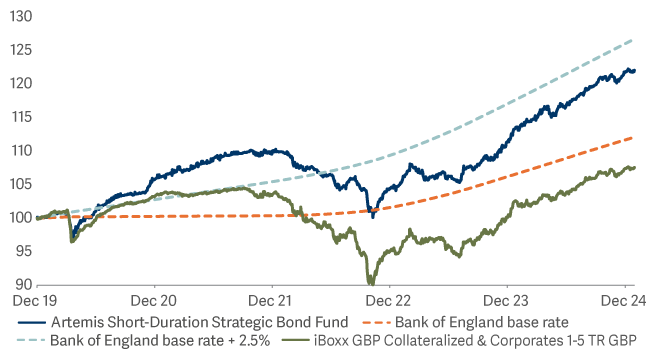
Past performance is not a guide to the future.
Source: Bloomberg, class I accumulation shares in GBP from 3 December 2019 to 31 December 2024. The target benchmark is the Markit iBoxx 1-5 year £ Collateralized & Corporates Index; before 18 March 2024 it was the Bank of England base rate +2.5%. All figures show total returns with dividends and/or income reinvested, net of all charges. Performance does not take account of any costs incurred when investors buy or sell the fund. The fund launched on 3 December 2019.
Fund performance relative to money market funds
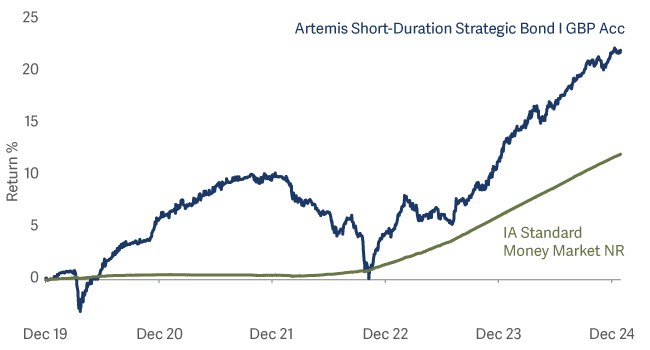
Past performance is not a guide to the future.
Source: Lipper Limited, class I accumulation shares in GBP as at 31 December 2024. All figures show total returns with dividends and/or income reinvested, net of all charges. Performance does not take account of any costs incurred when investors buy or sell the fund. The Artemis Short-Duration Strategic Bond Fund was launched on 3 December 2019. Performance is presented versus the IA Standard Money Market sector as a proxy for investing in a cash fund. The purpose is to demonstrate the performance of the strategy versus making an allocation to cash. Please note that these asset classes have different risk profiles and the potential for capital losses in the Artemis Short-Duration Strategic Bond Fund is greater.
Activity and positioning
The fund’s headline duration fluctuated within a narrow band of between 2.5 and 2.7 years over the quarter. In the primary market, we added four new issues to the fund’s credit module: Bayerische Landesbank (bank; investment-grade); Belron (auto repair; high-yield); Fressnapf (pet food; high-yield) and Techem (energy monitoring and services; high-yield).
In the secondary market, we topped up existing holdings in short-dated investment-grade bonds from Centrica, Schroders and Caterpillar. We trimmed holdings in Lloyds Bank and Danske Bank, both of which had performed well. We switched a holding in National Grid (which had been a strong performer) into vehicle leaser Motability (which had not). We also made a relative value switch between two different bonds issued by Avis.
On the high yield side, we added to several positions, with the focus of our additions being the higher-quality end of the market. We see the set-up for this part of the market as being favourable due to a combination of attractive yields, low duration risk, relatively low default risk and the potential for bonds to be redeemed early, giving us a useful capital uplift. Additions here included Iron Mountain (the data storage company); Coty (the global cosmetics business); IGT (the provider of gaming technology) and Live Nation (the concert ticketing company).
In the fund’s rates (government bond) module, our activity focused on re-introducing a long position in US real yields versus European real yields. In November, we closed a cross-market position through which the fund was short in Japanese government bonds versus US Treasuries. Towards the end of the quarter, meanwhile, we increased the fund’s exposure to curve-steepening strategies and inflation positions.
Outlook: The opportunity is still at the short end of the curve
The all-in yields available in shorter-dated end of the fixed income market remain very attractive. Since the upward reset in yields two years ago, it has been our view that investors don’t need to be too clever to earn a useful return in these market conditions: they can simply focus on short-dated bonds and take an attractive level of income. This remains our view.
The final quarter of 2024 saw a significant shift in global politics and in fiscal policy worldwide. In the UK, the new government’s first Budget saw the chancellor re-writing her fiscal rules to inject significant fiscal stimulus into the economy. With international investors’ perceptions of the UK’s fiscal prudence having already been dented by the country’s brief experiment with Trussonomics, Chancellor Reeves’ badly received Budget could have a long-lasting impact on sentiment towards the gilt market. More tangibly, because many of the measures announced in the Budget were unfunded, it will result in a significant increase in new issuance the market will need to digest.
The US election saw Donald Trump and his MAGA movement taking a stranglehold on American economic and geopolitical policy. A combination of tariffs and tax cuts seems likely to keep inflation in the US higher for longer. And while the Federal Reserve lowered rates again in December, the reality is that it will need to see a significant deterioration in either the economic cycle or clear signs that the labour market is slowing to cut rates again. With the election having fostered the market’s animal spirits, there is little sign of any cooling at this point.
The theme of greater fiscal slippage is not confined to the US or the UK; Europe is also struggling to rein in government spending. A new government in Germany seems likely to increase government spending. In France, the fragile coalition led by Michel Barnier collapsed because the legislature refused to sanction spending cuts designed to reduce the country’s budget deficit. As funding requirements across the Eurozone continue to grow, the pressure on government bond yields to rise will surely increase, potentially increasing the cost of servicing debt.
Any further easing of policy needs to be measured against risks of a reacceleration in inflation. While economic performance varied considerably between the US, UK and Europe in 2024, one consistent theme was that core inflation remained too high, with services inflation proving to be stickier than forecast. Domestic demand is being supported by government spending and by the strength of household balance sheets; many workers are still enjoying healthy wage gains in real terms.
The opportunity is still at the short end of the curve. While we are aware of the risks to bonds, valuations matter too. A key determinant is the current level of policy rates and their expected path. At the start of October, market pricing suggested that ‘neutral’ policy rates in the US would be below 3%. This has now increased significantly, to around 4%. Forward rates in the UK have also tightened significantly recent months. Markets are projecting that policy rate will drop – albeit only marginally - over the next few years, settling at around 4%. For us, the opportunity in these conditions exists in targeting shorter-dated bonds which are less vulnerable to the threat of rising supply and more closely tied to policy rate expectations. We are positive on prospects for risk assets (such as credit) in 2025 as the all-in yield argument is compelling. Despite this, we dialled down risk in the portfolio heading into the end of last year. This gives us room to add risk back as the new issuance season begins and activity picks up.
Notes and references
Past performance is not a guide to the future.
Source: Lipper Limited/Artemis to 31 December 2024 for class I accumulation GBP.
All figures show total returns with dividends and/or income reinvested, net of all charges.
Performance does not take account of any costs incurred when investors buy or sell the fund.
Returns may vary as a result of currency fluctuations if the investor's currency is different to that of the class.
Benchmarks: Markit iBoxx 1-5 year £ Collateralised & Corporates Index. An indicator of the performance of short-dated sterling denominated corporate investment grade bonds, in which the fund invests. It acts as a ‘target benchmark’ that the fund aims to outperform. Management of the fund is not restricted by this benchmark. While the fund has the flexibility to strategically invest across fixed income sectors, sterling denominated investment grade corporate bonds are likely to be the main asset class in the portfolio, and the manager believes this index is the closest proxy for the long-term asset allocation of the fund.
CAPITAL AT RISK. All financial investments involve taking risk and the value of your investment may go down as well as up. This means your investment is not guaranteed and you may not get back as much as you put in. Any income from the investment is also likely to vary and cannot be guaranteed.
This is a marketing communication. Before making any final investment decisions, and to understand the investment risks involved, refer to the fund prospectus (or in the case of investment trusts, Investor Disclosure Document and Articles of Association), available in English, and KIID/KID, available in English and in your local language depending on local country registration, available in the literature library.

Risks specific to Artemis Short-Duration Strategic Bond Fund
- Market volatility risk The value of the fund and any income from it can fall or rise because of movements in stockmarkets, currencies and interest rates, each of which can move irrationally and be affected unpredictably by diverse factors, including political and economic events.
- Currency risk The fund’s assets may be priced in currencies other than the fund base currency. Changes in currency exchange rates can therefore affect the fund's value.
- Bond liquidity risk The fund holds bonds which could prove difficult to sell. As a result, the fund may have to lower the selling price, sell other investments or forego more appealing investment opportunities.
- Higher-yielding bonds risk The fund may invest in higher-yielding bonds, which may increase the risk to capital. Investing in these types of assets (which are also known as sub-investment grade bonds) can produce a higher yield but also brings an increased risk of default, which would affect the capital value of the fund.
- Credit risk Investments in bonds are affected by interest rates, inflation and credit ratings. It is possible that bond issuers will not pay interest or return the capital. All of these events can reduce the value of bonds held by the fund.
- Derivatives risk The fund may invest extensively in derivatives with the aim of profiting from falling (‘shorting’) as well as rising prices. Should the asset’s value vary in an unexpected way, the fund value could reduce. Refer to the investment policy in fund's prospectus for further details on how derivatives may be used.
- Leverage risk The fund may operate with a significant amount of leverage. Leverage occurs when the economic exposure created by the use of derivatives is greater than the amount invested. A leveraged portfolio may result in large fluctuations in its value and therefore entails a high degree of risk including the risk that losses may be substantial.
- Charges from capital risk Where charges are taken wholly or partly out of a fund's capital, distributable income may be increased at the expense of capital, which may constrain or erode capital growth.
- Emerging markets risk Compared to more established economies, investments in emerging markets may be subject to greater volatility due to differences in generally accepted accounting principles, less governed standards or from economic or political instability. Under certain market conditions assets may be difficult to sell.
- Income risk The payment of income and its level is not guaranteed.
- Counterparty risk Investments such as derivatives are made using financial contracts with third parties. Those third parties may fail to meet their obligations to the fund due to events beyond the fund's control. The fund's value could fall because of loss of monies owed by the counterparty and/or the cost of replacement financial contracts.
- Mortgage- or asset-backed securities risk Mortgage- or asset-backed securities may not receive in full the amounts owed to them by underlying borrowers.
The intention of Artemis’ ‘investment insights’ articles is to present objective news, information, data and guidance on finance topics drawn from a diverse collection of sources. Content is not intended to provide tax, legal, insurance or investment advice and should not be construed as an offer to sell, a solicitation of an offer to buy, or a recommendation for any security or investment by Artemis or any third-party. Potential investors should consider the need for independent financial advice. Any research or analysis has been procured by Artemis for its own use and may be acted on in that connection. The contents of articles are based on sources of information believed to be reliable; however, save to the extent required by applicable law or regulations, no guarantee, warranty or representation is given as to its accuracy or completeness. Any forward-looking statements are based on Artemis’ current opinions, expectations and projections. Articles are provided to you only incidentally, and any opinions expressed are subject to change without notice. The source for all data is Artemis, unless stated otherwise. The value of an investment, and any income from it, can fall as well as rise as a result of market and currency fluctuations and you may not get back the amount originally invested.