Artemis Strategic Assets Fund
Q3 2025 update



Source for all information: Artemis as at 29 September 2025, unless otherwise stated.
Tariff deadline prompts flurry of trade deals and market recovery
Risk assets received some welcome relief as the original expiry date of the delayed retaliatory US tariffs was pushed out from 9 July to 1 August. On reaching the expiry date, risk assets initially sold off, but a swift recovery followed. The S&P 500 soon hit fresh highs as the market was calmed by the US having already reached trade deals with several large economies such as the EU and Japan.
Federal Reserve cuts rates
Chair of the Federal Reserve Jerome Powell came under sustained pressure from President Donald Trump to cut interest rates to support the economy. This pressure had diminished by September as the central bank reduced rates due to a softening in the labour market and indicated it would do so twice more before the end of 2025. This reduction in borrowing costs supported financial markets.
Europe reaches end of cutting cycle – for now
President of the European Central Bank Christine Lagarde affirmed the organisation's hawkish stance in July, leaving interest rates unchanged over the current quarter against a stagnant economic backdrop. Industrial sector weakness, notably in the auto sector, and a relatively lacklustre economy were expected to be offset by a large increase in planned fiscal spending led by Germany. Simultaneously, debt sustainability issues began to affect European sovereign bonds, notably in France where the government collapsed after it was unable to agree a curtailment in government spending.
Gold offers shelter to investors
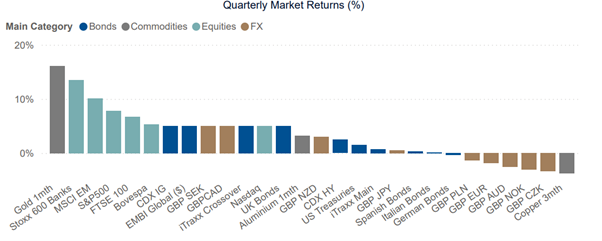
Attacks on the independence of the Federal Reserve, concerns that rates are being cut while inflation is still relatively elevated and debt sustainability fears spreading across the globe led to strong demand for gold.
Source: FactSet
Performance
Artemis Strategic Assets contains two ‘buckets’: a Directional (Trends) Strategy that aims to take advantage of market trends; and a Non-Directional Strategy, which endeavours to generate returns that are uncorrelated to market movements by taking long and short positions whose exposures offset each other. For both strategies, the fund invests in financial derivatives that provide exposure to a diversified range of asset classes, including equities, bonds and currencies.
The fund continued its recovery which began in June. The Directional (Trends) Strategy appreciated during the quarter, driven largely by long positions in equity markets, with the positive backdrop for risk assets providing support. Selected currency positions also added value, including the long in Mexican pesos versus the dollar and the short in Japanese yen versus the euro.
The Non-Directional Strategy also performed well, benefiting from currency longs in the Czech koruna and Australian and US dollars. Our longs in US and Canadian equities also did well, more than offsetting the short in emerging markets. However, the rates (government bonds) side marginally hindered returns due to relative shorts in Canada against the backdrop of a weak economy.
Overall, the fund returned 4.0% during the quarter, ahead of the 1.1% from its CPI + 3% benchmark but behind the 6.5% made by its IA Flexible Investment sector.
| Three months | Six months | One year | Three years | Five years | |
|---|---|---|---|---|---|
| Artemis Strategic Assets | 4.0% | 0.2% | -3.1% | 14.2% | 36.6% |
| CPI + 3% | 1.1% | 3.6% | 6.8% | 22.5% | 47.1% |
| IA Flexible Investment sector | 6.5% | 10.8% | 11.0% | 33.0% | 43.3% |
Past performance is not a guide to the future. Source: Lipper Limited to 30 September 2025 for class I Acc GBP. All figures show total returns with dividends and/or income reinvested, net of all charges. Performance does not take account of any costs incurred when investors buy or sell the fund. Returns may vary as a result of currency fluctuations if the investor's currency is different to that of the class. This class may have charges or a hedging approach different from those in the IA sector benchmark.
Activity
Directional (Trends) Strategy
- Equities: We increased our exposure to equities during the quarter as momentum strengthened in a relatively low volatility environment. The portfolio retained a preference for long positions in emerging Asian equity markets that were beneficiaries of expected fiscal support from China's government. We also like US utilities – an indirect beneficiary of technology spend on data centres.
- Bonds: Weak economic data in Switzerland and New Zealand were largely responsible for the increase in our bond duration during September. Having been pared back to flat by early August, we again increased duration by the end of the period, to 4.8 years. For much of the quarter, longs in shorter maturities were broadly offset by shorts in longer tenors where debt sustainability fears affected the cost of long-term borrowing.
- Long FTSE China & Hang Seng: The expectation of fiscal and monetary stimulus from Chinese authorities and an easing in the tariff war with the US supported the emerging Asia region.
- Long SPI200: Australia was also an indirect beneficiary of a thawing in US-China trade relations.
Non-Directional Strategy
- Short GBP/long AUD: Positioning in the Australian dollar looks low and the economy is, on balance, improving slightly.
- Long GBP/short CAD: Outflows and relatively low yields versus other currencies kept us negative on the Canadian dollar.
- Short GBP/long JPY: Inflows into the Japanese yen combined with relatively strong economic growth and short positioning led us to go long.
Total portfolio risk contribution
Source: Artemis
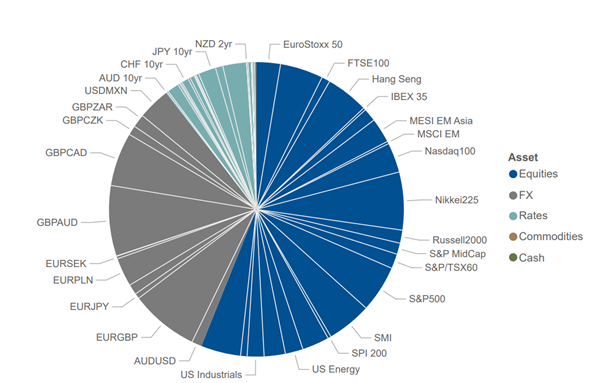
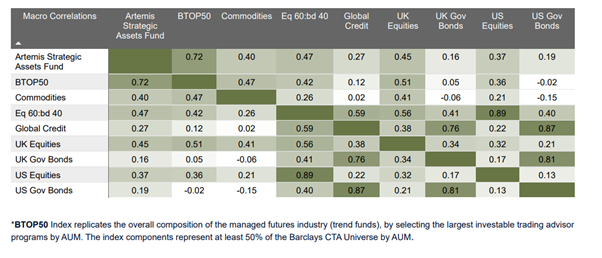
Since the change in manager, the fund has shown a somewhat low correlation to equities, bonds and commodities, while delivering a high correlation to the cross-asset trend peer group index (BTOP50) that it is trying to capture.
Outlook
Debt sustainability questions growing
Questions continue to be raised over the ability of governments to service the debt piles they have accrued in the last few decades. The UK finds itself in an impasse, the chancellor having committed to certain fiscal rules that, coupled with weak productivity and growth forecasts, will require further tax rises in the Budget later this year. In France too, the government has collapsed twice this year, originally under Prime Minister François Bayrou, then more recently under Sébastien Lecornu who headed up the caretaker government. In both cases there was a failure to agree the necessary reduction in fiscal spending to bring long-term debt levels under control. Governments will need to make some unpalatable decisions in the coming years on where best to reduce fiscal spending that has become more expensive to finance now that inflation and interest rates have normalised.
Federal Reserve dual mandate focusing on employment
Now that the US has agreed trade deals with some of its major trading partners, much of the uncertainty surrounding tariff announcements appears over. However, one surprise still awaits markets in the form of the Supreme Court ruling on the legality of the tariffs which is due to begin in November. Regardless, in delivering the most recent reduction in interest rates, Chair of the Federal Reserve Jerome Powell leaned more on labour market weakness as justification for easing monetary policy, implicitly showing less concern with inflation, the other part of his dual mandate.
At the time of writing, the US government is 'shut down' as Democrats and Republicans cannot agree on future public spending plans, with the sticking points focused around healthcare insurance and related tax-credit extensions. Given historical experiences, this is likely to be resolved relatively soon. However, this will only make the Federal Reserve's decision whether to reduce interest rates by a further 50bps by year-end (as implied in its most recent 'dotplot') even more difficult, as many significant data releases on the US economy are presently unavailable. More recent private sector activity indicators point to a stable US economy, although prices remain elevated, which will inevitably slow the pace at which monetary policy easing can be used to stimulate the economy.
Unclear if further rate cuts in Europe are required
Sentiment in Europe has been buoyed by the commitment of all NATO country members to increase defence and security spending to 5% of GDP by 2035. In addition, the region has successfully negotiated a relatively low tariff rate of 15%. While the European Central Bank may want the current rate of 2% to represent the bottom of the rate cycle, a meaningful slowdown in US activity will also affect Europe and could cause policy to be eased once more. Cracks are already appearing in the European automotive sector, with competition in electric vehicles at home and in China causing earnings downgrades and a contraction in industrial activity.
CAPITAL AT RISK. All financial investments involve taking risk and the value of your investment may go down as well as up. This means your investment is not guaranteed and you may not get back as much as you put in. Any income from the investment is also likely to vary and cannot be guaranteed.
This is a marketing communication. Before making any final investment decisions, and to understand the investment risks involved, refer to the fund prospectus (or in the case of investment trusts, Investor Disclosure Document and Articles of Association), available in English, and KIID/KID, available in English and in your local language depending on local country registration, available in the literature library.

Risks specific to Artemis Strategic Assets Fund
- Market volatility risk The value of the fund and any income from it can fall or rise because of movements in stockmarkets, currencies and interest rates, each of which can move irrationally and be affected unpredictably by diverse factors, including political and economic events.
- Currency risk The fund’s assets may be priced in currencies other than the fund base currency. Changes in currency exchange rates can therefore affect the fund's value.
- Derivatives risk The fund may invest extensively in derivatives with the aim of profiting from falling (‘shorting’) as well as rising prices. Should the asset’s value vary in an unexpected way, the fund value could reduce. Refer to the investment policy in fund's prospectus for further details on how derivatives may be used.
- Leverage risk The fund may operate with a significant amount of leverage. Leverage occurs when the economic exposure created by the use of derivatives is greater than the amount invested. A leveraged portfolio may result in large fluctuations in its value and therefore entails a high degree of risk including the risk that losses may be substantial.
- Cash risk The fund may hold a large amount of cash. If it does so when markets are rising, the fund's returns could be less than if the cash was fully invested in other types of assets.
- Government and public securities risk The fund may invest more than 35% of its value in transferable securities and money market instruments issued or guaranteed by the United Kingdom, United States or Germany. Refer to the investment policy in the fund's prospectus for further details on how large exposures to government and public securities may be held.
- Counterparty risk Investments such as derivatives are made using financial contracts with third parties. Those third parties may fail to meet their obligations to the fund due to events beyond the fund's control. The fund's value could fall because of loss of monies owed by the counterparty and/or the cost of replacement financial contracts.
The intention of Artemis’ ‘investment insights’ articles is to present objective news, information, data and guidance on finance topics drawn from a diverse collection of sources. Content is not intended to provide tax, legal, insurance or investment advice and should not be construed as an offer to sell, a solicitation of an offer to buy, or a recommendation for any security or investment by Artemis or any third-party. Potential investors should consider the need for independent financial advice. Any research or analysis has been procured by Artemis for its own use and may be acted on in that connection. The contents of articles are based on sources of information believed to be reliable; however, save to the extent required by applicable law or regulations, no guarantee, warranty or representation is given as to its accuracy or completeness. Any forward-looking statements are based on Artemis’ current opinions, expectations and projections. Articles are provided to you only incidentally, and any opinions expressed are subject to change without notice. The source for all data is Artemis, unless stated otherwise. The value of an investment, and any income from it, can fall as well as rise as a result of market and currency fluctuations and you may not get back the amount originally invested.