
Artemis SmartGARP UK Equity Fund
Q4 2025 update


Source for all information: Artemis as at 31 December 2025, unless otherwise stated.
Performance
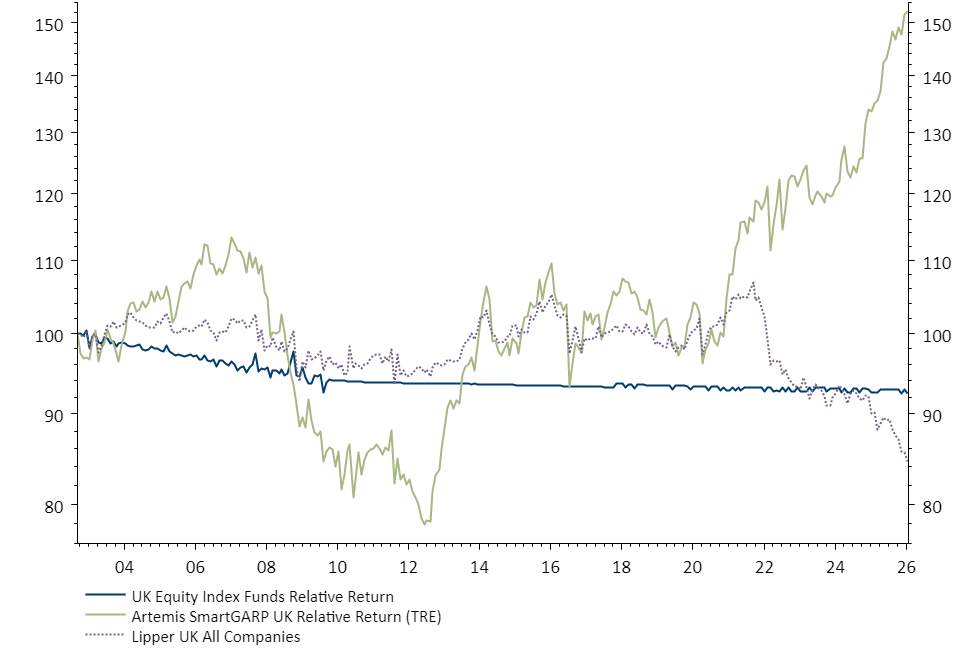
Artemis SmartGARP UK Equity had a good quarter (up 9.5%) and indeed a good year (up 39.9%). The FTSE All-Share was up 6.4% and 24.0% over the same periods respectively.
The fund has outperformed the market substantially during a period when the average UK unit trust has had a torrid time. Just a few years ago, active funds were doing well. While it is difficult to predict either the market or how everyone else performs, we think our holdings' low valuations and decent growth increase the odds that the fund will deliver good returns in the future.
Slowly and then quickly
Source: LSEG Datastream
| Three months | Six months | One year | Three years | Five years | |
|---|---|---|---|---|---|
| Artemis SmartGARP UK Equity Fund | 9.5% | 19.7% | 39.9% | 80.4% | 151.0% |
| FTSE All-Share TR | 6.4% | 13.7% | 24.0% | 46.5% | 73.9% |
| IA UK All Companies average | 3.8% | 6.8% | 14.7% | 32.8% | 41.1% |
Past performance is not a guide to the future. Source: Lipper Limited/Artemis to 31 December 2025 for class I accumulation GBP. All figures show total returns with dividends and/or income reinvested, net of all charges. Performance does not take account of any costs incurred when investors buy or sell the fund. Returns may vary as a result of currency fluctuations if the investor's currency is different to that of the class. Classes may have charges or a hedging approach different from those in the IA sector benchmark.
Re-rating + good growth = great returns
The fund has done well because of a combination of rising prices to earnings (P/Es) and earnings per share (EPS).
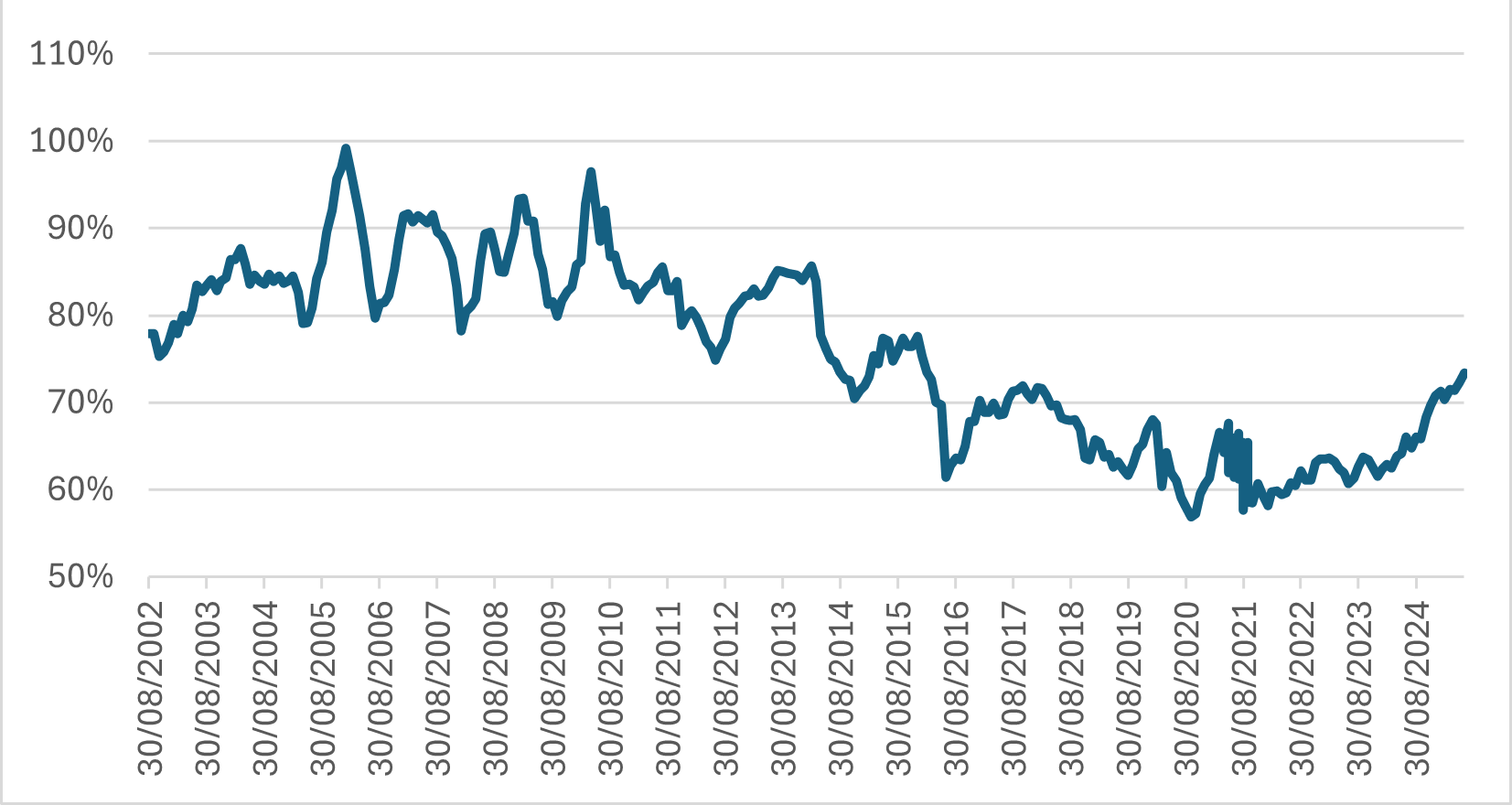
Fund PE Relative
Source: Artemis
The P/E relative was fairly stable in the 80 to 90% range prior to 2016 (in other words, the fund had a slight value tilt). As the spread of valuations within markets widened through to 2020, we leaned into this and allowed the fund to move onto a lower and lower P/E. Since the nadir in late 2020, the P/E has risen 25% from 7.5 to 9.4x. Over the same period, the prospective P/E for the UK market has fallen from 16 to 15.3x. Our rising P/E has accounted for more than half the outperformance over that period.
The P/E relative is still quite low compared with what I would consider a 'normal' range (80 to 90%). As such, we have probably witnessed about two-thirds of the relative P/E recovery.
Nevertheless, throughout this period the fund has witnessed superior EPS growth compared with the market.
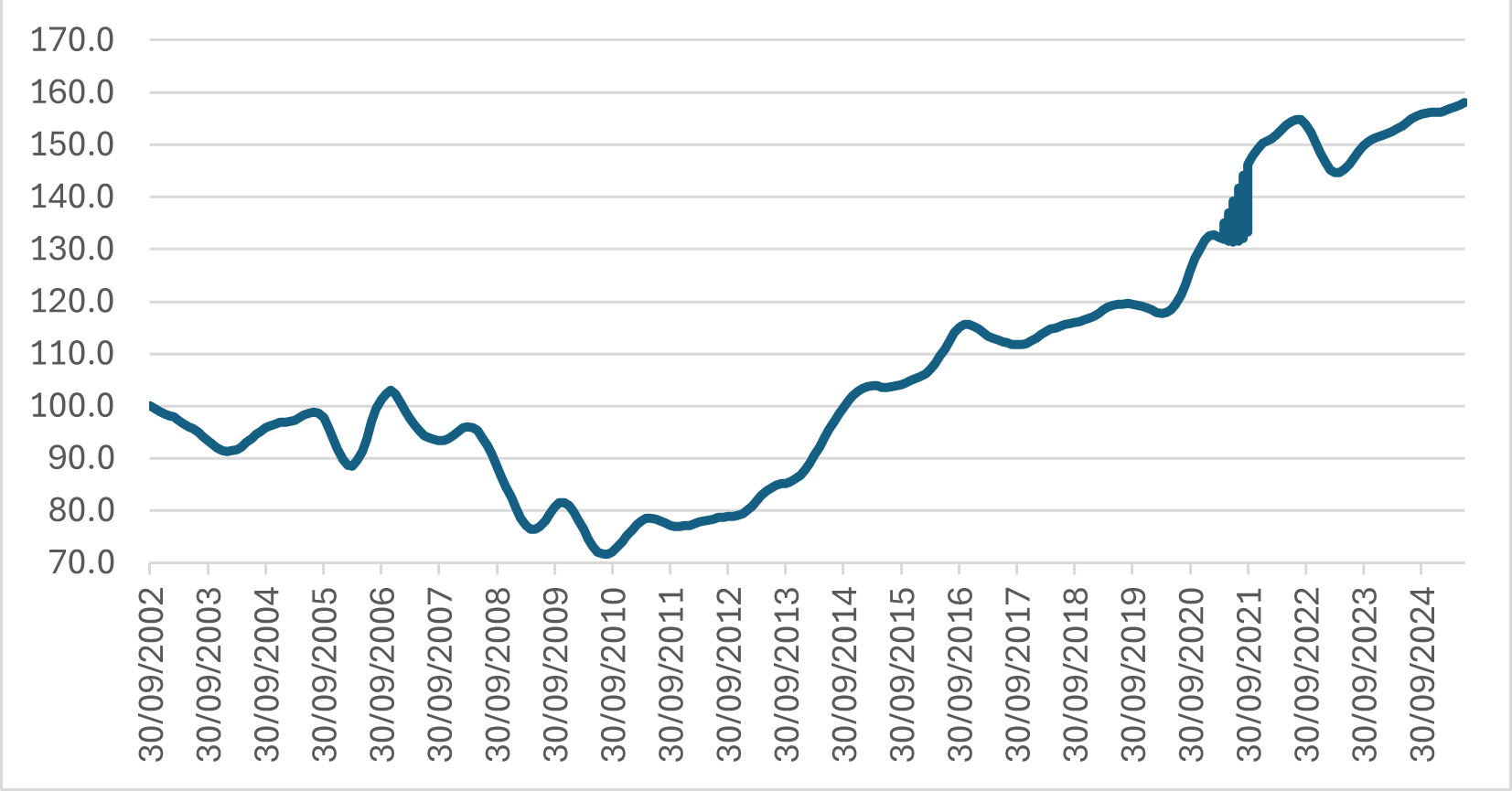
Relative EPS
Source: Artemis
Over the years, our fund’s forecast EPS (after fees) have been compounding at about 2% faster than the market (and by nearer 4% per annum for the past decade). It is this factor that drives outperformance in the long run – the ability of SmartGARP to identify future winners. So, while the tailwind from rising valuations may be diminishing, our ability to position the fund in stocks with superior growth still appears to be in full swing.
What was everyone else thinking?
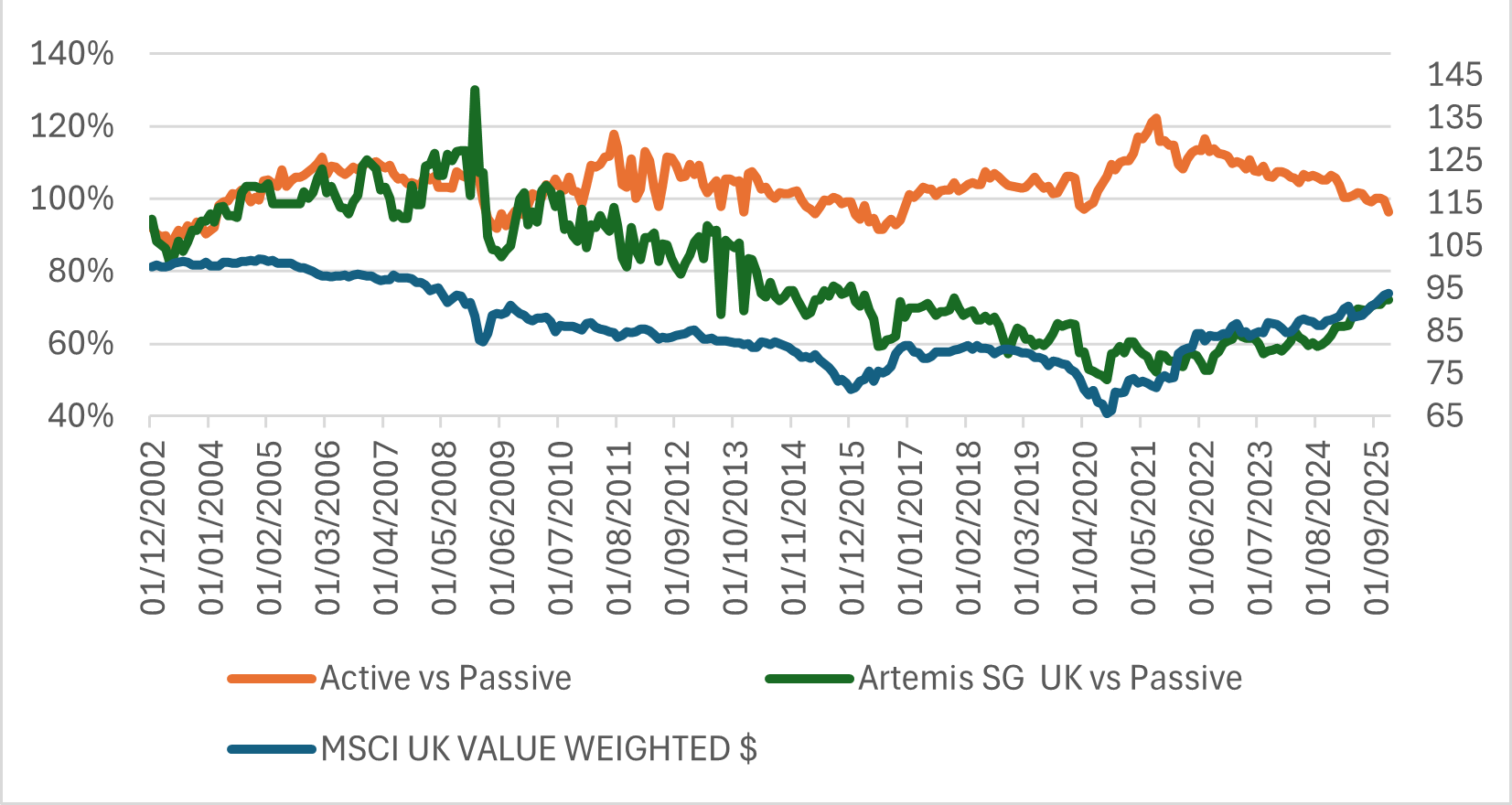
Until 2021, it looked like this fund was a more volatile version of active funds in general. However, the reality is that under the bonnet, there was a big divergence. We moved into value stocks while the rest of the industry migrated to expensive ones. This set the scene for the dramatic subsequent divergence.
In the chart below I illustrate the historic P/E for both our fund and active funds in general versus passive funds (both left-hand scale). On the right-hand scale, I illustrate the performance of UK value stocks versus the UK market.
Active industry in a muddle!
Source: Morningstar, LSEG Datastream & MSCI
It would appear that in the final years of the value bear market (2018 onwards), active investors started to go underweight this factor while we were going in the opposite direction. UK funds got to their peak bearishness on value stocks in August 2021 and have spent the past few years reversing this ill-timed bet.
They now have a neutral value tilt, but my suspicion is that they have achieved this by buying perennial losers. Looking at the SmartGARP characteristics of UK equity funds, it would appear their most significant tilts are to be overweight in mid-cap downgrade stocks.
Estimate revisions
I don’t want to dwell unduly on the rest of the industry. What I would point out is that we look upon estimate revisions (principally changes in consensus EPS forecasts) as the single most important factor within our SmartGARP engine. Of the eight factors, it has the highest alpha and produces the shortest drawdowns. Basically, it reduces the probability of us buying value traps and increases the chance that we own some unexpected growth stocks.
While I think it is important to have a value bias in the portfolio, it is even more important to have a bias towards stocks that keep upgrading profit forecasts.
Recent changes
We made lots of small sells in Q4, the biggest of which were in AJ Bell, Just Group, Conduit, Marks & Spencer and Drax. While the Just Group sale was a function of a takeover bid, the others were mostly down to slowing EPS momentum. We rotated the funds into the likes of Rio Tinto, Man Group and J Sainsbury. The common thread on the purchases was good value and upgrades to profit forecasts.
Performance-wise, these changes had little immediate impact on the portfolio. The good performance was driven mostly by stockpicking (Fresnillo, Barclays and being light in some industrials) and to some extent by sector positioning (our overweight in banks helped).
Outlook
How other people manage their money does amaze me sometimes. Investors sound very professional but show the (worst) characteristics of momentum investing. We stick to what we think is a tried, tested and logical way of looking after wealth. We won’t always have good years, but we hope to have more good ones than bad. In the meantime, even though the fund is at an all-time high, buying equities that are on less than 10x prospective earnings, growing and beating expectations suggests that things should continue in the right direction.
FOR PROFESSIONAL INVESTORS AND/OR QUALIFIED INVESTORS AND/OR FINANCIAL INTERMEDIARIES ONLY. NOT FOR USE WITH OR BY PRIVATE INVESTORS.
CAPITAL AT RISK. All financial investments involve taking risk and the value of your investment may go down as well as up. This means your investment is not guaranteed and you may not get back as much as you put in. Any income from the investment is also likely to vary and cannot be guaranteed.
This is a marketing communication. Before making any final investment decisions, and to understand the investment risks involved, refer to the fund prospectus (or in the case of investment trusts, Investor Disclosure Document and Articles of Association), available in English, and KIID/KID, available in English and in your local language depending on local country registration, available in the literature library.

Risks specific to Artemis SmartGARP UK Equity Fund
- Market volatility risk The value of the fund and any income from it can fall or rise because of movements in stockmarkets, currencies and interest rates, each of which can move irrationally and be affected unpredictably by diverse factors, including political and economic events.
- Currency risk The fund’s assets may be priced in currencies other than the fund base currency. Changes in currency exchange rates can therefore affect the fund's value.
- Charges from capital risk Where charges are taken wholly or partly out of a fund's capital, distributable income may be increased at the expense of capital, which may constrain or erode capital growth.
Important information
The intention of Artemis’ ‘investment insights’ articles is to present objective news, information, data and guidance on finance topics drawn from a diverse collection of sources. Content is not intended to provide tax, legal, insurance or investment advice and should not be construed as an offer to sell, a solicitation of an offer to buy, or a recommendation for any security or investment by Artemis or any third-party. Potential investors should consider the need for independent financial advice. Any research or analysis has been procured by Artemis for its own use and may be acted on in that connection. The contents of articles are based on sources of information believed to be reliable; however, save to the extent required by applicable law or regulations, no guarantee, warranty or representation is given as to its accuracy or completeness. Any forward-looking statements are based on Artemis’ current opinions, expectations and projections. Articles are provided to you only incidentally, and any opinions expressed are subject to change without notice. The source for all data is Artemis, unless stated otherwise. The value of an investment, and any income from it, can fall as well as rise as a result of market and currency fluctuations and you may not get back the amount originally invested.