Artemis SmartGARP Global Equity Fund
Q4 2025 update

Source for all information: Artemis as at 31 December 2025, unless otherwise stated.
- Artemis SmartGARP Global Equity outperformed during the quarter, returning 8.1% compared with 3.4% from the MSCI AC World index.
- The fund was up 32.4% in 2025 compared with 13.9% from the MSCI AC World index.
- Contributors included Asia Vital (electronic components), General Motors (car manufacturer), Barrick Mining (gold and copper) and Samsung Electronics.
- Detractors included Altria Group (tobacco), HF Sinclair (petroleum refining), and Galp Energia (energy). Not holding pharmaceutical Eli Lilly also worked against us as it railed.
- It was a strong quarter for global markets, supported by accommodative monetary and fiscal policy.
Artemis SmartGARP Global Equity Fund: Key financial metrics
| P/E | Return on equity (ROE) | Analyst revisions | Dividend yield | |
| Fund | 11.8 | 14.2% | 5.1% | 2.9% |
| Benchmark | 18.9 | 13.9% | 2.7% | 1.8% |
| Relative | -38% | +0.3 percentage points | +2.4 percentage points | +1.1 percentage points |
Source: Artemis, Bloomberg, MSCI as at 5 January 2026. RoE is a blend of 3-year trailing and 2-year forward.
Review of the quarter to 31 December 2025
Looking back at the beginning of 2025, we spoke in our January commentary not so much about what the future held, but the opportunity that was evident to us in the fund. At that time, there was a clear case for a fund that traded at an undemanding valuation, paying a healthy income and providing truly global exposure to the equity market. However, the market’s focus was on all that Donald Trump would do to support corporates (and their share prices), unburdened by opposition from within his administration as he was in his first term. The 2025 call was to buy everything US and sit back and relax.
Fast forward to today and the world we are in seems very different. The relatively benign geopolitical environment that we became accustomed to is creaking and the economy that was likely the biggest beneficiary (US) is spearheading its demise. This change forms part of a broader shift that has been under way since Covid. The benign environment that existed prior to that was a boon for larger US-based businesses, allowing the proliferation of global supply chains, leveraging a strong dollar, ultra-low interest rates, cheap energy and cheap labour overseas.
Over this period, diversification was not your friend as the US moved from 44% of the MSCI AC World Index at the end of 2008 to 63% at the end of 2025. Earnings growth has undoubtedly been a factor, but the S&P 500 has also moved from a P/E of 11.6x to 22.3x (one-year forward) over the same period. While earnings growth may continue, it is unlikely, and valuations cannot expand in the same manner.
For investors, change brings opportunities. Correlations between the major international indices and the S&P 500 have decreased, strengthening the case for taking a more balanced approach.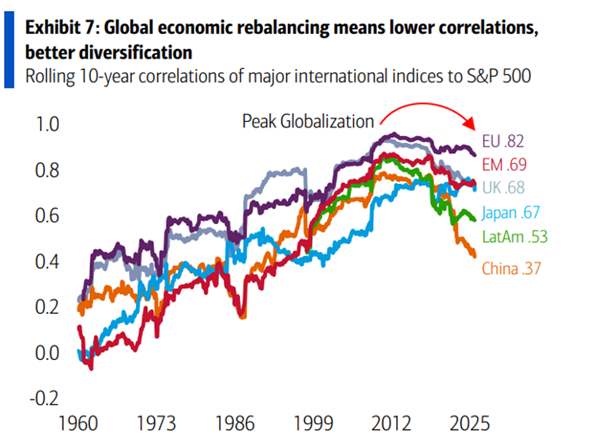
BofA Research Investment Committee, Global Financial Date – BofA Global Research
Valuations support the diversification argument. While these don’t matter so much in the short term, in the long term they do. It is almost impossible to time the point when the optimism fades, but one can start preparing for when that might happen.
Finally, and perhaps most importantly, there is a plethora of attractive opportunities in other equity markets. 2025 was proof of this. European banks (+89.3%), Asian tech hardware (+62.4%), Asian semiconductors (+59.0%) and emerging market materials (+58.2%) were the best performing sectors. Fundamentals were strong, and as a global investor, dollar weakness helped on a relative basis. The reappraisal of the global equity universe over 2025 benefited our positioning but did not diminish the opportunity in the fund as we start 2026. Extremes remain, risks are elevated in certain areas and the case for balance within your global equity exposure has only grown. We are excited by what 2026 has to offer.
Performance
Q4 was another strong period, with the fund returning 8.1% compared with 3.4% from the MSCI ACWI benchmark, leaving yearly performance at 32.4% compared with 13.9% from the benchmark and near the top of the peer group. At a regional level, asset allocation rewarded us, with overweights in emerging markets and Europe and an underweight to the US proving additive. At a sector level, materials, technology and financials were our top contributors, while industrials and energy marginally detracted.
| Three months | Six months | One year | Three years | Five years | |
| Artemis SmartGARP Global Equity | 8.1% | 23.3% | 32.4% | 67.3% | 101.7% |
| MSCI AC World NR | 3.4% | 13.3% | 13.9% | 57.1% | 72.7% |
| IA Global average | 2.8% | 9.7% | 10.3% | 39.9% | 47.0% |
Past performance is not a guide to the future. Source: Lipper Limited/Artemis 31 December 2025 for class I accumulation GBP. All figures show total returns with dividends and/or income reinvested, net of all charges. Performance does not take account of any costs incurred when investors buy or sell the fund. Returns may vary as a result of currency fluctuations if the investor's currency is different to that of the class. Classes may have charges or a hedging approach different from those in the IA sector benchmark.
Contributors
An eclectic mix of contributors pointed towards a number of themes that SmartGARP identified during 2025 and Q4.
1. AI 'picks and shovels'
The growing anxiety around the circular nature of spend that is taking place by the hyperscalers in the US has resulted in a more discerning approach by the market to gain exposure to the theme. The 'picks and shovels', many of which sit outside the US, became more attractive on a relative basis. Asia Vital and Samsung were two names we held that contributed more than 1 percentage point in relative performance for the quarter. Asia Vital provides fans and liquid cooling products for CPUs and personal computing devices, while Samsung produced a standout quarter driven by its memory business. We also held Alphabet, widely seen as the loser of the hyperscalers, yet it produced not only the fastest model (Gemini 3) but also a powerful, proprietary AI chip (TPU).
2. Strategic independence
The weaponisation of supply chains by Trump has been a catalyst for countries to refocus their attention on having greater independence. This has manifested itself in two forms, one being the need to de-dollarize reserves, and the second to promote domestic resource production. On the former, there have been a number of areas that have benefited, but gold has been the standout. Barrick Mining and Lundin Gold (both Canadian) were helped by this theme. On the latter, miners CMOC and China Hongqiao performed well as the world’s largest producers of cobalt and aluminium, respectively.
3. Domestic brands
While in aggregate we are underweight the US, we are still finding opportunities. One of these avenues has been in more domestically orientated businesses such as General Motors. The auto maker has an extremely strong brand in the US, with names such as Chevrolet, Cadillac, GMC and Buick almost entirely focused on their home market. It trades on an undemanding valuation of 7.1x forward earnings and has retired 15% of its shares over the past year, with more buybacks expected in 2026.
Contributors/detractors
Not a huge amount to note on the negative side, with two names costing the fund more than 20bps – Eli Lilly, which we don't hold, and Altria. On the latter, the US tobacco business reported some headwinds in its Q3 earnings release which resulted in downgrades. We reduced the position on the weaker news flow.
Activity
We made a number of changes over the quarter, with our largest disposals predominantly driven by rotating capital away from deterioration and towards those areas and companies with more positive tailwinds.
Sales
In the US we sold Netflix and HEICO. In Japan we sold SCREEN Holdings and in China, Alibaba.
Purchases
In the basic resources sector we bought Commercial Metals (US) and Ero Copper (Canada). In energy we bought HF Sinclair (US), Galp Energia (Portugal) and in automobiles we added to an existing position in General Motors.
This leaves positioning for the start of the year largely unchanged from previous months, but somewhat different to how we started 2025. Our largest sector change has been in basic resources, as we moved from marginally underweight to significantly overweight. To fund this change, we have been reducing our exposure to banks, food & beverages and insurance, all of which have worked out well.
In terms of regions, we maintain a 20% underweight to the US, and reallocated capital from Europe to emerging markets.
CAPITAL AT RISK. All financial investments involve taking risk and the value of your investment may go down as well as up. This means your investment is not guaranteed and you may not get back as much as you put in. Any income from the investment is also likely to vary and cannot be guaranteed.
This is a marketing communication. Before making any final investment decisions, and to understand the investment risks involved, refer to the fund prospectus (or in the case of investment trusts, Investor Disclosure Document and Articles of Association), available in English, and KIID/KID, available in English and in your local language depending on local country registration, available in the literature library.

Risks specific to Artemis SmartGARP Global Equity Fund
- Market volatility risk The value of the fund and any income from it can fall or rise because of movements in stockmarkets, currencies and interest rates, each of which can move irrationally and be affected unpredictably by diverse factors, including political and economic events.
- Currency risk The fund’s assets may be priced in currencies other than the fund base currency. Changes in currency exchange rates can therefore affect the fund's value.
- Charges from capital risk Where charges are taken wholly or partly out of a fund's capital, distributable income may be increased at the expense of capital, which may constrain or erode capital growth.
- Emerging markets risk Compared to more established economies, investments in emerging markets may be subject to greater volatility due to differences in generally accepted accounting principles, less governed standards or from economic or political instability. Under certain market conditions assets may be difficult to sell.
The intention of Artemis’ ‘investment insights’ articles is to present objective news, information, data and guidance on finance topics drawn from a diverse collection of sources. Content is not intended to provide tax, legal, insurance or investment advice and should not be construed as an offer to sell, a solicitation of an offer to buy, or a recommendation for any security or investment by Artemis or any third-party. Potential investors should consider the need for independent financial advice. Any research or analysis has been procured by Artemis for its own use and may be acted on in that connection. The contents of articles are based on sources of information believed to be reliable; however, save to the extent required by applicable law or regulations, no guarantee, warranty or representation is given as to its accuracy or completeness. Any forward-looking statements are based on Artemis’ current opinions, expectations and projections. Articles are provided to you only incidentally, and any opinions expressed are subject to change without notice. The source for all data is Artemis, unless stated otherwise. The value of an investment, and any income from it, can fall as well as rise as a result of market and currency fluctuations and you may not get back the amount originally invested.