Artemis High Income Fund
Q4 2025 update




Source for all information: Artemis as at 31 December 2025, unless otherwise stated.
Performance
The benefits of focusing on high income delivery within a flexible mandate shone through in 2025, with the fund delivering a total return of 10.1%, handily beating the peer group’s gain of 7.2%.
We have spoken for more than three years now about how the return to more reasonable yields has created a fantastic operating environment for the Artemis High Income Fund. Over the three years since the end of 2022, it has produced a total return of 34.3%, while the average Strategic Bond fund has delivered 20.7%.
| Three months | Six months | One year | Three years | Five years | 10 years | |
| Artemis High Income Fund | 2.1% | 4.4% | 10.1% | 34.3% | 27.9% | 60.8% |
| IA Strategic Bond | 1.7% | 3.3% | 7.2% | 20.7% | 7.2% | 36.3% |
| Sector quartile | 2 | 1 | 1 | 1 | 1 | 1 |
Past performance is not a guide to the future. Source: Artemis/Lipper Limited, class I Inc GBP to 31 December 2025. All figures show total returns with dividends and/or income reinvested, net of all charges. Performance does not take account of any costs incurred when investors buy or sell the fund. Returns may vary as a result of currency fluctuations if the investor's currency is different to that of the class. This class may have charges or a hedging approach different from those in the IA sector benchmark.
The vast majority of the fund’s assets are held in high-yield bonds (61.7%), alongside 15.6% in dividend-paying equities, 11.3% in government bonds, 10.9% in investment-grade credit and the balance (0.5%) in cash, as at 31 December 2025.
Contributors
During Q4, the strongest performers within our credit portfolio included bonds issued by Isabel Marant (the French fashion label), BlueNord ASA (European oil & gas), IG Group (online trading and investments), Hammerson (property) and TP ICAP (the broker).
Isabel Marant bonds had a rewarding fourth quarter after trading weakly earlier in the year. The fashion house was a victim of the ‘complexity premium’ in our view, but we judged its underperformance to be overdone. Third-quarter results vindicated our belief that the market was mispricing the situation.
Among our equity holdings, UK banks (Barclays, NatWest and Lloyds) were the standout performers of Q4 as fears that the Budget would lead to a meltdown in the gilt market and windfall taxes failed to materialise. These factors, together with the Bank of England's decision to reduce capital requirements, helped UK banks to close some of their valuation gap with Asian and European peers.
TotalEnergies, National Grid, British American Tobacco, BMW and Anglo American also contributed positively to the fund’s returns.
Detractors
Bonds issued by INEOS Quattro (petrochemicals), Owens & Minor (the US healthcare distribution business), Ubisoft Entertainment (the French video game producer) and Tereos (the agro-industrial group) detracted from returns in Q4.
INEOS Quattro operates the specialty chemicals segment of the wider INEOS petrochemicals group. The chemicals industry has come under pressure due to high energy costs in Europe, as well as from displaced Chinese supply which has made its way into European and south-east Asian markets. We believe the market is punishing INEOS Quattro excessively for these cyclical concerns, ignoring bottom-up credit and company fundamentals. INEOS Quattro is a veteran of many cycles, most much more severe than the current one, and it holds ample cash reserves to cope with the fundamental economics of its industry. Its combination of cost advantage, scale and deep liquidity reserves are underappreciated by the market, in our view.
Elsewhere, Owens & Minor bonds fell following news of a disposal that we viewed as being positive, but the market took negatively.
Ubisoft bonds underperformed following a delayed results release. The company confirmed that its Tencent transaction – which gives it a large cash injection, helping to significantly de-lever the business – went through successfully.
We believe that both Owens & Minor and Ubisoft are symptomatic of a credit market in which ‘uncontroversial’ names trade at incredibly tight valuations, but anything slightly more complex trades at silly levels. For a strategy focused on finding mispriced higher-yielding names, this is a great situation to be in – and we expect both of these bonds to be significant positive contributors in months to come.
On the equity side, 3i Group (private equity), Entain (sports betting and gaming), Marks & Spencer (retail), Melrose Industries (aerospace) and Deutsche Telekom (telecommunications) were the most significant detractors.
3i reacted negatively to weaker like-for-like trading at Action (the discount retailer in which 3i has a majority holding) in October and early November. This was driven entirely by Action’s French stores (which account for just under one-third of sales), due to a combination of weak consumer sentiment (political uncertainty), unseasonably warm weather and greater discounting from a competitor, which has collapsed into administration. We regarded the sell-off as being an overreaction and topped up our exposure.
Activity
In December, we bought fresh positions in bonds issued by Maxam Prill, a market leader in the provision of civil explosives. We also bought back into a position we had sold a few months ago – Cloud Software Group, the provider of enterprise software solutions – following its underperformance. Our only sell for the month involved trimming our holding in Vistry following a bounce after the Budget.
In November, we added new lines in Odfjell, an owner of offshore drilling rigs. We like the company’s strong market position in the Norwegian North Sea and long-term relationships with investment-grade oil & gas companies. A lot of overcapacity in the industry seen through the mid-2010s has irrevocably left the market today, leaving the supply/demand relationship much more balanced than in the past.
We also participated in the refinancing trade for the David Lloyd 2027 notes. These bonds were redeemed two years ahead of their maturity and went from a 5.5% coupon to a 7.0% one, highlighting the ‘early call’ dynamic that we have seen driving short-dated high-yield returns for a few years now.
On the sales side, we sold out of a position in Iron Mountain 2027 bonds following the release of a short report. While we don’t believe the note contained much new information, the bonds were unchanged on the release and offered little upside.
In a similar vein, we sold our position in CURRENTA, the owner of a large chemical production facility in northern Germany. While we are fundamentally comfortable that the business model – based around renting the site to chemical production companies, rather than attempting to produce chemicals itself – is solid, the absence of a significant move in the company’s bonds compared with some very significant moves in other chemical exposures within the market led us to sell.
In October, bonds we held in Albertsons and Energean were refinanced (continuing the trend of short-dated bonds trading below par being called early by the issuers and thereby creating upside for us as holders) and we participated in the new five-year bonds issued by both companies. We view Albertsons – the second largest US grocery chain – as being a well-positioned company with the potential to move to investment grade over the coming years, which should result in spread tightening.
Energean is a UK-listed energy company whose largest asset is the Karish gas field in the eastern Mediterranean. The structure of contracts relating to gas produced at this field – with floor pricing around $40 per barrel of oil equivalent and a production cost of $10 per barrel of oil equivalent – results in a very low-risk form of oil & gas exposure. The key to our strategy in the energy space is not to try to predict oil prices, but to make sure that the holdings we have can make money in all reasonable environments.
We also bought new issues from luggage producer Samsonite and Greek utility Public Power Corporation, both of which occupy the upper quality tier within the high-yield market. Meanwhile, we trimmed our holdings in some equities following strong recent performance, including NatWest and Barclays. We continue to be bullish on all these names and hold sizeable positions in each.
Outlook
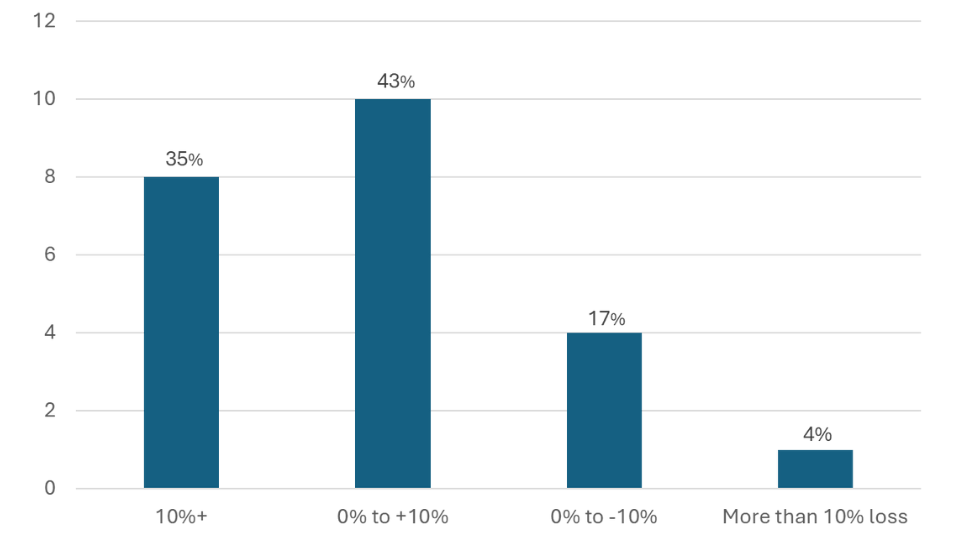
Every time January rolls around, there is usually speculation about whether something significant might unfold in the new year. However, in 80% of the 23 years since Artemis has been running the High Income Fund, what actually occurred was just another year of positive returns. There is always a possibility that something significantly negative might happen – but a loss of more than 10% has only occurred in one of the past 23 years (in 2008).
Artemis High Income Fund annual return distribution, 2003-2025
Source: Artemis as at 31 December 2025. Past performance is not a guide to the future.
Obviously, there is always risk in the market. In our view, the three main risks at present appear to be: the chance of an artificial intelligence (AI) overbuild and correction; a US growth shock; and expectations of US Federal Reserve rate cuts underwhelming and the curve steepening. Importantly, none of these risks appear to be all that threatening for the high-yield bond market and/or for our fund’s investment strategy.
While AI-linked issuance has picked up in the higher-yielding parts of the credit universe, it remains a small part of the overall market and, as such, the systemic risk is low. This sector will probably grow during 2026, so it may become a bigger risk in 2027 and 2028.
Although we have highlighted a US growth shock as a potential risk for this year, there are powerful forces in play to prevent it. First, the US administration will want to prime the economy as much as possible ahead of the midterm elections in November. Second, the US Federal Reserve has become highly politicised – and pressure to ease policy is likely to increase next year, given that midterm incentive. Finally, the AI spending boom seems unlikely to slow in 2026. It is estimated to have added more than a percentage point to growth in 2025 – as such, it will probably remain supportive for growth this year.
Turning to US monetary policy, we expect the appointment of a replacement for Jerome Powell to give the Fed a dovish tilt. However, if inflation remains sticky, the labour market proves resilient and a narrative develops of a ‘monetary policy mistake’, we could see the pricing of more hawkish monetary policy over the long term, even if short-term rates remain relatively constrained. This could pressure markets.
Yet before we start worrying about another 2022, it is important to note the key differences between now and then. For one, while inflation may overshoot on the margin, we are nowhere near the world of March 2022 with a CPI print above 8% against a 0.25% Fed funds rate. In addition, the yields on offer in credit markets are much higher than they were at the start of 2022, providing reduced room to widen, as well as greater current income to offset the negative price impact of any such movement.
In summary, we expect this year to be comparable to most other years for the Artemis High Income Fund (including the past three), with a respectably positive total return. As always, there are risks on the horizon that could derail this prediction – but, from our perspective at least, these look manageable.
CAPITAL AT RISK. All financial investments involve taking risk and the value of your investment may go down as well as up. This means your investment is not guaranteed and you may not get back as much as you put in. Any income from the investment is also likely to vary and cannot be guaranteed.
This is a marketing communication. Before making any final investment decisions, and to understand the investment risks involved, refer to the fund prospectus (or in the case of investment trusts, Investor Disclosure Document and Articles of Association), available in English, and KIID/KID, available in English and in your local language depending on local country registration, available in the literature library.

Risks specific to Artemis High Income Fund
- Market volatility risk The value of the fund and any income from it can fall or rise because of movements in stockmarkets, currencies and interest rates, each of which can move irrationally and be affected unpredictably by diverse factors, including political and economic events.
- Currency risk The fund’s assets may be priced in currencies other than the fund base currency. Changes in currency exchange rates can therefore affect the fund's value.
- Bond liquidity risk The fund holds bonds which could prove difficult to sell. As a result, the fund may have to lower the selling price, sell other investments or forego more appealing investment opportunities.
- Higher-yielding bonds risk The fund may invest in higher-yielding bonds, which may increase the risk to capital. Investing in these types of assets (which are also known as sub-investment grade bonds) can produce a higher yield but also brings an increased risk of default, which would affect the capital value of the fund.
- Credit risk Investments in bonds are affected by interest rates, inflation and credit ratings. It is possible that bond issuers will not pay interest or return the capital. All of these events can reduce the value of bonds held by the fund.
- Charges from capital risk Where charges are taken wholly or partly out of a fund's capital, distributable income may be increased at the expense of capital, which may constrain or erode capital growth.
- Emerging markets risk Compared to more established economies, investments in emerging markets may be subject to greater volatility due to differences in generally accepted accounting principles, less governed standards or from economic or political instability. Under certain market conditions assets may be difficult to sell.
- Income risk The payment of income and its level is not guaranteed.
The intention of Artemis’ ‘investment insights’ articles is to present objective news, information, data and guidance on finance topics drawn from a diverse collection of sources. Content is not intended to provide tax, legal, insurance or investment advice and should not be construed as an offer to sell, a solicitation of an offer to buy, or a recommendation for any security or investment by Artemis or any third-party. Potential investors should consider the need for independent financial advice. Any research or analysis has been procured by Artemis for its own use and may be acted on in that connection. The contents of articles are based on sources of information believed to be reliable; however, save to the extent required by applicable law or regulations, no guarantee, warranty or representation is given as to its accuracy or completeness. Any forward-looking statements are based on Artemis’ current opinions, expectations and projections. Articles are provided to you only incidentally, and any opinions expressed are subject to change without notice. The source for all data is Artemis, unless stated otherwise. The value of an investment, and any income from it, can fall as well as rise as a result of market and currency fluctuations and you may not get back the amount originally invested.