Artemis Funds (Lux) – SmartGARP Pan-European Equity
Q2 2026 update

Source for all information: Artemis as at 29 June 2026, unless otherwise stated.
Artemis Funds (Lux) – Pan-European Equity was launched on 18 November 2025 and is an actively managed fund. Its objective is to increase the value of shareholders’ investments primarily through capital growth over a five-year period.
Overview
For some time now we have used a chart of Nokia's 30-year history to illustrate the close connection between fundamentals and share prices over the long term, as well as divergences in the short term.
Earnings and total returns of Nokia relative to MSCI Europe index
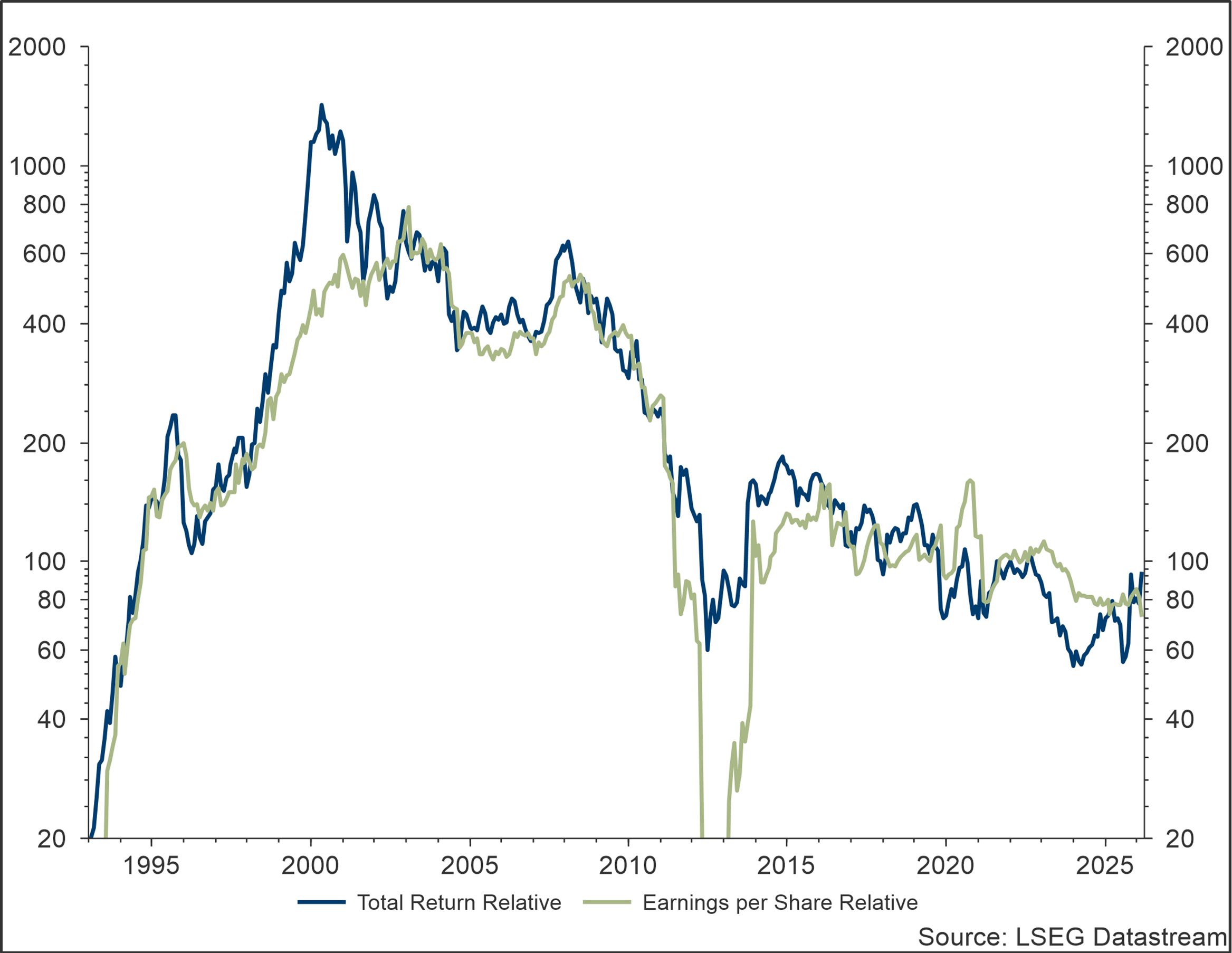
The business began life as a paper mill in Finland, moved on to making rubber boots and household electronics, then later found itself as the poster child (in Europe) of the mobile phone revolution. More recently, our lack of exposure to Nokia has made it one of the fund’s largest year-to-date detractors (it has returned 106.7% in 2026). In 2000, at the height of the TMT bubble, Fortune published an article titled '10 stocks to last the next decade', with Nokia included alongside the likes of Enron and Nortel Networks. Making forecasts of this nature is perilous. It has been a bumpy road since then, yet the business is now viewed as one of Europe’s potential AI beneficiaries, having pivoted into connectivity.
Aside from being a business that has a knack for reinventing itself, there are a few interesting observations:
1) Stocks, sectors, countries and factors can spend years in the (relative) doldrums, creating structural biases among investors over time. The same is true of those that become excessively popular.
2) It is hard to predict when a recovery or decline will occur. Valuation itself is a poor indicator, but when combined with faster-moving components (such as revisions and momentum), you should have a higher degree of confidence.
Following a protracted period of underperformance, the value style of investing in Europe is now in its fifth year of recovery from both a share price and fundamental perspective. While value has done well over the past 120 years, most of our peers still struggle with the concept of owning cheap stocks. Fund managers in Europe appear to find this especially problematic, with allocations to value relatively stable for the past 10 years, although they seem to be coming round more recently.
We track which stocks active equity funds own and thus can see their SmartGARP characteristics compared with passive vehicles. Below are the tilts that Europe ex-UK funds have for 'quality' and 'ownership'. Europe has been viewed for some time as the home of the quality investor: a market of stable businesses with competitive moats and good management teams, resulting in higher profitability. The issue with many pro-quality funds is they find themselves in heavily owned stocks that in many cases are experiencing downgrades. The result can be painful when the world doesn’t turn out the way you expect, with LVMH, Novo Nordisk and Wolters Kluwer examples of this heady mix.
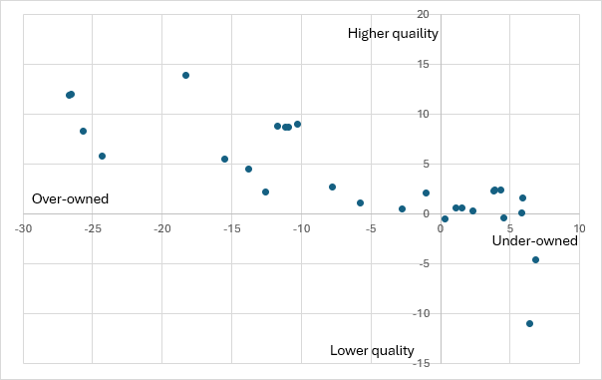
Source: Artemis/Factset, Europe ex-UK peers, 31 May 2026
Looking forward, it is not a stretch to suggest that investors may recognise the need for balance in their European equity sleeve.
Contributors/detractors
Despite Europe having relatively low exposure to the AI theme, technology was the standout sector. Our underweight to this part of the market was our main detractor on a relative basis. Contributions came from our financials exposure, in particular banks, which continue to be one of the most consistent sources of upgrades to forecasts of any sector, yet trade at about a 30% discount to the broader market.
At a stock level, our main detractor was ASML as it rallied but we don't own it. Holdings in Repsol and Eni (both oil & gas) and Yara (fertilisers) worked against us as the market looked past the conflict in the Middle East and towards a return to normal in the Strait of Hormuz. As we stand today, the conflict looks far from being resolved.
On the positive side, our top contributor was AT&S, which makes printed circuit boards, as well as IC (integrated circuit) substrates that connect these to chips. Within financials, OTP Bank, UNIPOL (insurance) and Societe Generale (bank) also performed well.
In terms of factor returns for Europe, they look remarkably similar to other areas of the global equity market. Momentum, growth and heavily traded stocks delivered the best returns during the three-month period, with quality and low-volatility names performing poorly.
Q2 2026 factor returns for MSCI Europe ex UK index
| Style | Q2 |
|---|---|
| Trade activity | 6.71 % |
| Momentum | 6.34 % |
| Growth | 5.60 % |
| Share buybacks | 2.78 % |
| ESG | 2.78 % |
| Value | 2.17 % |
| Size | 2.13 % |
| Revisions | (0.45%) |
| Dividends | (0.56%) |
| Quality | (0.82%) |
| Volatility | (7.78%) |
Source: Bloomberg as at 8 July 2026
Activity & positioning
We continued to steer capital towards areas where news flow was positive.
In terms of individual purchases, we added ASM International, an equipment producer that sits within the AI supply chain. We also bought Zabka (household goods) and topped up positions in Banco Santander and Indra Sistemas. To fund these purchases, we removed LM Ericsson, TUI and Air France-KLM.
Our fund is deliberately focused on themes we think deliver long-term outperformance rather than short-term dopamine hits. As such it is quite different from your typical equity vehicle.
Outlook
A differentiated offering
While the opportunity in European value remains pronounced, we do not focus on this factor alone. We recognise that styles can go in and out of favour and therefore look to incorporate other components to create an all-weather process. This allows us to keep our head above water when value is out of favour but also supplement returns when it comes back in.
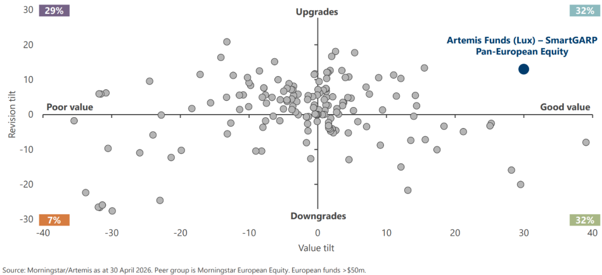
As the market has become focused on a narrow opportunity set, we are convinced our combination of under-owned, lowly valued and income-generating businesses that are receiving upgrades is not a bad addition to a global equity portfolio.
CAPITAL AT RISK. All financial investments involve taking risk and the value of your investment may go down as well as up. This means your investment is not guaranteed and you may not get back as much as you put in. Any income from the investment is also likely to vary and cannot be guaranteed.
This is a marketing communication. Before making any final investment decisions, and to understand the investment risks involved, refer to the fund prospectus (or in the case of investment trusts, Investor Disclosure Document and Articles of Association), available in English, and KIID/KID, available in English and in your local language depending on local country registration, available in the literature library.

Risks specific to Artemis Funds (Lux) – SmartGARP Pan-European Equity
- Market volatility risk The value of the fund and any income from it can fall or rise because of movements in stockmarkets, currencies and interest rates, each of which can move irrationally and be affected unpredictably by diverse factors, including political and economic events.
- Currency risk The fund’s assets may be priced in currencies other than the fund base currency. Changes in currency exchange rates can therefore affect the fund's value.
- Charges from capital risk Where charges are taken wholly or partly out of a fund's capital, distributable income may be increased at the expense of capital, which may constrain or erode capital growth.
- ESG risk The fund may select, sell or exclude investments based on ESG criteria; this may lead to the fund underperforming the broader market or other funds that do not apply ESG criteria. If sold based on ESG criteria rather than solely on financial considerations, the price obtained might be lower than that which could have been obtained had the sale not been required.
The intention of Artemis’ ‘investment insights’ articles is to present objective news, information, data and guidance on finance topics drawn from a diverse collection of sources. Content is not intended to provide tax, legal, insurance or investment advice and should not be construed as an offer to sell, a solicitation of an offer to buy, or a recommendation for any security or investment by Artemis or any third-party. Potential investors should consider the need for independent financial advice. Any research or analysis has been procured by Artemis for its own use and may be acted on in that connection. The contents of articles are based on sources of information believed to be reliable; however, save to the extent required by applicable law or regulations, no guarantee, warranty or representation is given as to its accuracy or completeness. Any forward-looking statements are based on Artemis’ current opinions, expectations and projections. Articles are provided to you only incidentally, and any opinions expressed are subject to change without notice. The source for all data is Artemis, unless stated otherwise. The value of an investment, and any income from it, can fall as well as rise as a result of market and currency fluctuations and you may not get back the amount originally invested.