Growth, income and simplicity: A different take on multi-asset investing


Equities are widely held to be the best way to grow long-term wealth but after a long bull market, cracks might be appearing in the paintwork. Speculation about whether US mega-cap technology companies are in bubble territory is mounting, at a time when global and US indices are increasingly concentrated.
Introducing bonds into the mix is a good first step to dampen down the volatility of portfolios that are heavily exposed to equities – but there are many additional ways to enhance both the return potential and resilience of portfolios, without deviating from a simple and transparent combination of stocks and bonds.
Income-generating assets offer protection in down markets
Tilting both the equity and bond allocations towards income-generating assets can help protect investors’ wealth during stock market downturns.
Consider a portfolio whose assets are evenly split between investment-grade bonds (ICE BofA Global Broad Market index) and dividend-paying equities (MSCI World High Dividend Yield index). Such a portfolio would have imposed far smaller losses on investors during major market corrections than a 100% allocation to equities (MSCI World).
By way of example: during the bursting of the dotcom bubble from 2000 to 2003, the maximum drawdown suffered by investors in the income-focused portfolio described above would have been 12%. But by March 2003, investors with a 100% allocation to global equities would have endured a loss of 49%1.
More recently, in the short Covid-inspired sell-off in March 2020, investors in the simple income-based portfolio would have seen an 8% fall in the value of their investments. Losses incurred by the equity-only portfolio were, at 15%, almost twice as large1.
Income assets provide insulation in weak equity markets
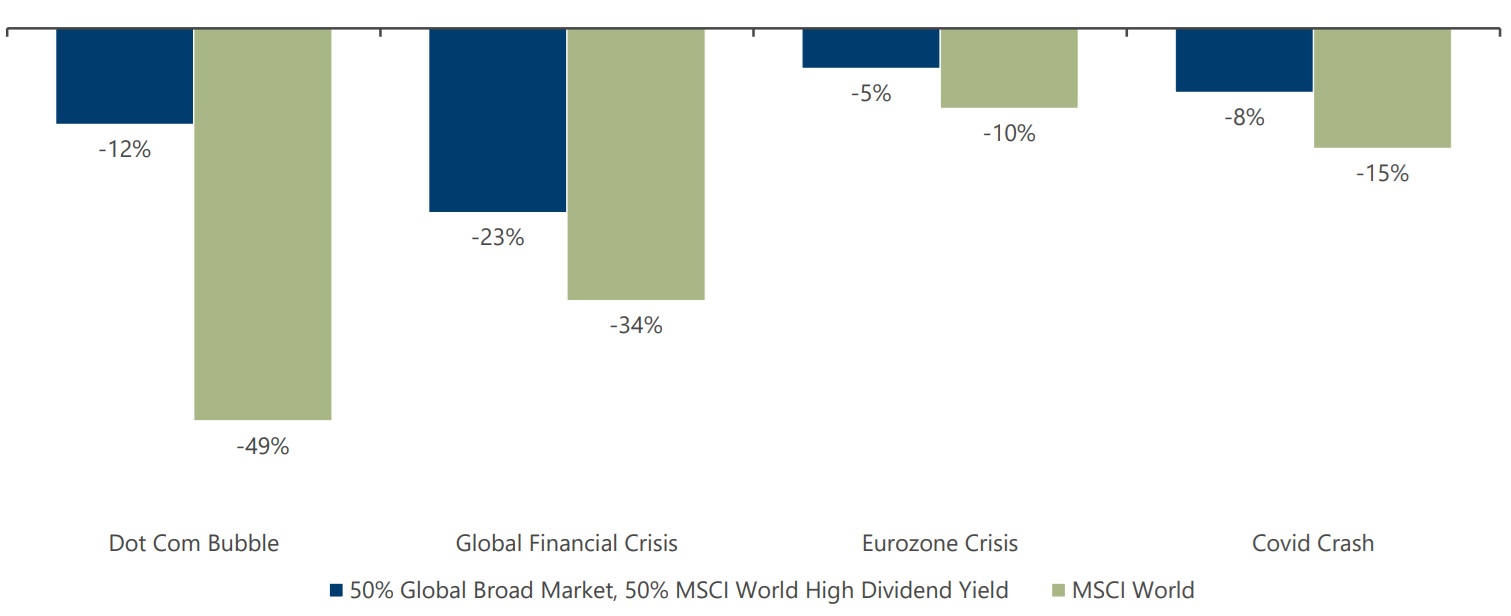
Source: Bloomberg, Artemis as at 30 June 2023. Index data in GBP, showing peak to trough MSCI World price change and the price change in a 50% MSCI World High Dividend Yield and 50% ICE BofA Global Broad Market Index portfolio, rebalanced monthly
Dividends can make a meaningful difference to long-term returns
Share price growth garners so much attention that it can be easy to overlook the significance of dividends in generating returns. Yet in the US, 55% of the cumulative total returns from the S&P 500 from 1988 to 2024 can be attributed to reinvested dividends2.
Growth of £10,000 invested from 1988-2025
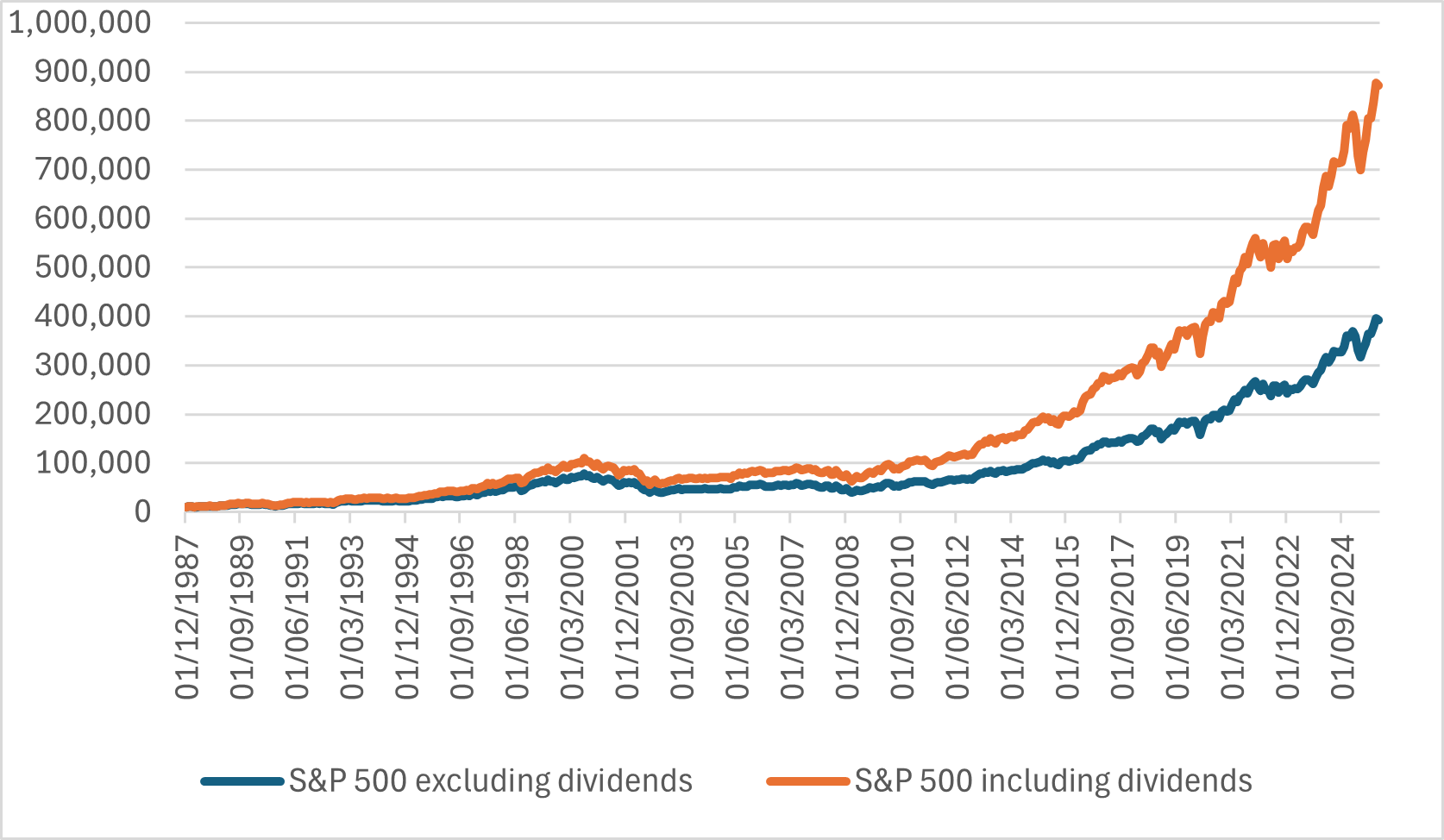
Source: Lipper to 30 November 2025
Diversify the equity portfolio away from the ‘usual suspects’
There is no denying that the world’s largest technology companies, such as Amazon and Microsoft, have been tremendously successful, but they are not the only game in town. There are plenty of other things happening in the world, away from tech and AI. It is perfectly possible to harvest attractive returns from global equities without placing an outsized wager on US mega-cap growth stocks.
Defence, banks, gold miners and Korean companies have all performed well this year. Kinross Gold has doubled and almost doubled again, up 197% year-to-date in local currency terms. Rheinmetall is up 151% even after an autumn sell-off, Siemens Energy has risen 128%, Heidelberg Materials has returned 82% and Standard Chartered is up 71%3.
They have all beaten Alphabet (66%), Nvidia (up 35% this year after a sell-off in November and December), Microsoft (16%), Apple (14%), Meta Platforms (11%), Amazon (7%) and Tesla (6%)3.
In the Artemis Monthly Distribution Fund, we have been taking profits from some stocks that have run up a long way and recycling capital into areas that offer better value, such as emerging market consumer stocks, healthcare names that look extremely cheap, and companies in Japan and Korea that continue to benefit from corporate governance reform. Standard Chartered is one of our largest equity holdings because we’re getting UK corporate governance standards plus emerging market growth for a UK multiple.
High-yield bonds can juice up returns
Within the fund’s fixed income allocation, we have significant exposure to high-yield bonds, which offer superior returns compared to investment-grade credit and exhibit lower volatility than equities.
There has never been a better time to invest in high yield, in our view. The asset class has undergone a transformation over the past decade, becoming much less risky. BBs (the highest-quality part of the market) have gone from 40% of the market 15 years ago to 60% today, whereas CCCs have fallen from 20% to 9%4. This suggests the default rate from here is likely to be half that of its historical level.
Increasing quality reduces the chance of a large default cycle in high yield
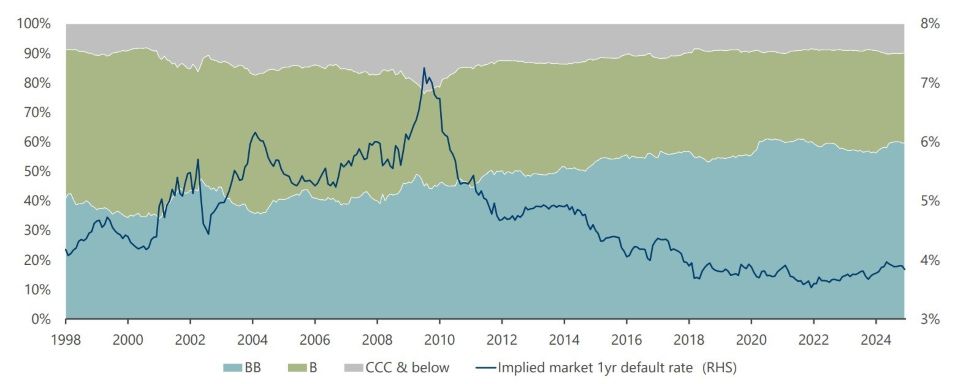
Source: ICE BofA Merrill Lynch Global High Yield Constrained Index as at 31 December 2024. Implied market 1yr default rate is based on S&P median default rates 1981-2021.
Within high yield, we aim to reduce risk further by focusing on short-dated credit from higher-quality issuers that are not heavily indebted.
Coordinating the equity and bond pieces enables us to reduce risk and amplify returns
The Artemis Monthly Distribution Fund is run by a team of four – two equity manages, two fixed income managers – who talk every day. A key advantage of this set-up is that we look throughout the entire capital structure to see what offers the most attractive combination of good value and good income, whilst also making sure we don’t inadvertently double down on risks. We discuss what the optimal trades should be from the entire fund’s perspective, not just for our individual slices.
Growth, income and simplicity
The future is uncertain. Given that, there may be something to be said for steadily gathering and reinvesting dividends from equities and coupon payments from bonds and then letting compounding slowly work its magic.
James Davidson is a fund manager in Artemis' Global Income team and he co-manages the equities element in Artemis' Monthly Distribution strategy.
Notes and references
1Source: Bloomberg, Artemis as at 30 June 2023, in sterling terms
2Source: Artemis, LSEG Datastream to 31 December 2024
3Source: Google Finance to 3 December 2025, in local currency terms
4Source: ICE BofA Merrill Lynch Global High Yield Constrained Index as at 31 December 2024
FOR PROFESSIONAL INVESTORS AND/OR QUALIFIED INVESTORS AND/OR FINANCIAL INTERMEDIARIES ONLY. NOT FOR USE WITH OR BY PRIVATE INVESTORS.
CAPITAL AT RISK. All financial investments involve taking risk and the value of your investment may go down as well as up. This means your investment is not guaranteed and you may not get back as much as you put in. Any income from the investment is also likely to vary and cannot be guaranteed.
This is a marketing communication. Before making any final investment decisions, and to understand the investment risks involved, refer to the fund prospectus (or in the case of investment trusts, Investor Disclosure Document and Articles of Association), available in English, and KIID/KID, available in English and in your local language depending on local country registration, available in the literature library.
Risks specific to Artemis Monthly Distribution Fund
- Market volatility risk The value of the fund and any income from it can fall or rise because of movements in stockmarkets, currencies and interest rates, each of which can move irrationally and be affected unpredictably by diverse factors, including political and economic events.
- Currency risk The fund’s assets may be priced in currencies other than the fund base currency. Changes in currency exchange rates can therefore affect the fund's value.
- Bond liquidity risk The fund holds bonds which could prove difficult to sell. As a result, the fund may have to lower the selling price, sell other investments or forego more appealing investment opportunities.
- Higher-yielding bonds risk The fund may invest in higher-yielding bonds, which may increase the risk to capital. Investing in these types of assets (which are also known as sub-investment grade bonds) can produce a higher yield but also brings an increased risk of default, which would affect the capital value of the fund.
- Credit risk Investments in bonds are affected by interest rates, inflation and credit ratings. It is possible that bond issuers will not pay interest or return the capital. All of these events can reduce the value of bonds held by the fund.
- Charges from capital risk Because one of the key objectives of the fund is to provide income, the fund charges are taken from capital. This may constrain capital growth or erode capital.
- Emerging markets risk Compared to more established economies, investments in emerging markets may be subject to greater volatility due to differences in generally accepted accounting principles, less governed standards or from economic or political instability. Under certain market conditions assets may be difficult to sell.
- Income risk The payment of income and its level is not guaranteed.
Important information
The intention of Artemis’ ‘investment insights’ articles is to present objective news, information, data and guidance on finance topics drawn from a diverse collection of sources. Content is not intended to provide tax, legal, insurance or investment advice and should not be construed as an offer to sell, a solicitation of an offer to buy, or a recommendation for any security or investment by Artemis or any third-party. Potential investors should consider the need for independent financial advice. Any research or analysis has been procured by Artemis for its own use and may be acted on in that connection. The contents of articles are based on sources of information believed to be reliable; however, save to the extent required by applicable law or regulations, no guarantee, warranty or representation is given as to its accuracy or completeness. Any forward-looking statements are based on Artemis’ current opinions, expectations and projections. Articles are provided to you only incidentally, and any opinions expressed are subject to change without notice. The source for all data is Artemis, unless stated otherwise. The value of an investment, and any income from it, can fall as well as rise as a result of market and currency fluctuations and you may not get back the amount originally invested.