The case for short-dated bonds in an uncertain world


One of the salient investment trends of 2025 was the popularity of safe havens. The gold price (a beneficiary of the falling dollar as well as a flight to safety) rose 65% last year1, whilst money market funds raked in a record £5.8bn of net new inflows from UK-based investors, according to Calastone’s Fund Flow Index2.
To put this another way: if you were worried about Donald Trump’s tariffs and unpredictable policy-making, the UK economy and the autumn Budget, and/or an AI bubble bursting – and the impact of all of this on your investment portfolio – then it seems you weren’t the only one. In light of events on the streets of Caracas in early January 2026, followed by Donald Trump’s threats to invade Greenland before a deal was reached, geopolitical tension shows no signs of abating this year.
The silver lining for investors in this uncertain world is that there are plenty of low-risk options to protect and grow their savings. Here in the UK, the Bank of England’s base rate of 3.75% means that many savings accounts are kicking off a decent yield. At the time of writing, best-buy cash ISA and easy access accounts3 were offering interest rates of 4.4% and 4.5% respectively (although both of these headline numbers include bonuses for the first 12 months, after which their interest rates will plummet).
Short-dated bonds versus money market funds and cash
With savings accounts paying out such generous rates at present, why should savers risk their money anywhere else?
The answer to that question is interest rates. If the Bank of England cuts rates this year, as we expect, returns from money market funds and savings accounts are likely to fall commensurately.
Money market funds have become popular as a way to make cash work harder without moving too far up the risk curve. But we would argue that in the current environment, it is well worth taking one step further out along the risk/return continuum and moving from saving to investing – especially for those concerned about interest rates and inflation, and who can afford to take a little bit more risk for some extra return.
Performance of the Artemis Short-Duration Strategic Bond Fund vs money market funds
Past performance is not a guide to the future.
Source: Lipper Limited, class I accumulation shares in GBP as at 31 December 2025. All figures show total returns with dividends and/or income reinvested, net of all charges. Performance does not take account of any costs incurred when investors buy or sell the fund. Returns may vary as a result of currency fluctuations if the investor's currency is different to that of the class. The Artemis Short-Duration Strategic Bond Fund was launched on 3 December 2019.
Performance is presented versus the IA Standard Money Market sector as a proxy for investing in a cash fund. The purpose is to demonstrate the performance of the strategy versus making an allocation to cash. Please note that these asset classes have different risk profiles and the potential for capital losses in the Artemis Short-Duration Strategic Bond Fund is greater.
This step further along the risk/return path takes us to short-dated bond funds. With more flexibility and a far greater array of tools at the fund managers’ disposal to maximise returns, the yields and total returns from short-duration bond funds do not follow interest rates as closely as money market funds and cash accounts.
By way of example: the core of our Artemis Short-Duration Strategic Bond Fund consists of short-dated investment-grade corporate bonds, but we have the flexibility to add high-quality, high-yield bonds to turbo-charge the fund’s income and we also have a government bonds sleeve. Here, we focus on pairs trading, for instance: long gilts, short treasuries; long index-linked gilts, short conventional government bonds; and another example would be curve trades. Over the long term, gilts, US Treasuries and German bunds are closely correlated, but those correlations can break down for short periods, sometimes dramatically so, creating tactical opportunities for us as active managers to implement relative value pairs trades.
What happens to short-dated bonds when interest rates fall?
Bond prices are negatively correlated with interest rates (because prices and yields move in inverse directions). So if interest rates fall and bond yields with them, the capital returns from bond funds would rise. And if the opposite happens and valuations fall, yields provide a cushion.
Generally speaking, an environment of falling interest rates is considered to be a positive for bond markets because prices would rise – but a negative for money market funds because their yields would fall.
In a rate-cutting environment, we would expect long-duration bonds to make more money than short-dated strategies in absolute terms, but what makes short-dated bonds so compelling, in our view, is their risk-adjusted returns.
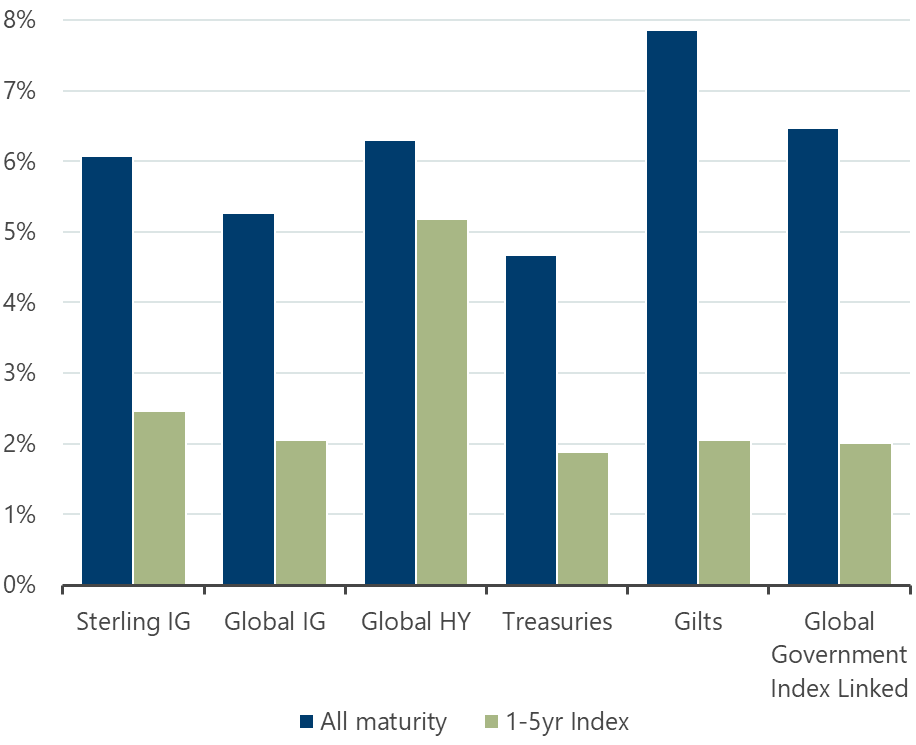
Short-dated bonds offer similar levels of income to all-maturity bonds
Source: Bloomberg as at 2 January 2026
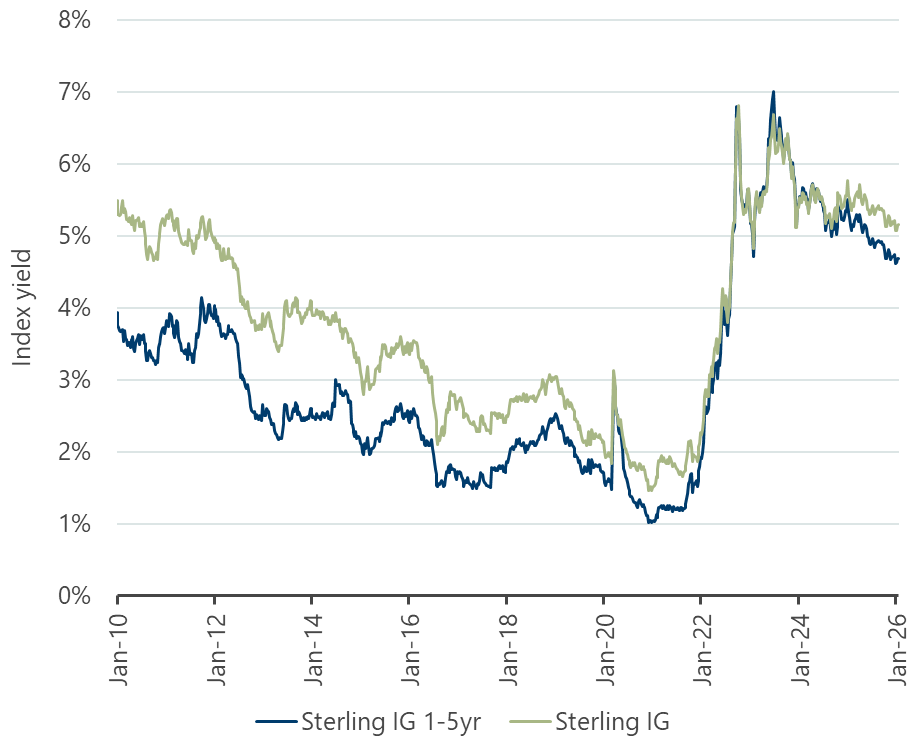
Short-dated bonds have a fraction of the volatility of their full maturity cousins, far less exposure to interest rate and duration risk, and yields that are almost as high.
Volatility of short-dated bond indices vs all maturity, January 2010 to present
Source: Bloomberg as at 2 January 2026
Short-dated bond funds are designed to harvest income and deliver steady returns without being as vulnerable to sudden market shifts as long-duration securities. What this means in practice is that investors are getting healthy compensation for the investment risk they are taking – ample reward, in our view, for taking that one step up from money market funds.
Why should investors consider an allocation to short-duration bonds?
Notes and references
FOR PROFESSIONAL INVESTORS AND/OR QUALIFIED INVESTORS AND/OR FINANCIAL INTERMEDIARIES ONLY. NOT FOR USE WITH OR BY PRIVATE INVESTORS.
CAPITAL AT RISK. All financial investments involve taking risk and the value of your investment may go down as well as up. This means your investment is not guaranteed and you may not get back as much as you put in. Any income from the investment is also likely to vary and cannot be guaranteed.
This is a marketing communication. Before making any final investment decisions, and to understand the investment risks involved, refer to the fund prospectus (or in the case of investment trusts, Investor Disclosure Document and Articles of Association), available in English, and KIID/KID, available in English and in your local language depending on local country registration, available in the literature library.
Risks specific to Artemis Short-Duration Strategic Bond Fund
- Market volatility risk The value of the fund and any income from it can fall or rise because of movements in stockmarkets, currencies and interest rates, each of which can move irrationally and be affected unpredictably by diverse factors, including political and economic events.
- Currency risk The fund’s assets may be priced in currencies other than the fund base currency. Changes in currency exchange rates can therefore affect the fund's value.
- Bond liquidity risk The fund holds bonds which could prove difficult to sell. As a result, the fund may have to lower the selling price, sell other investments or forego more appealing investment opportunities.
- Higher-yielding bonds risk The fund may invest in higher-yielding bonds, which may increase the risk to capital. Investing in these types of assets (which are also known as sub-investment grade bonds) can produce a higher yield but also brings an increased risk of default, which would affect the capital value of the fund.
- Credit risk Investments in bonds are affected by interest rates, inflation and credit ratings. It is possible that bond issuers will not pay interest or return the capital. All of these events can reduce the value of bonds held by the fund.
- Leverage risk The fund may operate with a significant amount of leverage. Leverage occurs when the economic exposure created by the use of derivatives is greater than the amount invested. A leveraged portfolio may result in large fluctuations in its value and therefore entails a high degree of risk including the risk that losses may be substantial.
- Charges from capital risk Where charges are taken wholly or partly out of a fund's capital, distributable income may be increased at the expense of capital, which may constrain or erode capital growth.
- Emerging markets risk Compared to more established economies, investments in emerging markets may be subject to greater volatility due to differences in generally accepted accounting principles, less governed standards or from economic or political instability. Under certain market conditions assets may be difficult to sell.
- Income risk The payment of income and its level is not guaranteed.
- Counterparty risk Investments such as derivatives are made using financial contracts with third parties. Those third parties may fail to meet their obligations to the fund due to events beyond the fund's control. The fund's value could fall because of loss of monies owed by the counterparty and/or the cost of replacement financial contracts.
- Mortgage- or asset-backed securities risk Mortgage- or asset-backed securities may not receive in full the amounts owed to them by underlying borrowers.
Important information
The intention of Artemis’ ‘investment insights’ articles is to present objective news, information, data and guidance on finance topics drawn from a diverse collection of sources. Content is not intended to provide tax, legal, insurance or investment advice and should not be construed as an offer to sell, a solicitation of an offer to buy, or a recommendation for any security or investment by Artemis or any third-party. Potential investors should consider the need for independent financial advice. Any research or analysis has been procured by Artemis for its own use and may be acted on in that connection. The contents of articles are based on sources of information believed to be reliable; however, save to the extent required by applicable law or regulations, no guarantee, warranty or representation is given as to its accuracy or completeness. Any forward-looking statements are based on Artemis’ current opinions, expectations and projections. Articles are provided to you only incidentally, and any opinions expressed are subject to change without notice. The source for all data is Artemis, unless stated otherwise. The value of an investment, and any income from it, can fall as well as rise as a result of market and currency fluctuations and you may not get back the amount originally invested.