
Could overseas investors jump the queue on a small-cap recovery?


Key takeaways
- While UK investors continue to pull money from domestic equities, overseas investors are piling in.
- The FTSE All-Share remains on a significant discount to the global average – and UK small caps sit on a further 20% discount to the large caps that drove performance last year.
- Economic data suggests the UK consumer is in much better shape than all the negative headlines suggest.
Britons remain famous for their love of queuing, instinctively adhering to the unwritten rule that they form an orderly line when more than one person is waiting for the same thing.
This little ritual helps to preserve a sense of fairness, speeds up the provision of services and avoids the unpleasant scenario of a free-for-all. Yet there are times when sticking rigidly to this social convention can be counterproductive – and I’m not just talking about the post-pandemic phenomenon of queuing at the bar.
When your turn has come but your mind is elsewhere and you ignore the less-than-subtle hints from those standing behind you, can you really blame them if they just… push in?
Outflows
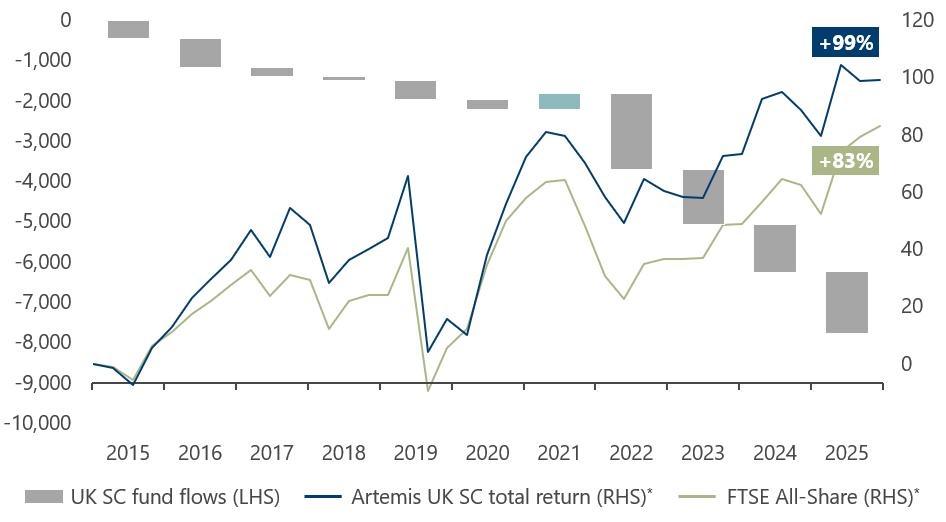
As I write this, news has broken that UK investors pulled a net £9.5bn from domestic equities last year1. I suppose you could argue that this hardly constitutes ‘news’ – they pulled a similar amount of money from UK equities in 2024 and the asset class has now seen net outflows in every year since 2016.
What does make the statistic interesting is it came in a year when the FTSE All-Share returned 24% – more than twice as much as the S&P 500. Us Britons may not be buying UK shares, but someone is.
UK Smaller Companies sector net fund flows (£m)
Past performance is not a guide to the future.
Source: Investment Association up until 31 October 2025. November/December data for 2025 are Morningstar Direct estimates.
*Bloomberg, class I accumulation units in GBP from 1 January 2015 to 31 December 2025. All figures show total returns with dividends and/or income reinvested, net of all charges. Performance does not take account of any costs incurred when investors buy or sell the fund. This class may have charges or a hedging approach different from those in the IA sector benchmark.
Even after such a strong run, the P/E ratio of the UK market sits well below the global average (this remains true even if you remove the US). But there is a sector that sits on a further 20% discount2 to the large caps that drove the FTSE All-Share’s performance last year – UK small caps.
Talking down the UK
It’s sometimes difficult to put into words just how unpopular this sector is. The small-cap market derives about 60% of revenues from the domestic economy (compared with just 20% for large caps)3, which over the last decade has been hit by Brexit, Covid and higher interest rates. And don’t we know it: in any year without a World Cup, it is not queuing but bashing the UK that becomes our national pastime.
Despite all the negativity and market shocks of the past decade, our Artemis UK Smaller Companies Fund still managed to double investors’ money. There is no real secret here: we invest in undervalued companies that have strong balance sheets and are generating healthy levels of free cashflow.
Flows into UK Equity from Foreign and Domestic Mutual fund Investors - weekly flows, USD (bn)
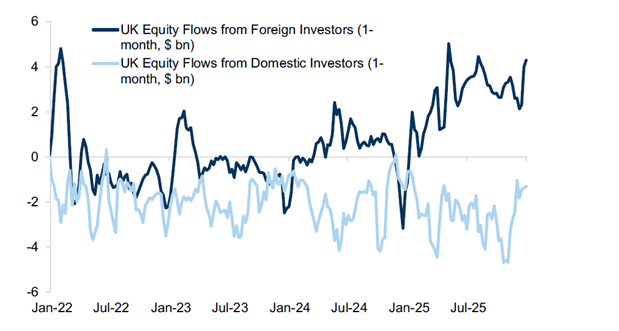
Source: EPFR, Goldman Sachs Global Investment Research
When the market gets cheaper – and it has seen net outflows in nine of the past 10 years – takeovers and share buybacks become more prevalent. These will continue to drive returns if the sector sees similar headwinds over the next decade as the last.
Headwinds to tailwinds
But here’s the thing. Not only do we think we are unlikely to see similar headwinds over the next decade, we believe many of them are now turning into tailwinds. The government is working towards greater integration with the EU. Interest rates are falling rather than rising. And it is becoming harder to see where the marginal seller will come from.
In any year without a World Cup, it is not queuing but bashing the UK that becomes our national pastime
This last point is perhaps the most important one. The reason why the 20% discount to large caps is so interesting is that small caps have traditionally traded at a premium. And with good reason – they have delivered much higher returns over the long term.
The UK economy is stronger than you think
Based on the overwhelming narrative of negativity around the UK, it would be entirely rational to expect this discount to persist. However, this pessimism is at odds with what we are seeing at the company level. Pub chain Fuller’s recently reported first-half earnings per share up 37%; package holiday operator On The Beach reported first-half earnings per share up 14%; and sofa retailer DFS reported full-year profit before tax up 188%.
These are not supposed to be representative, but they should serve as a reminder that, even for businesses exposed to discretionary consumer purchases, things are better than widely perceived.
The reason why the 20% discount to large caps is so interesting is that small caps have traditionally traded at a premium. And with good reason – they have delivered much higher returns over the long term
And rather than getting worse, we think they could get better still. If, as expected, there is no spike in unemployment, confidence should improve and consumer spending (which makes up 60% of the economy) would recover. The money is there – the savings ratio currently stands at 9.5%4, close to twice its pre-Covid level. It is estimated that a single percentage point fall in this figure would provide a £17bn boost to the economy.
Creating a ‘growth loop’
What happens if this finally convinces investors to return to UK small caps? Well, we could see a virtuous circle or ‘growth loop’. Increased investment. Faster growth. Rising confidence. Further fund inflows.
How does this work? Fund inflows reduce companies’ cost of capital as their share prices rise. A lower cost of capital reduces the required-rate-of-return hurdle that companies must exceed to justify investment. Higher investment boosts productivity and UK growth. Critically, investors who are early would also be handsomely rewarded through strong equity returns as share prices re-rate upwards.
Such a trend could finally help dispel the negativity around the UK. And remember, there’s a World Cup this year! But could it convince UK investors to start buying UK smaller companies once again? We’re not sure it matters – there is no polite queuing system here. If they don’t, then someone else will.
Notes and references
2. Source: Panmure Liberum, LSEG Workspace
3. Bloomberg
4. https://www.ons.gov.uk/economy/grossdomesticproductgdp/timeseries/dgd8/ukea
FOR PROFESSIONAL INVESTORS AND/OR QUALIFIED INVESTORS AND/OR FINANCIAL INTERMEDIARIES ONLY. NOT FOR USE WITH OR BY PRIVATE INVESTORS.
CAPITAL AT RISK. All financial investments involve taking risk and the value of your investment may go down as well as up. This means your investment is not guaranteed and you may not get back as much as you put in. Any income from the investment is also likely to vary and cannot be guaranteed.
This is a marketing communication. Before making any final investment decisions, and to understand the investment risks involved, refer to the fund prospectus (or in the case of investment trusts, Investor Disclosure Document and Articles of Association), available in English, and KIID/KID, available in English and in your local language depending on local country registration, available in the literature library.
Risks specific to Artemis UK Smaller Companies Fund
- Market volatility risk The value of the fund and any income from it can fall or rise because of movements in stockmarkets, currencies and interest rates, each of which can move irrationally and be affected unpredictably by diverse factors, including political and economic events.
- Currency risk The fund’s assets may be priced in currencies other than the fund base currency. Changes in currency exchange rates can therefore affect the fund's value.
- Charges from capital risk Where charges are taken wholly or partly out of a fund's capital, distributable income may be increased at the expense of capital, which may constrain or erode capital growth.
- Smaller companies risk Investing in small companies can involve more risk than investing in larger, more established companies. Shares in smaller companies may not be as easy to sell, which can cause difficulty in valuing those shares.
Risks specific to Artemis UK Future Leaders plc
- Market volatility risk The net asset value of the trust, and the income it receives from its investments, can rise and fall because of movements in stockmarkets, currencies and interest rates, each of which can move irrationally and be affected unpredictably by diverse factors, including political and economic events.
- Currency risk The trust’s assets may be priced in currencies other than the trust base currency. Changes in currency exchange rates can therefore affect the trust's value.
- Derivatives risk The trust may invest in derivatives with the aim of profiting from falling (‘shorting’) as well as rising prices. Should the asset’s value vary in an unexpected way, the trust value could reduce.
- Leverage risk The trust may operate with a significant amount of leverage. Leverage occurs when the economic exposure created by the use of derivatives is greater than the amount invested. A leveraged portfolio may result in large fluctuations in its value and therefore entails a high degree of risk including the risk that losses may be substantial.
- Charges from capital risk Where charges are taken wholly or partly out of a trust's capital, distributable income may be increased at the expense of capital, which may constrain or erode capital growth.
- Smaller companies risk Investing in small companies can involve more risk than investing in larger, more established companies. Shares in smaller companies may not be as easy to sell, which can cause difficulty in valuing those shares.
- Income risk The payment of income and its level is not guaranteed.
Important information
The intention of Artemis’ ‘investment insights’ articles is to present objective news, information, data and guidance on finance topics drawn from a diverse collection of sources. Content is not intended to provide tax, legal, insurance or investment advice and should not be construed as an offer to sell, a solicitation of an offer to buy, or a recommendation for any security or investment by Artemis or any third-party. Potential investors should consider the need for independent financial advice. Any research or analysis has been procured by Artemis for its own use and may be acted on in that connection. The contents of articles are based on sources of information believed to be reliable; however, save to the extent required by applicable law or regulations, no guarantee, warranty or representation is given as to its accuracy or completeness. Any forward-looking statements are based on Artemis’ current opinions, expectations and projections. Articles are provided to you only incidentally, and any opinions expressed are subject to change without notice. The source for all data is Artemis, unless stated otherwise. The value of an investment, and any income from it, can fall as well as rise as a result of market and currency fluctuations and you may not get back the amount originally invested.