Active management in volatile times

Before articulating how we are approaching current events from an investment perspective, it is important to acknowledge the human cost of the conflict. Our thoughts are with all those affected.
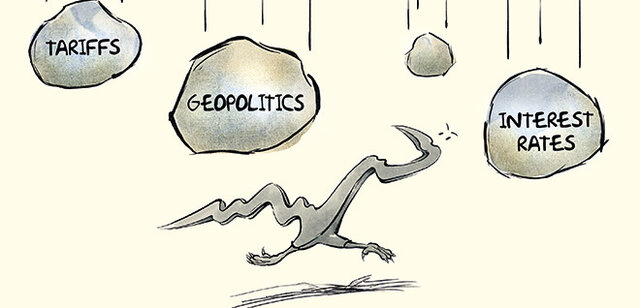
For active fund managers such as ourselves, the situation in the Middle East raises a number of questions. The severity of the conflict’s impact on the global economy, trade and financial markets will probably depend on its duration – but at the time of writing, that remained uncertain, with mixed messages coming out of the White House. While some commentators expect a resolution within weeks, the range of possible outcomes is wide.
Energy prices have moved higher, with oil & gas markets reacting to the risk of sustained supply disruption, particularly around the Strait of Hormuz.
That feeds directly into inflation concerns. We have already seen bond markets reprice interest rate expectations, with cuts now largely priced out for this year. How central banks respond will depend on whether price pressures prove persistent or transitory, which in turn depends on how the conflict evolves. This is something none of us can predict with confidence.
There are additional risks on the horizon. Artificial intelligence (AI) continues to throw up huge questions, which were already riling markets before the strikes on Iran. Will the hyperscalers be rewarded for their immense capital expenditure commitments? Are mega-cap tech stocks too expensive? Which companies will see their business models disrupted beyond repair by AI and who will the ultimate winners be?
It is also worth stepping back and recognising that markets had been strong coming into this episode. Economic data has been supportive, credit markets have been well behaved and equity valuations in many areas have re-rated significantly. That strength provides context but also demands discipline – especially if we see a prolonged correction unfold.
Needless to say, stock markets have moved from the near-Goldilocks conditions that characterised much of last year – once the post-Liberation Day recovery had taken hold – into an atmosphere of fear. The CBOE Volatility Index (VIX), which is often referred to as the ‘fear gauge’, has been elevated all month1.
How active managers can weather the storm
So what are we, as active managers, doing to navigate the current crisis and deliver optimal results for our clients?
First and foremost, our fund managers are sticking to their tried-and-trusted investment processes, with a resolute focus on company fundamentals. This approach has served us well when faced with a wide range of challenges in the past and we believe it remains well equipped to do so going forward.
The long track records and deep experience of our fund managers are helpful here. Many of them have been running their funds at Artemis for over a decade – two decades for some – so they have invested during periods of crisis and fear many times before.
The second thing we are doing may sound counterintuitive but it is, in fact, linked to the first. Our active managers are staying alert for tactical opportunities that periods of dislocation can present – whether that is adding selectively to credit or recycling capital into more attractively valued areas of the equity market.
They are able to do this precisely because of their focus on company fundamentals and their medium to long term views. Financial markets tend to overshoot at times of extreme pessimism and, on the other side, euphoria. Drawing upon their experience gleaned through a variety of market conditions, our fund managers can spot where stocks or bonds have become mispriced, oversold or unjustly tarnished, and move quickly to take advantage.
Although stock markets occasionally fall sharply, they tend to deliver solid returns over the long term. While it may be logical to add to investments during downturns, at cheaper prices, human instinct typically does the opposite – pulling back after falls and piling in after rallies. Although academics have long advised against this behaviour, it is hard to override human nature. This is where the expertise of active managers, following tried-and-tested investment processes, is so vital. In times such as these, we believe having an experienced hand on the tiller is reassuring for our clients.
Finding a margin of safety
There is no top-down house view or centralised investment process at Artemis and our fund managers have the freedom to implement their strategies with conviction. At the same time, there are common threads running through our various approaches. One of these is the belief that the price you pay for an asset matters, and has a significant impact on the returns you eventually make.
A margin of safety is particularly important during risk-off periods. The tech sell-off in recent months has demonstrated that when stocks are priced for perfection, it does not take a lot to knock them off their perch. Conversely, cheaper stocks have far lower expectations to hurdle and in some cases, a lot of bad news is already priced in.
Don’t put all your eggs in one basket
During good times and bad, our fund managers and risk teams ensure that our portfolios are not excessively exposed to any one theme or sector – even if their benchmarks might be. This diversification provides some protection if there is a sell-off in one part of the market, whilst also positioning us to benefit from rallies in unexpected areas.
We take diversification one step further. Across the board, we aim to offer portfolios that look substantially different to both peer funds and the most popular benchmarks. We expect that our clients have passive exposures – and other funds – elsewhere in their portfolios and it behoves us as active managers to offer something differentiated. We achieve this by investing with conviction and by skating towards where we think the puck is going, rather than falling back on yesterday’s winners.
Notes and references
CAPITAL AT RISK. All financial investments involve taking risk and the value of your investment may go down as well as up. This means your investment is not guaranteed and you may not get back as much as you put in. Any income from the investment is also likely to vary and cannot be guaranteed.
This is a marketing communication. Before making any final investment decisions, and to understand the investment risks involved, refer to the fund prospectus (or in the case of investment trusts, Investor Disclosure Document and Articles of Association), available in English, and KIID/KID, available in English and in your local language depending on local country registration, available in the literature library.
The intention of Artemis’ ‘investment insights’ articles is to present objective news, information, data and guidance on finance topics drawn from a diverse collection of sources. Content is not intended to provide tax, legal, insurance or investment advice and should not be construed as an offer to sell, a solicitation of an offer to buy, or a recommendation for any security or investment by Artemis or any third-party. Potential investors should consider the need for independent financial advice. Any research or analysis has been procured by Artemis for its own use and may be acted on in that connection. The contents of articles are based on sources of information believed to be reliable; however, save to the extent required by applicable law or regulations, no guarantee, warranty or representation is given as to its accuracy or completeness. Any forward-looking statements are based on Artemis’ current opinions, expectations and projections. Articles are provided to you only incidentally, and any opinions expressed are subject to change without notice. The source for all data is Artemis, unless stated otherwise. The value of an investment, and any income from it, can fall as well as rise as a result of market and currency fluctuations and you may not get back the amount originally invested.