
Five reasons for income investors to consider high yield


High yield remains an underappreciated asset class, with many investors seemingly put off by the outdated nickname of ‘junk bonds’. Yet it is their loss, as the asset class can offer high returns, as well as yields, while keeping volatility low.
For income investors in particular, high-yield bonds can play a valuable role within a multi-asset portfolio. They provide diversification away from government bonds, superior returns compared to investment grade credit and lower volatility than equities. This is why more than half of the Artemis High Income Fund’s portfolio and a quarter of the Artemis Monthly Distribution Fund is held in high yield1.
Below are five reasons why we believe income investors should take a closer look at high-yield bonds.
1) Higher yields mean higher returns
One question we are often asked is: in a world of higher ‘risk-free’ rates where we can get a decent income on government bonds, why take the additional risk from high yield?
The surprising answer is that investors receive a larger return when base rates are higher, even if the spread is the same.
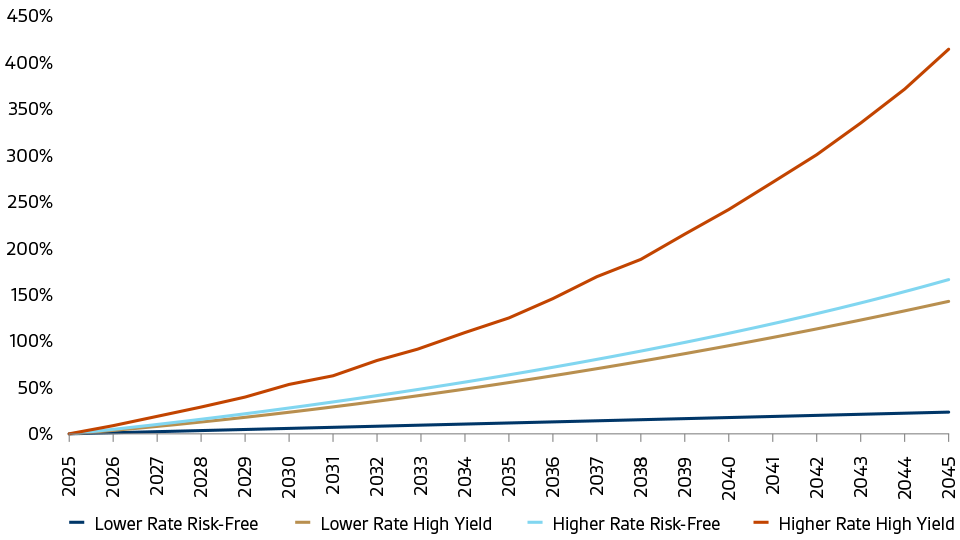
Consider two different environments: a higher-rate world (5% risk-free rate, 8.5% high yield) and a lower-rate one (1% risk-free rate, 4.5% high yield). The additional spread from high yield is the same (3.5%) in both scenarios.
Over 20 years, the additional return from being in high yield over risk-free assets in a higher-rate environment would be 246%, while in a lower rate environment it would only be 119%. Yes, risk-free rates provide a more respectable return in a higher-rate environment – but investors are losing out on a lot more by not holding high-yield bonds.
Counter-intuitively, the additional yield from high yield matters more in a higher interest rate environment
Source: Artemis
2) High yield is getting safer
High yield has had its problems in the past, but it has ironed these out over time and is now safer than ever before, for three main reasons:
- The market has gone from 20% in CCCs and 40% in BBs 15 years ago to 9% in CCCs and 60% in BBs today. This suggests the default rate from here is likely to be half that of its historical level.
- Unlike most cycles over the past 50 years, high yield has not been a source of incremental borrowing over the past decade – the size of the market hasn’t changed over this time. As defaults disproportionately occur in the early years of an issuer’s entrance into the high-yield universe, this ageing is positive for credit quality.
- Any company more than five years old has already experienced: a cyclical downturn in Covid of a speed and depth never seen before; an aggressive tightening of supply chains in 2021 and 2022; and a doubling or trebling of the interest they were paying on their debt from 2022 to 2023. To us, that looks like a decent stress test for future resilience.
3) Equity-like returns with much lower volatility
The great thing about yields when they are at their current levels is that you do not need a market movement in your favour to generate strong returns. Today, the high-yield market is yielding as much as it did in April 2022. By way of example, our Artemis Funds (Lux) – Short-Dated Global High Yield Bond strategy has delivered an annualised return of 7.6%2 since then, with no net tightening.
What is also interesting is how little volatility we took to achieve this return. Although the global stock market did fantastically over this time, the journey has not been a smooth one: the MSCI World index has a Sharpe ratio (a measure of risk-adjusted return) of 0.74 during this period, below the 0.83 from our fund3.
4) Returns can be higher than you think
With high-yield bonds, you tend to get a higher realised yield than the advertised figure, due to a general provision allowing the issuer to ‘call’ or redeem the debt early to improve their liquidity profile.
This redemption takes place at a price of 100c (‘par’) or above and tends to be executed between three and five years ahead of maturity.
When bonds are trading below par, the advertised ‘yield to worst’ figure will be the yield to its final maturity. Yet any earlier redemption by the company would effectively cause the price of the bond to rise to that 100c level sooner than the final maturity date, increasing the yield.
The reason this is so interesting today is that most of the high-yield bond market is trading below 100c, creating a powerful potential tailwind for future performance.
5) Higher yields make it harder to lose money
One of the criticisms levelled at the high-yield market today is that spreads are currently close to historical tights, meaning there is greater potential for losses if they were to widen.
But this ignores the fact that the high yields of today would cancel out a significant proportion of losses for anyone with more than the shortest of time horizons.
For example, Artemis Funds (Lux) – Global High Yield Bond is currently yielding 6.7%4, meaning its price would need to fall by more than this amount (and stay there) over the course of a year for an investor to lose money.
How likely is this? Well, if spreads moved from their current tights to their median level, you would make a return of 5.2%. If yields moved to their 75th percentile, you would still be in positive territory. Even if spreads widened to their 95th percentile, the losses over one year would be limited to 2.4%.
High income and low duration insulates in spread widening scenarios
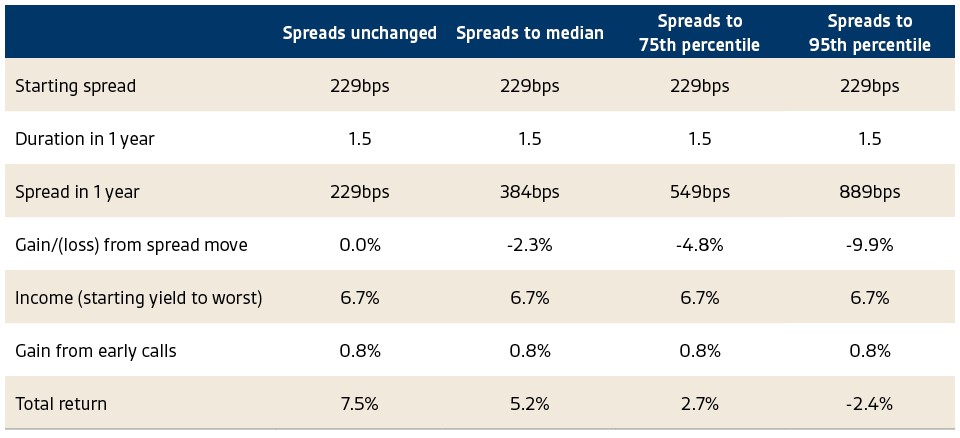
When spreads have been at the 95th percentile or above, global equities have historically delivered a 30% loss in the 12m run-up to that point.
Source: ICE BofA Indices, Bloomberg, Artemis as at 31 Oct 2025
The 95th percentile is not a ‘soft’ option – we are talking about a level that has only been breached (in most cases very briefly) on three occasions over the past 27 years. On average global equities have lost 30% over the 12 months to that point.
It is also worth remembering that the high-yield market tends to recover quickly after periods of stress as it has created a scenario of obvious mispricing.
For example, the global high-yield market recovered its full peak-to-trough loss after the Global Financial Crisis in less than seven months. It took global equities 65 months (almost 10 times as long) to do the same.
Jack Holmes co-manages the Artemis High Income Fund and the bond element of the Artemis Monthly Distribution Fund. He also co-manages Artemis' Global High Yield and Short-Dated Global High Yield strategies.
Notes and references
1 Source: Artemis; the Artemis High Income Fund and the Artemis Monthly Distribution Fund held 57.4% and 25.9% in non-investment grade bonds as at 31 Oct 2025
2 Source: Artemis, from 30 Apr 2022 to 31 Oct 2025, GBP hedged
3 Source: Artemis as at 31 Oct 2025
4 Source: Artemis as at 31 Oct 2025
FOR PROFESSIONAL INVESTORS AND/OR QUALIFIED INVESTORS AND/OR FINANCIAL INTERMEDIARIES ONLY. NOT FOR USE WITH OR BY PRIVATE INVESTORS.
CAPITAL AT RISK. All financial investments involve taking risk and the value of your investment may go down as well as up. This means your investment is not guaranteed and you may not get back as much as you put in. Any income from the investment is also likely to vary and cannot be guaranteed.
This is a marketing communication. Before making any final investment decisions, and to understand the investment risks involved, refer to the fund prospectus (or in the case of investment trusts, Investor Disclosure Document and Articles of Association), available in English, and KIID/KID, available in English and in your local language depending on local country registration, available in the literature library.
Risks specific to Artemis High Income Fund
- Market volatility risk The value of the fund and any income from it can fall or rise because of movements in stockmarkets, currencies and interest rates, each of which can move irrationally and be affected unpredictably by diverse factors, including political and economic events.
- Currency risk The fund’s assets may be priced in currencies other than the fund base currency. Changes in currency exchange rates can therefore affect the fund's value.
- Bond liquidity risk The fund holds bonds which could prove difficult to sell. As a result, the fund may have to lower the selling price, sell other investments or forego more appealing investment opportunities.
- Credit risk Investments in bonds are affected by interest rates, inflation and credit ratings. It is possible that bond issuers will not pay interest or return the capital. All of these events can reduce the value of bonds held by the fund.
- Charges from capital risk Where charges are taken wholly or partly out of a fund's capital, distributable income may be increased at the expense of capital, which may constrain or erode capital growth.
- Emerging markets risk Compared to more established economies, investments in emerging markets may be subject to greater volatility due to differences in generally accepted accounting principles, less governed standards or from economic or political instability. Under certain market conditions assets may be difficult to sell.
- Income risk The payment of income and its level is not guaranteed.
Risks specific to Artemis Monthly Distribution Fund
- Market volatility risk The value of the fund and any income from it can fall or rise because of movements in stockmarkets, currencies and interest rates, each of which can move irrationally and be affected unpredictably by diverse factors, including political and economic events.
- Currency risk The fund’s assets may be priced in currencies other than the fund base currency. Changes in currency exchange rates can therefore affect the fund's value.
- Bond liquidity risk The fund holds bonds which could prove difficult to sell. As a result, the fund may have to lower the selling price, sell other investments or forego more appealing investment opportunities.
- Higher-yielding bonds risk The fund may invest in higher-yielding bonds, which may increase the risk to capital. Investing in these types of assets (which are also known as sub-investment grade bonds) can produce a higher yield but also brings an increased risk of default, which would affect the capital value of the fund.
- Credit risk Investments in bonds are affected by interest rates, inflation and credit ratings. It is possible that bond issuers will not pay interest or return the capital. All of these events can reduce the value of bonds held by the fund.
- Charges from capital risk Because one of the key objectives of the fund is to provide income, the fund charges are taken from capital. This may constrain capital growth or erode capital.
- Emerging markets risk Compared to more established economies, investments in emerging markets may be subject to greater volatility due to differences in generally accepted accounting principles, less governed standards or from economic or political instability. Under certain market conditions assets may be difficult to sell.
- Income risk The payment of income and its level is not guaranteed.
Important information
The intention of Artemis’ ‘investment insights’ articles is to present objective news, information, data and guidance on finance topics drawn from a diverse collection of sources. Content is not intended to provide tax, legal, insurance or investment advice and should not be construed as an offer to sell, a solicitation of an offer to buy, or a recommendation for any security or investment by Artemis or any third-party. Potential investors should consider the need for independent financial advice. Any research or analysis has been procured by Artemis for its own use and may be acted on in that connection. The contents of articles are based on sources of information believed to be reliable; however, save to the extent required by applicable law or regulations, no guarantee, warranty or representation is given as to its accuracy or completeness. Any forward-looking statements are based on Artemis’ current opinions, expectations and projections. Articles are provided to you only incidentally, and any opinions expressed are subject to change without notice. The source for all data is Artemis, unless stated otherwise. The value of an investment, and any income from it, can fall as well as rise as a result of market and currency fluctuations and you may not get back the amount originally invested.