
High Yield Happenings: How short-dated high yield can help manage risk



Key takeaways
For the final instalment, I thought it was worth talking about the role high yield can play in managing risk – how it can allow investors to take some of their chips off the table, while still retaining the potential to generate meaningful returns.
Given the headlines over the first half of this year – the closure of the Strait of Hormuz, geopolitical uncertainty, and signs of renewed inflationary pressures – one could be forgiven for expecting risk markets to have been flat at best. Obviously, this has not been the case. At the halfway point of 2026:
- The S&P 500 was up 12% in sterling terms.
- MSCI Europe was up 10%.
- The Nikkei, meanwhile, was up 37%, despite a jump in yields on Japanese government bonds.1
Whether you view this as a triumph of the ability of capitalism to react efficiently to changes in the operating environment – or simply as a signal that a huge Ponzi scheme is about to collapse – probably comes down to your views on technological progress and the underlying efficiency of capital markets.
Given this environment, one could be forgiven for looking at the 3.4% return from US high yield over the year to date and asking why anyone should bother with it. After all, equity markets produce high total returns over the long term and it’s not as though high yield is a 'risk-off' asset. I would respond by pointing to two charts.
Short-dated high yield outperformed equities after the TMT bubble burst (2000-02)
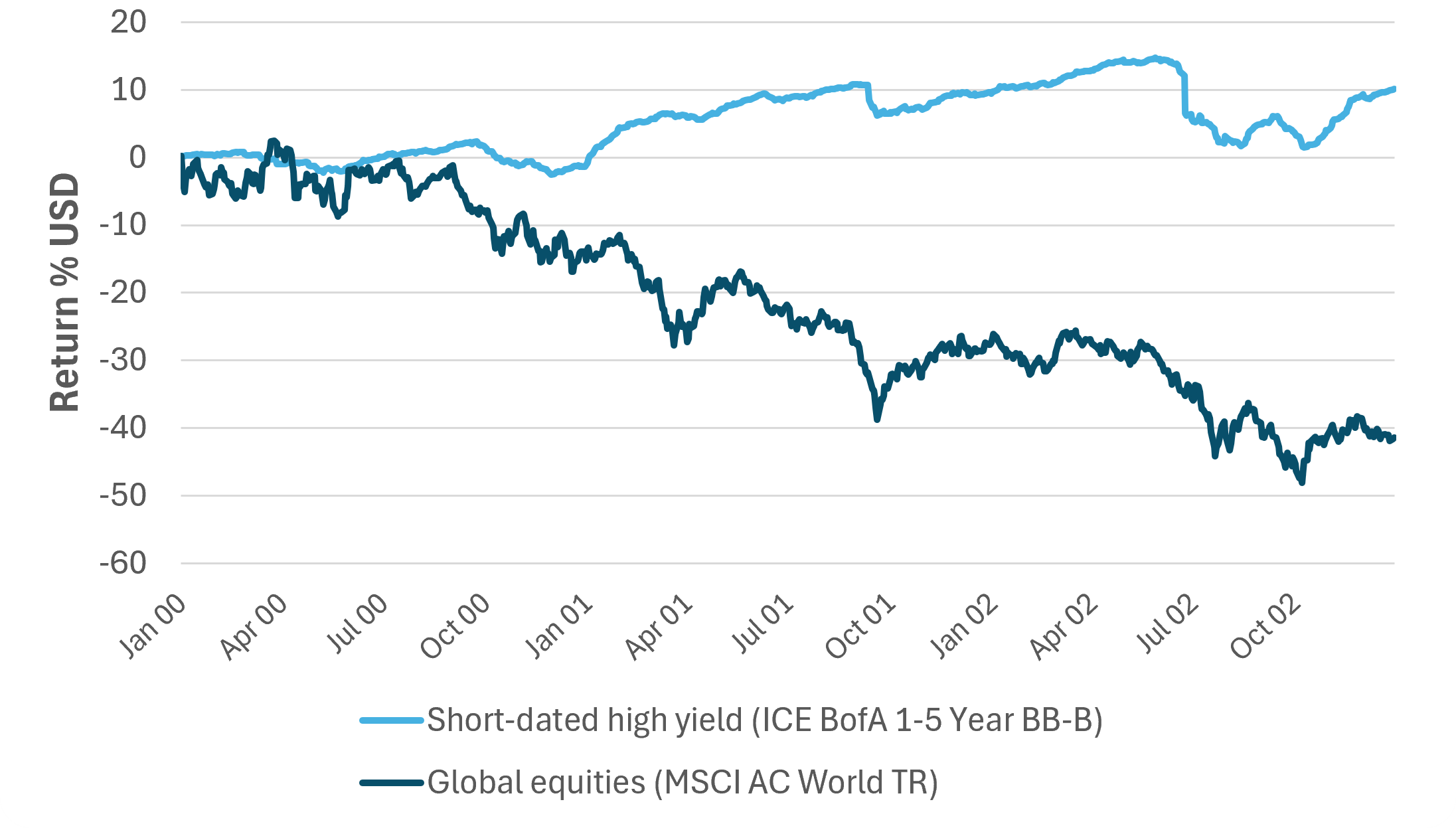
Comparing US-dollar denominated returns from short-dated high yield (the ICE BofA US 1-5yr BB-B index) to global equities (MSCI AC World). Source: Artemis, Lipper, MSCI, ICE BofA Indices from 31 December 1999 to 31 December 2002.
The first shows the performance of short-dated global high-yield bonds relative to equities from the start of the millennium through to the end of 2002. There are a couple of things to highlight here. The first is that returns from high yield clearly show the benefit of having a contractual right to near-term cashflows. The second is that, while equity markets are a great place to be when multiples are expanding and profits are growing (and, indeed, that is what is happening most of the time), things can turn nasty when profits fall and p/e multiples contract.
It is not that high yield was perfectly set up to perform well in the period after the dotcom bubble. Back in 2000, bonds issued by telecoms, media and technology (TMT) companies accounted for around a third of the market2. As a result, the cumulative default rate over this period was the worst in history3 and spreads doubled4. Here's the key point, however: the rise in defaults and the dramatic widening in spreads was almost entirely offset by the income that high-yield bonds paid over the period. Over the dark days of 2000-02, short-dated high-yield bonds – a contractual claim on near-term cashflows – produced a 10% return while global equities fell by more than 40%.
Short-dated high yield can also deliver compelling returns across longer timeframes (2000-06)
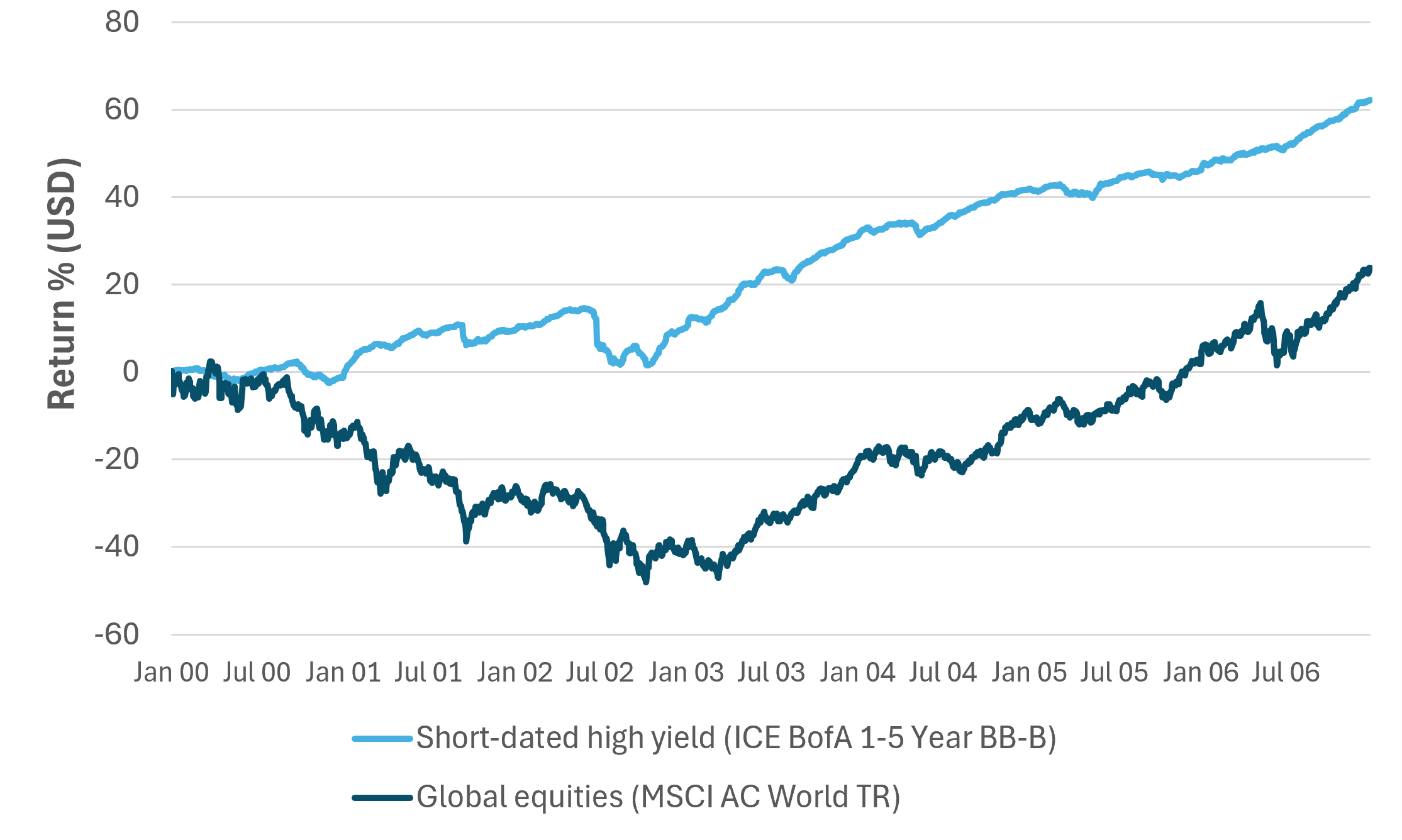
Comparing US-dollar denominated returns from short-dated high yield (the ICE BofA US 1-5yr BB-B index) to global equities (MSCI AC World). Source: Artemis, Lipper, MSCI, ICE BofA Indices from 31 December 1999 to 31 December 2006.
The second chart shows that investors have also done pretty well by investing in high yield over longer time periods. While high yield has generally delivered lower levels of return than equities through periods of strong equity-market performance (such as 2003-06), it has seen far lower levels of drawdown in periods of equity market weakness.
So, through the cycle – and unless you think market cycles have been abolished, this is a relevant observation – high yield can hold its own in terms of both absolute and risk-adjusted returns. Returns from high yield may lag those from equities through the good times – but history suggests they make up for that when times get tough.
Notes and references
2. Bloomberg (ICE BofA Global High Yield Constrained Index) as at 31 May 2026
3. New York University Leonard N. Stern School of Business Salomon Center Report on Defaults & Returns on High Yield Bonds: Analysis Through September 30, 2002
4. Bloomberg ICE BofA Global High Yield Constrained Index as at 31 May 2026.
CAPITAL AT RISK. All financial investments involve taking risk and the value of your investment may go down as well as up. This means your investment is not guaranteed and you may not get back as much as you put in. Any income from the investment is also likely to vary and cannot be guaranteed.
This is a marketing communication. Before making any final investment decisions, and to understand the investment risks involved, refer to the fund prospectus (or in the case of investment trusts, Investor Disclosure Document and Articles of Association), available in English, and KIID/KID, available in English and in your local language depending on local country registration, available in the literature library.
Risks specific to Artemis Funds (Lux) – Short-Dated Global High Yield Bond
- Market volatility risk The value of the fund and any income from it can fall or rise because of movements in stockmarkets, currencies and interest rates, each of which can move irrationally and be affected unpredictably by diverse factors, including political and economic events.
- Currency hedging risk The fund hedges with the aim of protecting against unwanted changes in foreign exchange rates. The fund is still subject to market risks, may not be completely protected from all currency fluctuations and may not be fully hedged at all times. The transaction costs of hedging may also negatively impact the fund’s returns.
- Bond liquidity risk The fund holds bonds which could prove difficult to sell. As a result, the fund may have to lower the selling price, sell other investments or forego more appealing investment opportunities.
- Higher-yielding bonds risk The fund may invest in higher-yielding bonds, which may increase the risk to capital. Investing in these types of assets (which are also known as sub-investment grade bonds) can produce a higher yield but also brings an increased risk of default, which would affect the capital value of the fund.
- Credit risk Investments in bonds are affected by interest rates, inflation and credit ratings. It is possible that bond issuers will not pay interest or return the capital. All of these events can reduce the value of bonds held by the fund.
- Derivatives risk The fund may invest in derivatives with the aim of profiting from falling (‘shorting’) as well as rising prices. Should the asset’s value vary in an unexpected way, the fund value could reduce.
- Charges from capital risk Where charges are taken wholly or partly out of a fund's capital, distributable income may be increased at the expense of capital, which may constrain or erode capital growth.
- Emerging markets risk Compared to more established economies, investments in emerging markets may be subject to greater volatility due to differences in generally accepted accounting principles, less governed standards or from economic or political instability. Under certain market conditions assets may be difficult to sell.
- Income risk The payment of income and its level is not guaranteed.
- ESG risk The fund may select, sell or exclude investments based on ESG criteria; this may lead to the fund underperforming the broader market or other funds that do not apply ESG criteria. If sold based on ESG criteria rather than solely on financial considerations, the price obtained might be lower than that which could have been obtained had the sale not been required.
Risks specific to Artemis Funds (Lux) – Global High Yield Opportunities
- Market volatility risk The value of the fund and any income from it can fall or rise because of movements in stockmarkets, currencies and interest rates, each of which can move irrationally and be affected unpredictably by diverse factors, including political and economic events.
- Currency hedging risk The fund hedges with the aim of protecting against unwanted changes in foreign exchange rates. The fund is still subject to market risks, may not be completely protected from all currency fluctuations and may not be fully hedged at all times. The transaction costs of hedging may also negatively impact the fund’s returns.
- Bond liquidity risk The fund holds bonds which could prove difficult to sell. As a result, the fund may have to lower the selling price, sell other investments or forego more appealing investment opportunities.
- Higher-yielding bonds risk The fund may invest in higher-yielding bonds, which may increase the risk to capital. Investing in these types of assets (which are also known as sub-investment grade bonds) can produce a higher yield but also brings an increased risk of default, which would affect the capital value of the fund.
- Credit risk Investments in bonds are affected by interest rates, inflation and credit ratings. It is possible that bond issuers will not pay interest or return the capital. All of these events can reduce the value of bonds held by the fund.
- Derivatives risk The fund may invest in derivatives with the aim of profiting from falling (‘shorting’) as well as rising prices. Should the asset’s value vary in an unexpected way, the fund value could reduce.
- Leverage risk The fund may operate with a significant amount of leverage. Leverage occurs when the economic exposure created by the use of derivatives is greater than the amount invested. A leveraged portfolio may result in large fluctuations in its value and therefore entails a high degree of risk including the risk that losses may be substantial.
- Charges from capital risk Where charges are taken wholly or partly out of a fund's capital, distributable income may be increased at the expense of capital, which may constrain or erode capital growth.
- Emerging markets risk Compared to more established economies, investments in emerging markets may be subject to greater volatility due to differences in generally accepted accounting principles, less governed standards or from economic or political instability. Under certain market conditions assets may be difficult to sell.
- Income risk The payment of income and its level is not guaranteed.
- Counterparty risk Investments such as derivatives are made using financial contracts with third parties. Those third parties may fail to meet their obligations to the fund due to events beyond the fund's control. The fund's value could fall because of loss of monies owed by the counterparty and/or the cost of replacement financial contracts.
- ESG risk The fund may select, sell or exclude investments based on ESG criteria; this may lead to the fund underperforming the broader market or other funds that do not apply ESG criteria. If sold based on ESG criteria rather than solely on financial considerations, the price obtained might be lower than that which could have been obtained had the sale not been required.
Risks specific to Artemis High Income Fund
- Market volatility risk The value of the fund and any income from it can fall or rise because of movements in stockmarkets, currencies and interest rates, each of which can move irrationally and be affected unpredictably by diverse factors, including political and economic events.
- Currency risk The fund’s assets may be priced in currencies other than the fund base currency. Changes in currency exchange rates can therefore affect the fund's value.
- Bond liquidity risk The fund holds bonds which could prove difficult to sell. As a result, the fund may have to lower the selling price, sell other investments or forego more appealing investment opportunities.
- Higher-yielding bonds risk The fund may invest in higher-yielding bonds, which may increase the risk to capital. Investing in these types of assets (which are also known as sub-investment grade bonds) can produce a higher yield but also brings an increased risk of default, which would affect the capital value of the fund.
- Credit risk Investments in bonds are affected by interest rates, inflation and credit ratings. It is possible that bond issuers will not pay interest or return the capital. All of these events can reduce the value of bonds held by the fund.
- Charges from capital risk Where charges are taken wholly or partly out of a fund's capital, distributable income may be increased at the expense of capital, which may constrain or erode capital growth.
- Emerging markets risk Compared to more established economies, investments in emerging markets may be subject to greater volatility due to differences in generally accepted accounting principles, less governed standards or from economic or political instability. Under certain market conditions assets may be difficult to sell.
- Income risk The payment of income and its level is not guaranteed.
The intention of Artemis’ ‘investment insights’ articles is to present objective news, information, data and guidance on finance topics drawn from a diverse collection of sources. Content is not intended to provide tax, legal, insurance or investment advice and should not be construed as an offer to sell, a solicitation of an offer to buy, or a recommendation for any security or investment by Artemis or any third-party. Potential investors should consider the need for independent financial advice. Any research or analysis has been procured by Artemis for its own use and may be acted on in that connection. The contents of articles are based on sources of information believed to be reliable; however, save to the extent required by applicable law or regulations, no guarantee, warranty or representation is given as to its accuracy or completeness. Any forward-looking statements are based on Artemis’ current opinions, expectations and projections. Articles are provided to you only incidentally, and any opinions expressed are subject to change without notice. The source for all data is Artemis, unless stated otherwise. The value of an investment, and any income from it, can fall as well as rise as a result of market and currency fluctuations and you may not get back the amount originally invested.