Why invest in defence stocks if there aren’t any wars?


Key takeaways
- Catalysts – such as defence stocks benefiting from the outbreak of war – only become obvious with the benefit of hindsight
- The most attractively valued companies are often those where there is no obvious reason for an uptick in performance
- Low valuations in UK small caps create an asymmetrical opportunity set – precisely because there is no obvious catalyst
Defence has been one of the best-performing sectors in recent years. The catalyst for this is obvious. When Russia invaded Ukraine, governments across Europe realised they would need to buy every bullet, tank and drone they could lay their hands on.
But this catalyst was only obvious in hindsight. You could have bought (and done very well from doing so) on the day the conflict began, but that decision could have swiftly looked foolish if the war had proved to be short lived.
Perhaps the true catalyst was not the invasion itself, but the gradual realisation that this would evolve into a multi-year war, triggering rising defence budgets across Europe. But what’s the use of that? As an investor you would have always been behind the market if you had waited for evidence of the conflict’s ongoing nature.
Valuations are more important than catalysts
This raises the question of how investors can hope to get ahead of such a catalyst. Our strategy is not to look for them at all. This is a very different approach to that taken by many of our peers (our sense is that in a momentum-driven market, most investors are clamouring for the next ‘catalyst’).
We owned defence stocks before February 2022 but not because we had any foresight about the upcoming conflict. What interested us was that many investors had shunned the sector: the ESG movement was at its peak and defence companies were seen as unpalatable. There was no obvious catalyst to turn this sector around.
But what was obvious was its attractive valuation. Lowly share prices created an appealing risk/return profile: defence companies looked likely to deliver reasonable (if unspectacular) gains during peacetime, with the potential for very strong returns should war break out.
A longer time horizon increases your chances
This is similar to how we approached beaten-up businesses during the pandemic. We had no way of knowing a vaccine would be successful or how quickly it would make its way through clinical trials. But we were confident that, five years after the first lockdown, people would be free to leave their homes. Once we had identified the companies with enough cash to survive such a period, we found the most attractively valued were those where there was no evident catalyst for recovery.
We owned defence stocks before February 2022 but not because we had any foresight about the upcoming conflict. What interested us was that many investors had shunned the sector
It is easier to sing about our successes than to highlight our failures, but it is even more important to acknowledge (and seek to learn from) these too. The Iran conflict has harmed our holdings exposed to the UK consumer.
Equally, we did not foresee the impact that fears about potential disruption from AI would have on our investments in media companies. As is evident in our recent performance, investing in out-of-favour companies without catalysts is no guarantee of success. However, for those investors with a long enough time horizon, we do believe it increases our chances.
Asymmetric risk in UK small caps
So which area of the market currently offers this sort of asymmetric risk?
As managers of a UK small-cap fund, you may be a touch cynical when we point out UK small caps fit the bill.
Yet we would note the UK market trades at a discount to the rest of the world and UK small caps trade at a discount to their larger counterparts. Meanwhile, our portfolio trades at a discount to small caps as a whole (and our investment trust is on a double-digit discount to the value of its own NAV).
UK small caps are being shunned (and hence are trading at such lowly valuations) because there is no obvious catalyst. But this valuation creates exactly the asymmetry that we like to see
The lowly valuations in UK small caps (our fund trades on 10x P/E for double-digit forecast EPS growth and a free cashflow yield of 9%1) are at odds with an economic picture that is much better than commonly reported: household debts are at an 18-year low2, while the household savings rate is at 10% (about double its historic level)3. A fall of 1% in this figure would be equivalent to an extra £20bn of consumer spending4. A return to pre-Covid levels would result in quite the boost to the economy.
Household saving ratio (four-quarter average, %)
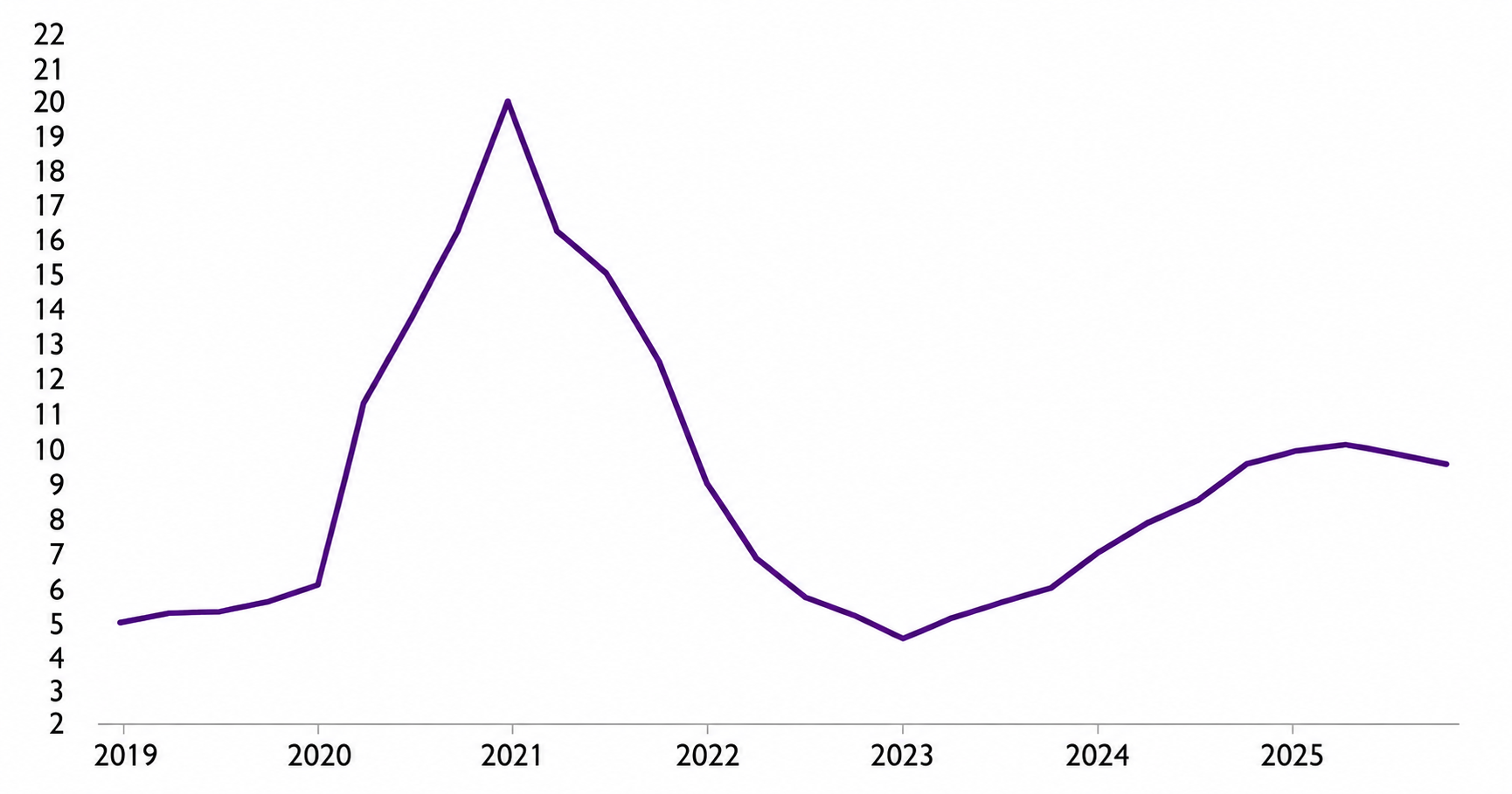
Source: Lazarus Economics, ONS
Absence of catalyst creates a valuation opportunity in small caps
If you are asking what could cause the consumer to spend more, or investors to return to UK small caps en masse, that is precisely the point that has brought about the opportunity.
UK small caps are being shunned (and hence trading at such lowly valuations) because there is no obvious catalyst. If nothing changes, we believe we can still expect respectable returns from the operating performance of our companies, supplemented by takeovers and share buybacks.
And yet… this is what defence stocks looked like before 2022. If you can afford to take a long-term view on an asset class, sector or stock where a lot of bad news is factored in, even a slight improvement in the outlook could be the catalyst for a rapid reappraisal from investors.
Notes and references
1 Artemis as at 30 June 2026
2, 3 & 4 Lazarus Economics, ONS
FOR PROFESSIONAL INVESTORS AND/OR QUALIFIED INVESTORS AND/OR FINANCIAL INTERMEDIARIES ONLY. NOT FOR USE WITH OR BY PRIVATE INVESTORS.
CAPITAL AT RISK. All financial investments involve taking risk and the value of your investment may go down as well as up. This means your investment is not guaranteed and you may not get back as much as you put in. Any income from the investment is also likely to vary and cannot be guaranteed.
This is a marketing communication. Before making any final investment decisions, and to understand the investment risks involved, refer to the fund prospectus (or in the case of investment trusts, Investor Disclosure Document and Articles of Association), available in English, and KIID/KID, available in English and in your local language depending on local country registration, available in the literature library.
Risks specific to Artemis UK Future Leaders plc
- Market volatility risk The net asset value of the trust, and the income it receives from its investments, can fall or rise because of movements in stockmarkets, currencies and interest rates, each of which can move irrationally and be affected unpredictably by diverse factors, including political and economic events.
- Currency risk The trust’s assets may be priced in currencies other than the trust base currency. Changes in currency exchange rates can therefore affect the trust's value.
- Derivatives risk The trust may invest in derivatives with the aim of profiting from falling (‘shorting’) as well as rising prices. Should the asset’s value vary in an unexpected way, the trust's value could reduce.
- Gearing risk The trust may borrow to finance further investment (gearing). The use of gearing is likely to lead to volatility in the net asset value meaning that any movement in the value of the trust’s assets will result in a magnified movement in the net asset value.
- Smaller companies risk Investing in small companies can involve more risk than investing in larger, more established companies. Shares in smaller companies may not be as easy to sell, which can cause difficulty in valuing those shares.
- Income risk The payment of income and its level is not guaranteed.
- Premium/discount risk Investment trust shares tend to trade at discounts to their underlying net asset values, although they can also trade at a premium. Discounts and premiums can fluctuate considerably leading to more volatile returns for shareholders. There is no guarantee that the market price of the trust's shares will fully reflect their underlying net asset value.
- Market spread risk As with all stock exchange investments, the prices at which shares can be purchased and sold can be different, this is called the bid-offer spread. The bid-offer spread can widen when trading volumes are lower or when there is increased market volatility.
Risks specific to Artemis UK Smaller Companies Fund
- Market volatility risk The value of the fund and any income from it can fall or rise because of movements in stockmarkets, currencies and interest rates, each of which can move irrationally and be affected unpredictably by diverse factors, including political and economic events.
- Currency risk The fund’s assets may be priced in currencies other than the fund base currency. Changes in currency exchange rates can therefore affect the fund's value.
- Charges from capital risk Where charges are taken wholly or partly out of a fund's capital, distributable income may be increased at the expense of capital, which may constrain or erode capital growth.
- Smaller companies risk Investing in small companies can involve more risk than investing in larger, more established companies. Shares in smaller companies may not be as easy to sell, which can cause difficulty in valuing those shares.
Important information
The intention of Artemis’ ‘investment insights’ articles is to present objective news, information, data and guidance on finance topics drawn from a diverse collection of sources. Content is not intended to provide tax, legal, insurance or investment advice and should not be construed as an offer to sell, a solicitation of an offer to buy, or a recommendation for any security or investment by Artemis or any third-party. Potential investors should consider the need for independent financial advice. Any research or analysis has been procured by Artemis for its own use and may be acted on in that connection. The contents of articles are based on sources of information believed to be reliable; however, save to the extent required by applicable law or regulations, no guarantee, warranty or representation is given as to its accuracy or completeness. Any forward-looking statements are based on Artemis’ current opinions, expectations and projections. Articles are provided to you only incidentally, and any opinions expressed are subject to change without notice. The source for all data is Artemis, unless stated otherwise. The value of an investment, and any income from it, can fall as well as rise as a result of market and currency fluctuations and you may not get back the amount originally invested.