Emerging markets: following the evidence, not the crowd


Key takeaways
- Emerging markets account for a disproportionate share of SmartGARP’s ‘best ideas’
- Strong returns have not erased emerging markets’ valuation advantage
- China still offers more compelling opportunities than India
At Artemis, we pride ourselves on having the courage to be different – on following the evidence rather than the crowd. Our funds reflect that. And one distinctive feature our global equity strategies share is their overweight exposure to emerging markets.
That isn’t due to any wilful contrarianism on our part. It simply reflects our willingness to take a clear view on where the best opportunities are.
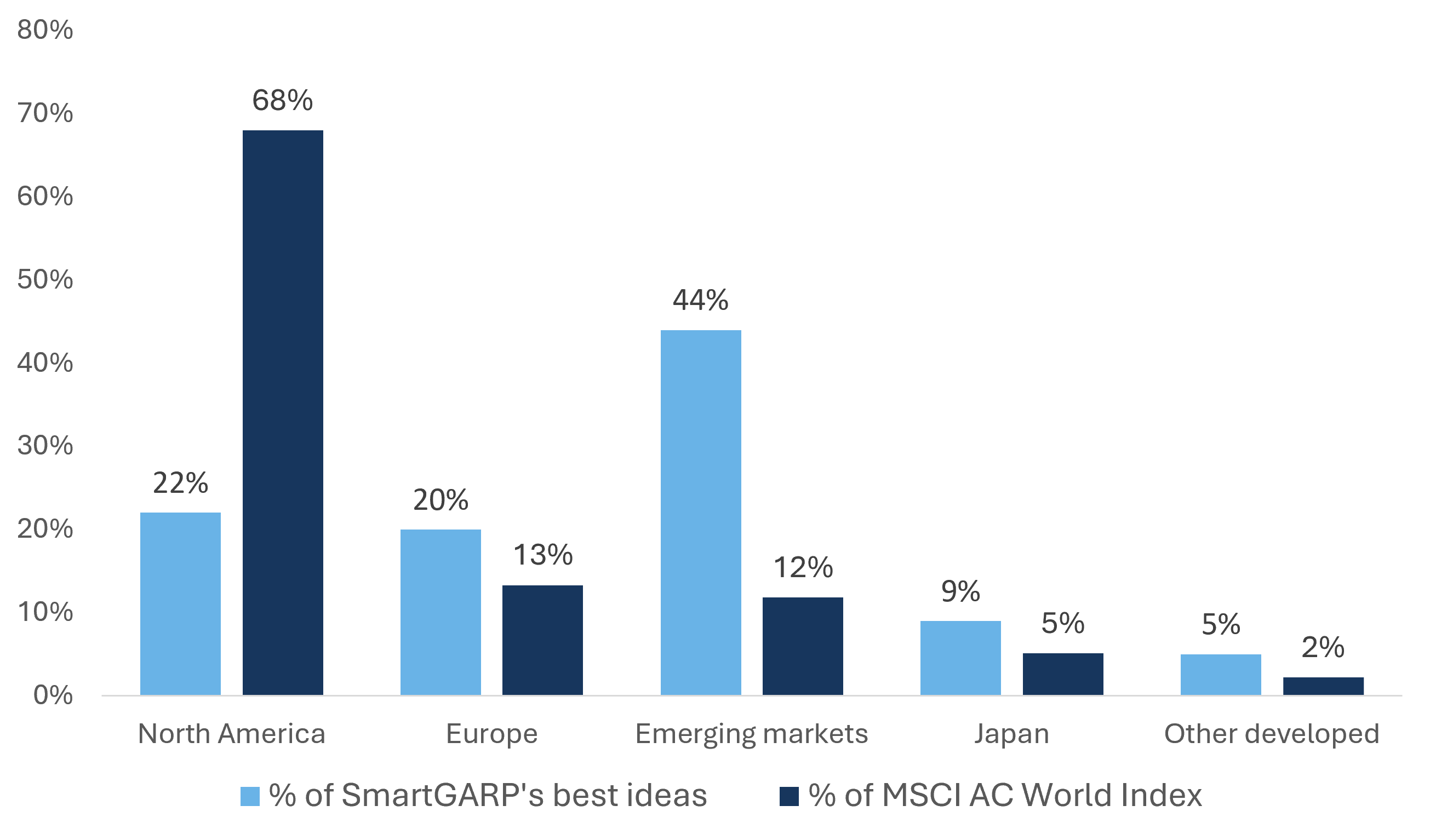
Almost half of SmartGARP’s ‘best ideas’ globally are in emerging markets
SmartGARP, Artemis’ stock-screening tool, measures around 7,000 companies around the world for a range of financial characteristics, trying to identify instances where share prices do not reflect the strength of a company’s fundamentals.
One of the fascinating things SmartGARP has been indicating in recent years relates to global asset allocation. If you buy a passive global equity portfolio today, roughly two-thirds of your money goes into the US. Just 11% goes into emerging markets1. The asset allocation that SmartGARP points us towards, however, is quite different.
At the end of September 2026, 22% of SmartGARP’s ‘best ideas’ were in North America. Emerging markets, by contrast, accounted for 44% of SmartGARP’s best ideas globally2. The mismatch between some investors’ index-driven approach to asset allocation and SmartGARP’s evidence-based assessment of where the best opportunities lie is striking.
The mismatch between some investors’ index-driven approach to asset allocation and SmartGARP’s evidence-based assessment of where the best opportunities lie is striking.
SmartGARP's perspective on emerging markets
Source: Artemis as at 30 September 2026
Investors have not missed the emerging-market rally
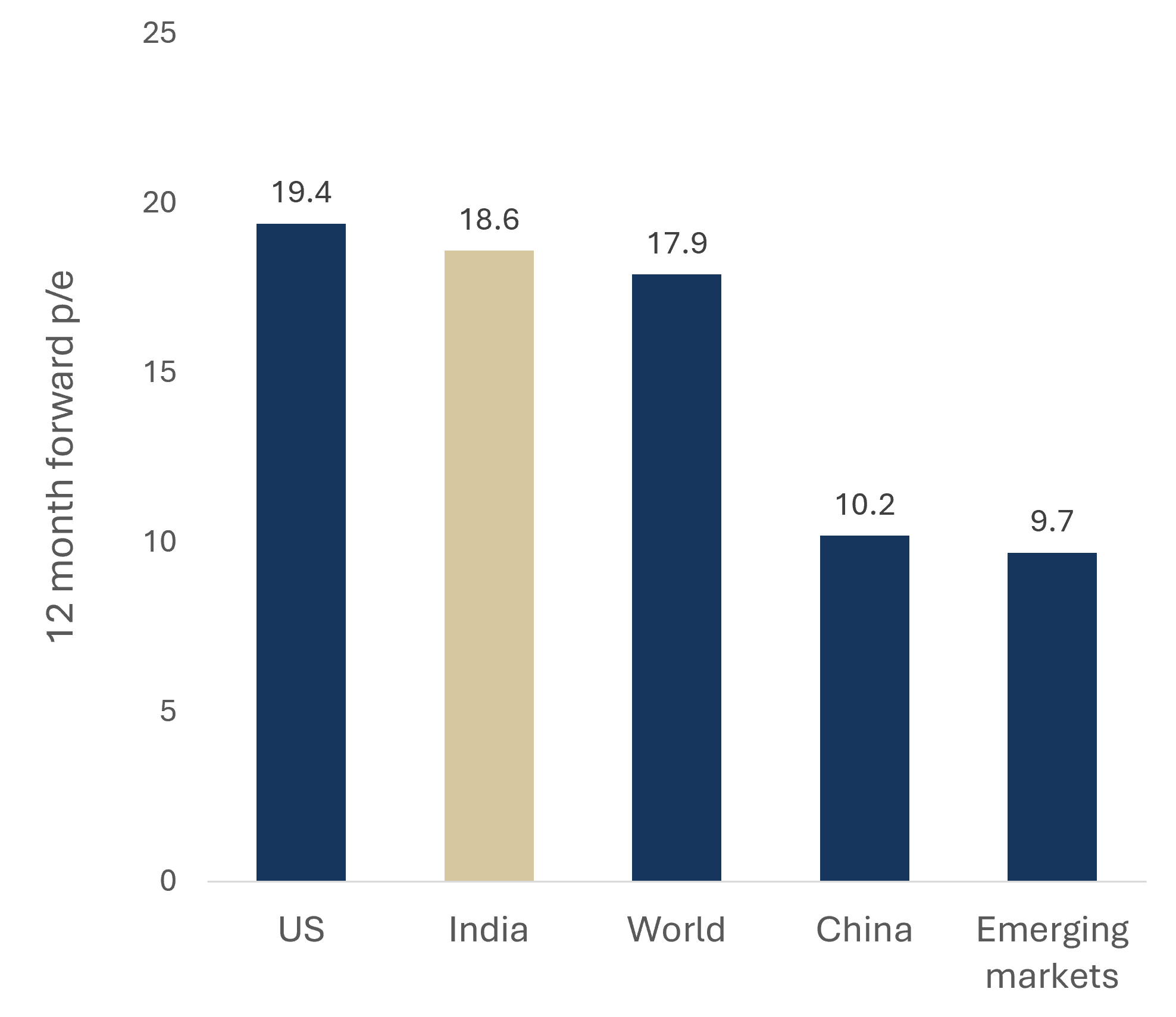
Over the last three years, emerging markets have modestly outperformed developed markets, delivering an annualised return of 24% versus 22% from the MSCI World index3. But that outperformance hasn't made them expensive; emerging markets still trade on a meaningful discount. At the end of September, the MSCI Emerging Markets index traded on a forward price-to-earnings multiple of 9.7x versus 17.9x for MSCI World index4. That’s a discount of roughly 45%.
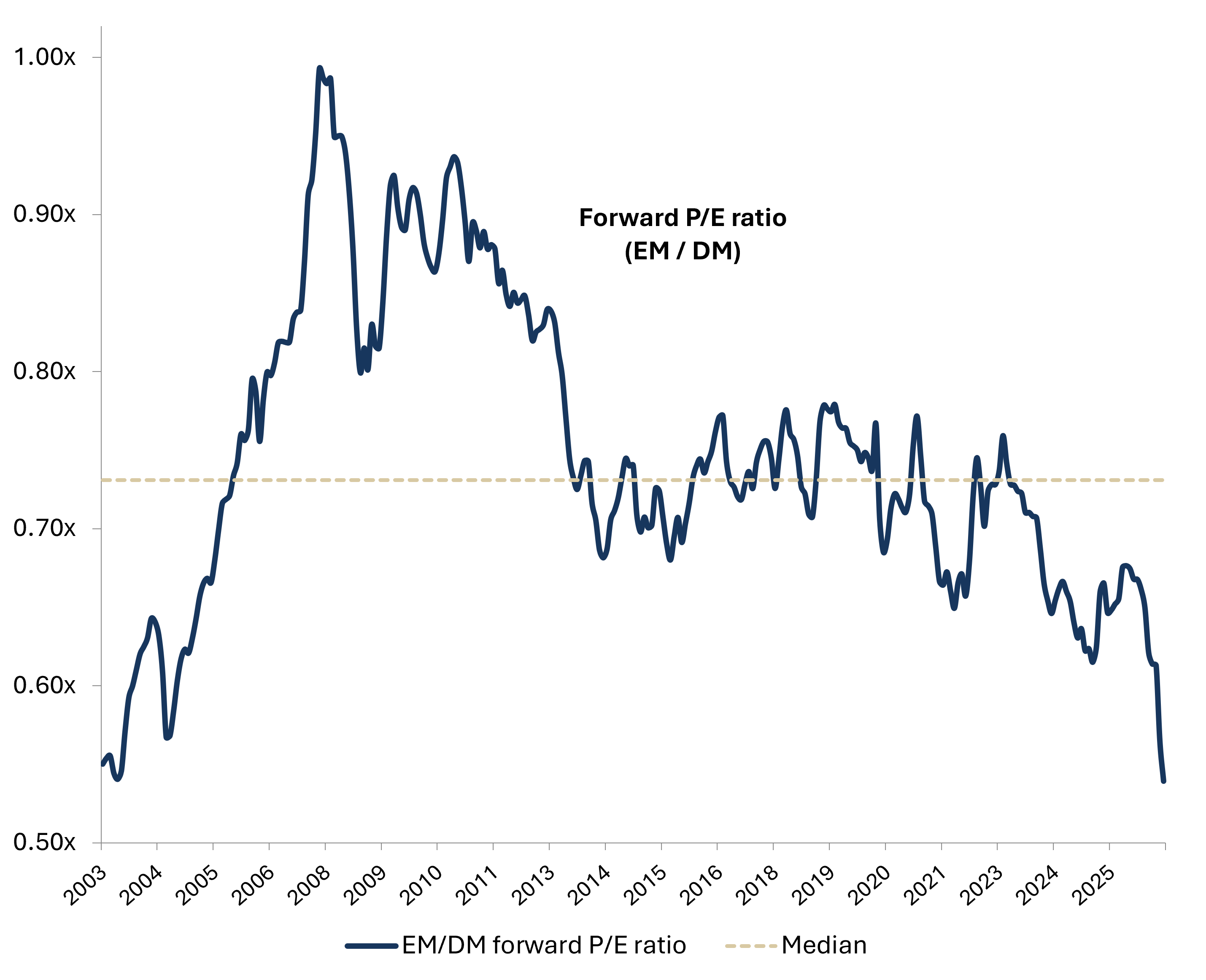
Strong performance often makes an asset class more expensive. In this case, however, the earnings of emerging-market stocks have risen even more quickly than their share prices. As a result, emerging-market equities are now trading at their lowest relative valuation to developed markets in 20 years5.
EM equities are at a 20-year valuation low relative to developed markets
Artemis, MSCI as at 31 August 2026
There is still more value in China than India
Until relatively recently, one question our clients often asked was why we had so little invested in India. After all, its long-term attractions seemed clear: it has a large domestic economy, a growing technology sector, an expanding middle class and supportive demographics. India’s economy has grown rapidly, averaging growth of around 7% outside the pandemic year over the past decade6.
Our response was simple: valuations matter. And many Indian companies appeared significantly less attractively valued than stocks in other emerging markets, including China.
India still trades at a premium
MSCI as at 30 September 2026
Over the past year, the Indian market has fallen despite retaining its structural advantages7. Rising oil prices have been part of the problem, squeezing the Indian economy, which is dependent on imported energy. Yet while share prices have fallen, the valuation and earnings picture has not improved sufficiently to prompt us to add to our holdings there. That may change. India is more interesting than it was, but it is not quite interesting enough – yet – to encourage us to change our underweight stance.
For now, SmartGARP continues to identify better opportunities elsewhere, and particularly in China. To be clear, we still think investors in China need to be selective. Growth has slowed and the property market remains weak. But across a number of sectors – financials, industrials, logistics and consumer stocks - we can find national champions that trade on modest valuations despite their improving earnings and strong competitive positions.
How we retain our perspective in volatile markets
Emerging markets rarely lack compelling stories. We prefer to focus on the evidence. Today, that evidence points to relative valuations that are unusually low and an opportunity set that is far richer than market-cap-weighted global indices imply. For investors prepared to follow that evidence rather than the crowd, we think the case for greater exposure to selected emerging markets is hard to dispute.
Notes and references
1. MSCI, 30 September 2026
2. Artemis as at 30 September 2026
3. MSCI, 30 September 2026 MSCI Emerging Markets and MSCI World Factsheets
4. MSCI, 30 September 2026 MSCI Emerging Markets and MSCI World Factsheets
5. Artemis, MSCI as at 30 September 2026
6. World Bank, World Development Indicators as at 30 September 2026
7. MSCI India Index, 30 September 2026
FOR PROFESSIONAL INVESTORS AND/OR QUALIFIED INVESTORS AND/OR FINANCIAL INTERMEDIARIES ONLY. NOT FOR USE WITH OR BY PRIVATE INVESTORS.
CAPITAL AT RISK. All financial investments involve taking risk and the value of your investment may go down as well as up. This means your investment is not guaranteed and you may not get back as much as you put in. Any income from the investment is also likely to vary and cannot be guaranteed.
This is a marketing communication. Before making any final investment decisions, and to understand the investment risks involved, refer to the fund prospectus (or in the case of investment trusts, Investor Disclosure Document and Articles of Association), available in English, and KIID/KID, available in English and in your local language depending on local country registration, available in the literature library.
Risks specific to Artemis SmartGARP Global Emerging Markets Equity Fund
- Market volatility risk The value of the fund and any income from it can fall or rise because of movements in stockmarkets, currencies and interest rates, each of which can move irrationally and be affected unpredictably by diverse factors, including political and economic events.
- Currency risk The fund’s assets may be priced in currencies other than the fund base currency. Changes in currency exchange rates can therefore affect the fund's value.
- Charges from capital risk Where charges are taken wholly or partly out of a fund's capital, distributable income may be increased at the expense of capital, which may constrain or erode capital growth.
- Emerging markets risk Compared to more established economies, investments in emerging markets may be subject to greater volatility due to differences in generally accepted accounting principles, less governed standards or from economic or political instability. Under certain market conditions assets may be difficult to sell.
- China risk The fund can invest in China A-shares (shares traded on Chinese stock exchanges in Renminbi). There is a risk that the fund may suffer difficulties or delays in enforcing its rights in these shares, including title and assurance of ownership.
Important information
The intention of Artemis’ ‘investment insights’ articles is to present objective news, information, data and guidance on finance topics drawn from a diverse collection of sources. Content is not intended to provide tax, legal, insurance or investment advice and should not be construed as an offer to sell, a solicitation of an offer to buy, or a recommendation for any security or investment by Artemis or any third-party. Potential investors should consider the need for independent financial advice. Any research or analysis has been procured by Artemis for its own use and may be acted on in that connection. The contents of articles are based on sources of information believed to be reliable; however, save to the extent required by applicable law or regulations, no guarantee, warranty or representation is given as to its accuracy or completeness. Any forward-looking statements are based on Artemis’ current opinions, expectations and projections. Articles are provided to you only incidentally, and any opinions expressed are subject to change without notice. The source for all data is Artemis, unless stated otherwise. The value of an investment, and any income from it, can fall as well as rise as a result of market and currency fluctuations and you may not get back the amount originally invested.