High-yield Happenings: Why we steer clear of bonds directly tied to AI


Key takeaways
- AI issuers have accounted for 41% of this year's new issuance in the US high-yield market1
- Despite this recent surge, credit directly related to AI only accounts for 1.7% of the global high-yield index2
- Artemis' high-yield funds currently have zero exposure to debt issued by AI providers
Financing the AI buildout is beginning to look less like a supply chain and more like a circle. Chipmakers invest in AI companies. AI companies sign long-dated commitments with developers of AI data centres. The developers then borrow against these commitments to buy chips. The guarantee that Nvidia has reportedly offered to a data-centre project proposed by OpenAI is a useful illustration of this circularity.
The same handful of names repeatedly appear as customer, supplier, investor and guarantor. The more circular the financing becomes, the less independent each apparent layer of support really is.
Capital may enter the ecosystem at several points, but repaying today's borrowing ultimately depends on companies such as (the unprofitable and unrated) OpenAI and a small group of other AI customers turning extraordinary quantities of compute into cashflows.
That does not mean the demand is imaginary, or that AI is not a transformational technology. But the financing of the AI buildout does rest on a fairly narrow set of assumptions:
- That the capacity being built will be needed
- That the power needed to run these data centres arrives on time
- That utilisation rates remain high
- That rapidly ageing chips in data centres remain economically useful
A strong guarantor – such as Nvidia – can improve the legal protection around project financing, but it does not remove the underlying economic question: has too much capacity been committed against too little proven cashflow?
Increasingly, the high-yield market is being asked to help finance the AI buildout. The Bank of England estimates that AI issuers have accounted for 41% of new issuance in the US high-yield market this year (that wasn’t simply refinancing old debt). So AI accounts for almost half of the new borrowing in the high-yield market.1
AI-related issuance in the US high-yield market ($billions)
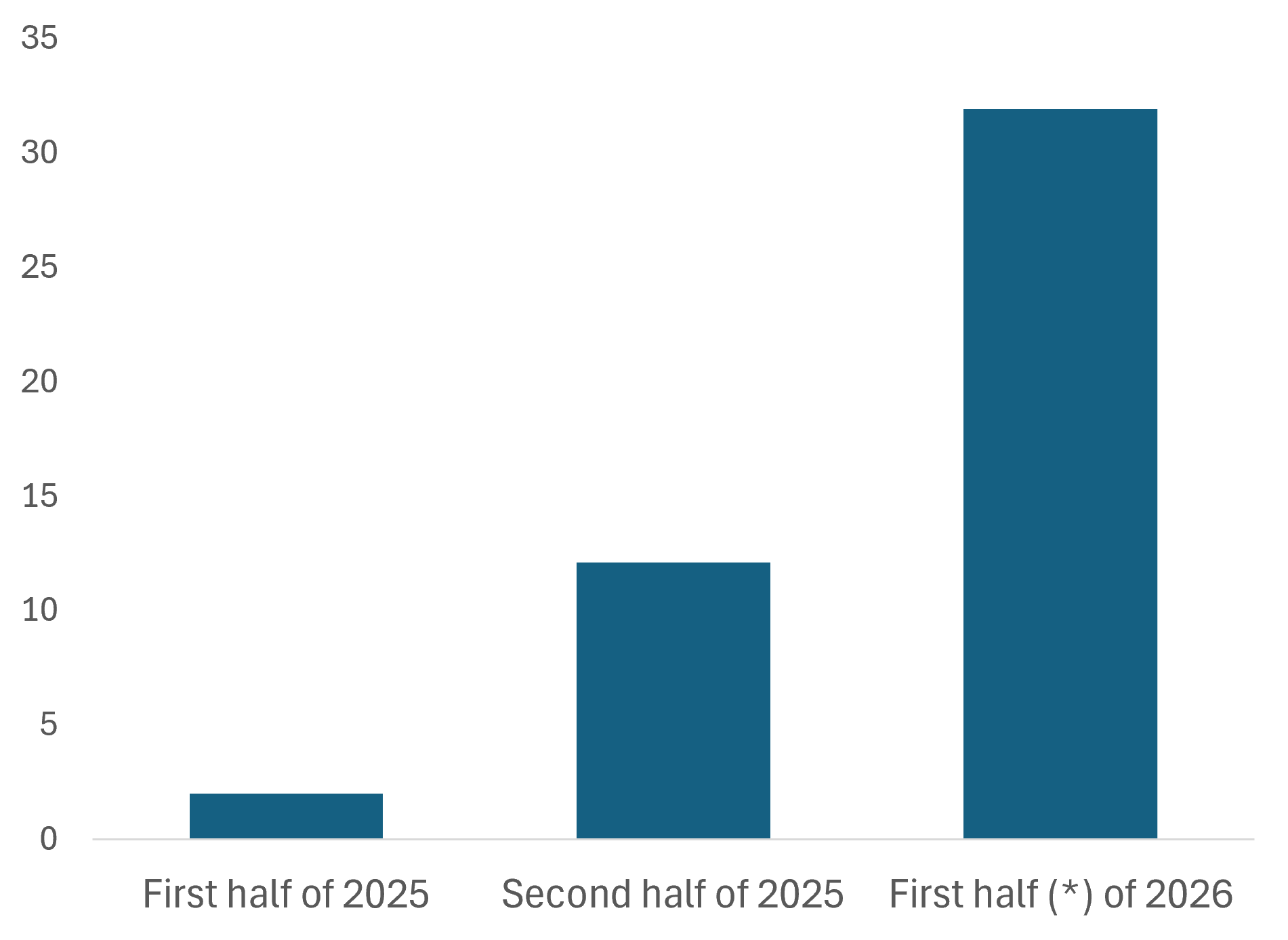
Source: Morningstar, Pitchbook. (*) Data to 8 July 2026.
At the same time, the stock of AI-related debt remains small in relative terms. A narrow basket of bonds issued by direct providers of compute and single-purpose data-centre vehicles represents around 1.7% of the global high-yield index.2
Our funds currently have zero exposure to high-yield issuance directly related to AI
At the end of June, the direct exposure of Artemis' high-yield strategies to the AI basket was precisely zero. That was not by accident. Why have we stayed away? Because the return profile looks upside-down for bondholders.
Scenario One: If power to run AI arrives on time, if utilisation rates are high and if the chips remain economically useful, then the hyperscalers' equity can – potentially – be worth multiples of its value today. At best, their bondholders will receive a coupon before being redeemed at par.
Scenario Two: If too much capacity is built, if power is delayed, if chips depreciate faster than expected or if a major tenant cannot honour its commitments, then bondholders can lose their principal.
So equity owns the (potential) upside from the AI buildout while credit markets finance the uncertainty.
We shouldn't overstate the immediate threat. At around 1.7% of the global high-yield index, even a severe disappointment across the direct AI basket would not, by itself, be enough to create a high-yield crisis. The high-yield market is broader and more diversified than the headlines might suggest, and we should not mistake a highly visible theme with a systemically important part of the index.
What matters more is the direction of travel. The fortunes of a growing number of publicly traded bonds, private credit, leases, special-purpose vehicles, guarantees and utilities are increasingly tied to the same small group of forecasts.
Add to that long-dated debt secured on facilities whose utility depends on rapidly changing chips they contain, and the disappointment has the potential to travel beyond the original borrowers – into collateral values, funding costs, and eventually risk appetite. The risk is less that an AI default breaks the high-yield market, and more that it exposes how many different layers of financing rely on the same underlying assumptions.
AI may well change the world. But that does not make every form of financing being used to build it a good investment. We are being asked to take equity-like downside for a bond-like return; we don’t think that is an attractive trade.
Notes and references
1. Financial Stability Report - July 2026 | Bank of England
2. ICE BofA as at 28 July 2026
FOR PROFESSIONAL INVESTORS AND/OR QUALIFIED INVESTORS AND/OR FINANCIAL INTERMEDIARIES ONLY. NOT FOR USE WITH OR BY PRIVATE INVESTORS.
CAPITAL AT RISK. All financial investments involve taking risk and the value of your investment may go down as well as up. This means your investment is not guaranteed and you may not get back as much as you put in. Any income from the investment is also likely to vary and cannot be guaranteed.
This is a marketing communication. Before making any final investment decisions, and to understand the investment risks involved, refer to the fund prospectus (or in the case of investment trusts, Investor Disclosure Document and Articles of Association), available in English, and KIID/KID, available in English and in your local language depending on local country registration, available in the literature library.
Risks specific to Artemis Funds (Lux) – Short-Dated Global High Yield Bond
- Market volatility risk The value of the fund and any income from it can fall or rise because of movements in stockmarkets, currencies and interest rates, each of which can move irrationally and be affected unpredictably by diverse factors, including political and economic events.
- Currency hedging risk The fund hedges with the aim of protecting against unwanted changes in foreign exchange rates. The fund is still subject to market risks, may not be completely protected from all currency fluctuations and may not be fully hedged at all times. The transaction costs of hedging may also negatively impact the fund’s returns.
- Bond liquidity risk The fund holds bonds which could prove difficult to sell. As a result, the fund may have to lower the selling price, sell other investments or forego more appealing investment opportunities.
- Higher-yielding bonds risk The fund may invest in higher-yielding bonds, which may increase the risk to capital. Investing in these types of assets (which are also known as sub-investment grade bonds) can produce a higher yield but also brings an increased risk of default, which would affect the capital value of the fund.
- Credit risk Investments in bonds are affected by interest rates, inflation and credit ratings. It is possible that bond issuers will not pay interest or return the capital. All of these events can reduce the value of bonds held by the fund.
- Derivatives risk The fund may invest in derivatives with the aim of profiting from falling (‘shorting’) as well as rising prices. Should the asset’s value vary in an unexpected way, the fund value could reduce.
- Charges from capital risk Where charges are taken wholly or partly out of a fund's capital, distributable income may be increased at the expense of capital, which may constrain or erode capital growth.
- Emerging markets risk Compared to more established economies, investments in emerging markets may be subject to greater volatility due to differences in generally accepted accounting principles, less governed standards or from economic or political instability. Under certain market conditions assets may be difficult to sell.
- Income risk The payment of income and its level is not guaranteed.
- ESG risk The fund may select, sell or exclude investments based on ESG criteria; this may lead to the fund underperforming the broader market or other funds that do not apply ESG criteria. If sold based on ESG criteria rather than solely on financial considerations, the price obtained might be lower than that which could have been obtained had the sale not been required.
Risks specific to Artemis Funds (Lux) – Global High Yield Opportunities
- Market volatility risk The value of the fund and any income from it can fall or rise because of movements in stockmarkets, currencies and interest rates, each of which can move irrationally and be affected unpredictably by diverse factors, including political and economic events.
- Currency hedging risk The fund hedges with the aim of protecting against unwanted changes in foreign exchange rates. The fund is still subject to market risks, may not be completely protected from all currency fluctuations and may not be fully hedged at all times. The transaction costs of hedging may also negatively impact the fund’s returns.
- Bond liquidity risk The fund holds bonds which could prove difficult to sell. As a result, the fund may have to lower the selling price, sell other investments or forego more appealing investment opportunities.
- Higher-yielding bonds risk The fund may invest in higher-yielding bonds, which may increase the risk to capital. Investing in these types of assets (which are also known as sub-investment grade bonds) can produce a higher yield but also brings an increased risk of default, which would affect the capital value of the fund.
- Credit risk Investments in bonds are affected by interest rates, inflation and credit ratings. It is possible that bond issuers will not pay interest or return the capital. All of these events can reduce the value of bonds held by the fund.
- Derivatives risk The fund may invest in derivatives with the aim of profiting from falling (‘shorting’) as well as rising prices. Should the asset’s value vary in an unexpected way, the fund value could reduce.
- Leverage risk The fund may operate with a significant amount of leverage. Leverage occurs when the economic exposure created by the use of derivatives is greater than the amount invested. A leveraged portfolio may result in large fluctuations in its value and therefore entails a high degree of risk including the risk that losses may be substantial.
- Charges from capital risk Where charges are taken wholly or partly out of a fund's capital, distributable income may be increased at the expense of capital, which may constrain or erode capital growth.
- Emerging markets risk Compared to more established economies, investments in emerging markets may be subject to greater volatility due to differences in generally accepted accounting principles, less governed standards or from economic or political instability. Under certain market conditions assets may be difficult to sell.
- Income risk The payment of income and its level is not guaranteed.
- Counterparty risk Investments such as derivatives are made using financial contracts with third parties. Those third parties may fail to meet their obligations to the fund due to events beyond the fund's control. The fund's value could fall because of loss of monies owed by the counterparty and/or the cost of replacement financial contracts.
- ESG risk The fund may select, sell or exclude investments based on ESG criteria; this may lead to the fund underperforming the broader market or other funds that do not apply ESG criteria. If sold based on ESG criteria rather than solely on financial considerations, the price obtained might be lower than that which could have been obtained had the sale not been required.
Important information
The intention of Artemis’ ‘investment insights’ articles is to present objective news, information, data and guidance on finance topics drawn from a diverse collection of sources. Content is not intended to provide tax, legal, insurance or investment advice and should not be construed as an offer to sell, a solicitation of an offer to buy, or a recommendation for any security or investment by Artemis or any third-party. Potential investors should consider the need for independent financial advice. Any research or analysis has been procured by Artemis for its own use and may be acted on in that connection. The contents of articles are based on sources of information believed to be reliable; however, save to the extent required by applicable law or regulations, no guarantee, warranty or representation is given as to its accuracy or completeness. Any forward-looking statements are based on Artemis’ current opinions, expectations and projections. Articles are provided to you only incidentally, and any opinions expressed are subject to change without notice. The source for all data is Artemis, unless stated otherwise. The value of an investment, and any income from it, can fall as well as rise as a result of market and currency fluctuations and you may not get back the amount originally invested.