
You should probably cheer up – unless you want to outperform


Key takeaways
- The number of companies in the MSCI AC World index receiving profit upgrades from analysts on a net basis has more than doubled over the past year
- It is difficult to square this positivity against a backdrop of rising energy prices, inflation expectations and bond yields
- While earnings upgrades are one of the biggest determinants of future outperformance, low starting valuations play a more important role when expectations become detached from reality
Being optimistic is good for you – and that’s a fact.
In white paper The Neural Basis of Always Looking on the Bright Side, psychiatrist Owen P. O’Sullivan noted that a positive outlook is something of an evolutionary necessity, as “to reconcile the full spectrum of conceivable eventualities would be endlessly time-consuming and tortuous”.
This is why human beings tend to discount the possibility of experiencing a negative event – such as the death of a loved one, being diagnosed with a serious illness, or suffering an accident – even when it is a statistical likelihood.
In fact, the paper found that the only group of people to maintain a systemic pessimistic bias, overestimating the likelihood of a negative outcome and underestimating that of a positive one, are those affected by severe depression. All others, said O’Sullivan, generally “overestimate the likelihood of success in work, relationships” and, crucially, “financial investments”.
What moves share prices?
Upgrades to profit forecasts are one of the biggest determinants of future outperformance. From that point of view, the past year looks like it has been a fantastic one for the prospects of global equities.
At the end of August 2025, just 1.8% of companies1 in the MSCI AC World index had received profit upgrades from analysts on a net basis. By the end of the year, that figure had risen to 2.7%2.
Today, as at the end of August, it stands at 4.1%3 – more than doubling in just 12 months.
There’s a tension here for me. Yes, forecasts of profit upgrades are a good thing. But is there a point where this is more about natural human biases? Should we be sceptical?
I’ve recently been watching a programme called ‘the news’ and the main storylines over the past year are not ones that have traditionally made investors excited about the future: the US starting another unwinnable war in the Middle East; rising energy prices, inflation and bond yields; and the world’s biggest companies loading up on debt to gain a foothold in a technology they don’t even know will be profitable.
The growth of the momentum trade
Perhaps I’m overstating things. The economy is not the stock market and corporate profits look healthy in many regions and sectors, particularly Europe and emerging markets.
I’ve recently been watching a programme called ‘the news’ and the main storylines over the past year are not ones that have traditionally made investors excited about the future
Yet in others, retail investor participation and the growth of the momentum trade have led the market to become concentrated in a small number of themes – namely AI and its supporting players. This is especially true of the US, which now accounts for more than 70% of the MSCI World index4.
Here, I wonder if growing analyst optimism is reflective of the pressure to justify higher valuations. On the whole, it’s difficult to see how the strong returns delivered over the past five or six years can be sustained.
Low valuations offer a margin of safety
So what approach should investors take in this environment? I would suggest going back to the factors that determine future performance. After analyst revisions, this means starting valuations. Whether earnings estimates are rising or falling, they remain just that – estimates. Low starting valuations at least offer a margin of safety.
The benefits of buying inexpensive stocks have become obvious in the period since we emerged from Covid. The list of best-performing markets over this time is dominated by unfashionable European countries such as Spain and Italy, for two main reasons: first because starting expectations for these areas were so depressed, with a lot of bad news already priced in; and second because they offered attractive dividend yields, an underappreciated component of your total return.
Performance of indices over 5yrs
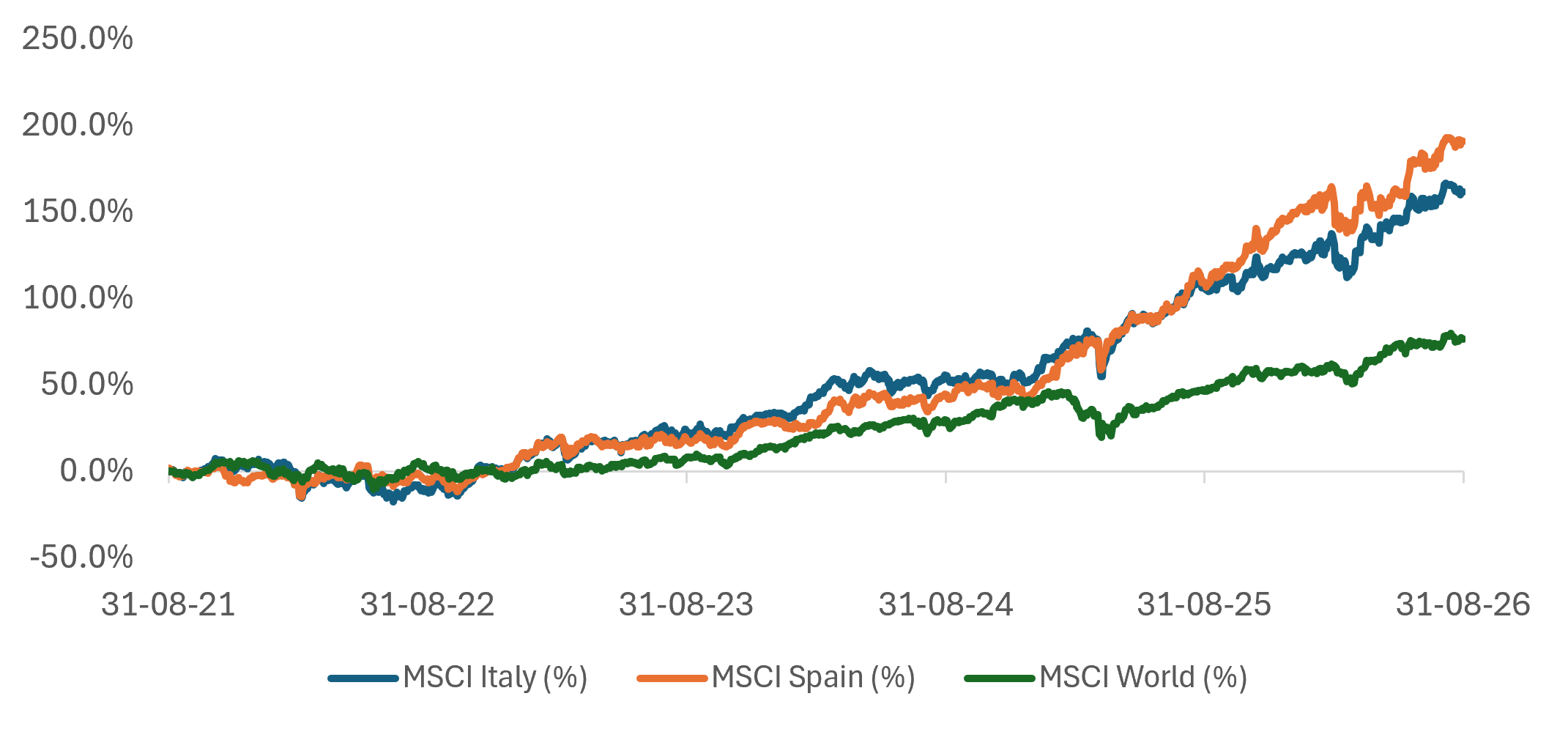
Source: Bloomberg, GBP, total return, 31 August 2021 to 31 August 2026
After lockdowns ended, it quickly became apparent we were in a very different environment to that of the 2010s. Yet many investors just picked up where they left off.
In most cases, they paid a heavy price. Labels such as ‘quality’ or ‘growth’ offered little protection for companies on lofty valuations as inflation pressures eroded profit margins while geopolitical issues and protectionism challenged the multinational business model.
Behavioural biases
Five years on, not an awful lot has changed. Although the switch from growth to value is under way, many of the biggest funds in our peer group continue to sit on a valuation premium to the market5. Meanwhile, global tracker funds have more than two-thirds in the US6 when both its equity market and currency look expensive.
Perhaps this goes back to optimism and other behavioural biases. Some investors are averse to selling at a loss, even when earnings continue to fall. Others may be reluctant to ditch a strategy that has worked in the past. Perhaps most difficult of all is to leave the safety of the herd when doing so would mean admitting that expectations for whole swathes of the economy are based on little more than hope.
It’s good to stay positive, but we know that humans have a bias towards overlooking negative scenarios even as their likelihood grows exponentially larger.
And, in such circumstances, I would probably prefer to be miserable.
Notes and references
1, 2 & 3: Artemis
4. https://www.msci.com/documents/10199/255599/msci-world-index.pdf
5. Source: Morningstar, Artemis as at 31 August 2026. Morningstar EEA Large Cap Blend, Large Cap Growth, Large Cap Value, Global Equity Income. Funds over £100m.
6. https://www.msci.com/documents/10199/255599/msci-world-index.pdf
FOR PROFESSIONAL INVESTORS AND/OR QUALIFIED INVESTORS AND/OR FINANCIAL INTERMEDIARIES ONLY. NOT FOR USE WITH OR BY PRIVATE INVESTORS.
CAPITAL AT RISK. All financial investments involve taking risk and the value of your investment may go down as well as up. This means your investment is not guaranteed and you may not get back as much as you put in. Any income from the investment is also likely to vary and cannot be guaranteed.
This is a marketing communication. Before making any final investment decisions, and to understand the investment risks involved, refer to the fund prospectus (or in the case of investment trusts, Investor Disclosure Document and Articles of Association), available in English, and KIID/KID, available in English and in your local language depending on local country registration, available in the literature library.
Important information
The intention of Artemis’ ‘investment insights’ articles is to present objective news, information, data and guidance on finance topics drawn from a diverse collection of sources. Content is not intended to provide tax, legal, insurance or investment advice and should not be construed as an offer to sell, a solicitation of an offer to buy, or a recommendation for any security or investment by Artemis or any third-party. Potential investors should consider the need for independent financial advice. Any research or analysis has been procured by Artemis for its own use and may be acted on in that connection. The contents of articles are based on sources of information believed to be reliable; however, save to the extent required by applicable law or regulations, no guarantee, warranty or representation is given as to its accuracy or completeness. Any forward-looking statements are based on Artemis’ current opinions, expectations and projections. Articles are provided to you only incidentally, and any opinions expressed are subject to change without notice. The source for all data is Artemis, unless stated otherwise. The value of an investment, and any income from it, can fall as well as rise as a result of market and currency fluctuations and you may not get back the amount originally invested.