Artemis Funds (Lux) – Global High Yield Opportunities
On 28 April 2026 the name of the fund changed from Artemis Funds (Lux) – Global High Yield Bond to Artemis Funds (Lux) – Global High Yield Opportunities.
Accessing high-yield bonds across different regions and currencies
Differentiated
The portfolio is significantly different in composition to its peers, seeking bonds that are not well-researched by competitors
Global approach
Using insight from across our fixed income team, the fund seeks global opportunities regionally focused investors might miss
Nimble
The fund is sufficiently agile and able to alter its positioning quickly as the managers see market conditions changing
A high-yield bond is a bond issued by a company. It generally has a lower credit rating than an investment grade bond, with a higher risk of default (i.e. not being repaid) and therefore pays a higher yield. Learn more about different types of bond.
Key details
| Benchmark | ICE BofA Global HY Constrained Index |
|---|---|
| Base currency | USD |
| SFDR classification | Article 8 |
| Unit type | Accumulation |
| Year end | 31 Oct |
| Pay dates | 31 Mar, 30 Jun, 30 Sep, 31 Dec |
| Valuation point | 16:00 CET |
| ISA eligible | Yes |
This fund is actively managed.
Objective
To increase the value of Shareholders’ investments through a combination of income and capital growth.
There is no guarantee that the fund will achieve a positive return over a five-year period or any other time period and your capital is at risk.
Portfolio
Top 10 holdings (%)
Czechoslovak Group A.S. 6.5% 10-Jan-2031 | 1.6 |
Perenti Finance Pty Ltd. 7.5% 26-Apr-2029 | 1.5 |
Mitchells & Butlers Finance Plc 6.469% 15-Sep-2030 | 1.5 |
Encore Capital Group, Inc. 4.25% 01-Jun-2028 | 1.5 |
Marston's Issuer Plc 5.177% 15-Apr-2027 | 1.5 |
Mineral Resources Limited 6.0% 01-May-2032 | 1.5 |
Alta Equipment Group Inc. 9.0% 01-Jun-2029 | 1.5 |
Im Group Sas 8.0% 01-Mar-2028 | 1.5 |
Sotheby's 5.875% 01-Jun-2029 | 1.4 |
Nufarm Australia Ltd. 5.0% 27-Jan-2030 | 1.4 |
Total number of holdings | 123 |
Effective duration | 3.4 |
Sector breakdown (%)
Basic Industry | 20.8 |
Services | 11.6 |
Energy | 9.7 |
Retail | 9.2 |
Leisure | 9.0 |
Real Estate | 5.3 |
Automotive | 4.7 |
Financial Services | 4.7 |
Asset Backed | 4.4 |
Technology & Electronics | 4.1 |
Healthcare | 4.1 |
Capital Goods | 3.8 |
Media | 2.5 |
Transportation | 2.3 |
Consumer Goods | 2.0 |
Utility | 1.6 |
Commercial Mortgage Backed | 1.0 |
Convertible Media | 0.9 |
Country breakdown (%)
United States | 42.9 |
United Kingdom | 15.9 |
France | 7.5 |
Australia | 5.9 |
Norway | 5.8 |
Canada | 4.0 |
Germany | 3.9 |
Luxembourg | 2.2 |
Sweden | 1.8 |
Netherlands | 1.7 |
Belgium | 1.6 |
Czech Republic | 1.6 |
Austria | 1.3 |
Greece | 1.3 |
Israel | 0.9 |
Hong Kong | 0.9 |
Bermuda | 0.8 |
Japan | 0.8 |
Italy | 0.5 |
Ireland | 0.4 |
Source: Artemis as at 30 April 2026.
Figures may not add up to 100% due to rounding and cash and derivative holdings. Visit Glossary of terms for an explanation of investment terms.
Risk considerations
Market volatility risk
The value of the fund and any income from it can fall or rise because of movements in stockmarkets, currencies and interest rates, each of which can move irrationally and be affected unpredictably by diverse factors, including political and economic events.
Currency hedging risk
The fund hedges with the aim of protecting against unwanted changes in foreign exchange rates. The fund is still subject to market risks, may not be completely protected from all currency fluctuations and may not be fully hedged at all times. The transaction costs of hedging may also negatively impact the fund’s returns.
Bond liquidity risk
The fund holds bonds which could prove difficult to sell. As a result, the fund may have to lower the selling price, sell other investments or forego more appealing investment opportunities.
Higher-yielding bonds risk
The fund may invest in higher-yielding bonds, which may increase the risk to capital. Investing in these types of assets (which are also known as sub-investment grade bonds) can produce a higher yield but also brings an increased risk of default, which would affect the capital value of the fund.
Credit risk
Investments in bonds are affected by interest rates, inflation and credit ratings. It is possible that bond issuers will not pay interest or return the capital. All of these events can reduce the value of bonds held by the fund.
Derivatives risk
The fund may invest in derivatives with the aim of profiting from falling (‘shorting’) as well as rising prices. Should the asset’s value vary in an unexpected way, the fund value could reduce.
Leverage risk
The fund may operate with a significant amount of leverage. Leverage occurs when the economic exposure created by the use of derivatives is greater than the amount invested. A leveraged portfolio may result in large fluctuations in its value and therefore entails a high degree of risk including the risk that losses may be substantial.
Charges from capital risk
Where charges are taken wholly or partly out of a fund's capital, distributable income may be increased at the expense of capital, which may constrain or erode capital growth.
Emerging markets risk
Compared to more established economies, investments in emerging markets may be subject to greater volatility due to differences in generally accepted accounting principles, less governed standards or from economic or political instability. Under certain market conditions assets may be difficult to sell.
Income risk
The payment of income and its level is not guaranteed.
Counterparty risk
Investments such as derivatives are made using financial contracts with third parties. Those third parties may fail to meet their obligations to the fund due to events beyond the fund's control. The fund's value could fall because of loss of monies owed by the counterparty and/or the cost of replacement financial contracts.
ESG risk
The fund may select, sell or exclude investments based on ESG criteria; this may lead to the fund underperforming the broader market or other funds that do not apply ESG criteria. If sold based on ESG criteria rather than solely on financial considerations, the price obtained might be lower than that which could have been obtained had the sale not been required.
Risk and reward profile
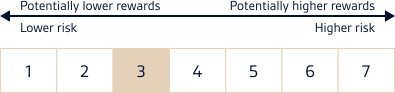
The fund is in the category shown due to historic volatility (how much and how quickly the value of shares in the fund may have risen and fallen in the past due to movements in markets, currencies and interest rates). It may not be a reliable indication of the future risk profile of the fund. The figure highlighted in the risk reward profile is the Synthetic Risk and Reward Indicator (SRRI). For more information visit our Glossary of terms.
Integrating investment and stewardship
We believe stewardship activities can contribute to better performing companies and therefore our return to clients. These activities encompass environmental, social and governance (ESG) integration, engagement and voting.
We consider ESG risks alongside our analysis of other relevant investment factors including financials, covenants, and the pricing of risks. We do not believe a standardised or fully automated approach to ESG analysis results in effective management of ESG risks within a high-yield portfolio. This is due to the lack of research coverage of the high-yield market by external ESG ratings services. We utilise the expertise of Artemis’ wider fixed income and equity teams to inform decision making.
SFDR fund sustainability disclosure (PDF)
Under the EU's Sustainable Finance Disclosures Regulation (SFDR), our Luxembourg funds are required to make certain disclosures in regard to their investment processes in order to help investors understand their approach to sustainability. The English version of this document contains the full set of disclosures, whilst versions in other languages contain summaries only.
How to invest
There are several ways to invest in our funds. If you feel you might need advice before making an investment, we recommend you speak to a financial adviser. Advisers can help you plan your investments and can invest in Artemis funds on your behalf.
Find an adviser with unbiased.co.uk

Invest via a platform, including the following

Alternatively, you can invest directly with Artemis
Or on 0800 092 2051 if you already have an account with us
Contact us
General enquiries:
Tel: 0800 092 2051
Fund Service Centre
Artemis Fund Managers Limited
Sunderland SR43 4BH
Other information
This is a marketing communication. Before making any final investment decisions, and to understand the investment risks involved, refer to the fund prospectus and KIID/KID, available in English and in your local language (depending on local country registration) above or on the literature page. The documents can also be found on www.fundinfo.com.
Investment in a fund concerns the acquisition of units/shares in the fund and not in the underlying assets of the fund.
Reference to specific shares or companies should not be taken as advice or a recommendation to invest in them.
For information on sustainability-related aspects of a fund, visit the relevant fund page
The fund is a sub-fund of Artemis Funds (Lux). For further information, visit our fund structures page
For changes made to the Artemis Funds (Lux) range of Luxembourg-registered funds since launch, visit our fund changes page
Third parties (including FTSE, Russell, MSCI and Refinitiv) whose data may be included in this document do not accept any liability for errors or omissions. For information, visit our third party data page
Any research and analysis in this communication has been obtained by Artemis for its own use. Although this communication is based on sources of information that Artemis believes to be reliable, no guarantee is given as to its accuracy or completeness.
Any forward-looking statements are based on Artemis’ current expectations and projections and are subject to change without notice.
Visit our glossary for an explanation of investment terms.
Additional information for investors in Switzerland: CACEIS Bank, Montrouge Zurich branch/Switzerland, Bleicherweg 7, CH 8027 Zurich acts as the Swiss Representative and Paying Agent.
Société d'Investissement à Capital Variable (SICAV) funds are investment funds domiciled in Luxembourg. They are authorised and regulated by the Luxembourg based EU regulator, the Commission de Surveillance du Secteur Financier (CSSF). Artemis Funds (Lux) (the “Company”) are SICAV funds and are therefore not authorised and regulated by the UK Financial Conduct Authority (“FCA”). They are, however, recognised under the UK Financial Conduct Authority’s (FCA) Overseas Fund Regime (OFR). Potential and current investors in the UK should be aware that, although the Company is recognised by the UK FCA for the purposes of distribution, the activities of the Company, the UK Representative, the Management Company, or the Depositary are not subject to the rules and regulations made under the Financial Services and Markets Act 2000 for the protection of investors. As a result, UK investors will not be protected by the UK Financial Services Compensation Scheme (FSCS) for financial losses suffered as a result of any of the mentioned bodies being unable to meet their liabilities to Shareholders, as these rules generally do not apply to an investment in the Company. In addition, UK investors will not be able to refer a complaint against the mentioned bodies to the UK Financial Ombudsman Service (“FOS”). We recommend that you get independent financial advice before making any investment decisions. The FCA introduced a package of measures during 2024 called the Sustainability Disclosure Requirements (SDR). The Company is not subject to these requirements.