Artemis High Income Fund
Seeking a high level of income through a blend of bonds and company shares
Income stream
The managers seek to generate a high level of income with the potential for capital growth by investing predominantly in high yield bonds
Flexible
Selectively invests in investment grade and government bonds and holds up to 20% in the shares of dividend-paying companies
Risk-reward balance
Uses in-depth analysis in seeking quality companies that are stable and less likely to default on interest payments
A high-yield bond is a bond issued by a company. It generally has a lower credit rating than an investment grade bond, with a higher risk of default (i.e. not being repaid) and therefore pays a higher yield. Learn more about different types of bond.



Awards and ratings




Key details
| IA sector | IA Sterling Strategic Bond Sector |
|---|---|
| Base currency | GBP |
| Unit type | Distribution |
| Year end | 07 Aug |
| Pay dates | 07 Jan, 07 Apr, 07 Jul, 07 Oct |
| Valuation point | 12:00 UK time |
| Fund launch | 26 May 1995 |
| ISA eligible | Yes |
This fund is actively managed.
Objective
To provide a combination of a high level of income and capital growth, before fees, over a rolling five year period. The manager defines a high level of income as equal to, or in excess of, the average yield of the funds in the fund’s Investment Association sector, the Strategic Bond sector.
There is no guarantee that the fund will achieve a positive return over a five-year period or any other time period and your capital is at risk.
Investment strategy
- The fund is actively managed.
- The manager seeks investments that offer the best value free cashflow available, as cashflow evidenced by an above-average yield on bonds or shares.
- On occasion, investments are made on the basis of future dividend growth.
- The manager focuses on the ability of a bond issuer to pay the interest on a bond and to repay a bond at its expiry, and the valuation attached to a bond as a result.
Portfolio
Top 10 holdings (%)
The United States Of America 4.125% 15-Feb-2036 | 4.8 |
The United States Of America 4.625% 15-Feb-2046 | 4.7 |
Barclays | 2.3 |
TotalEnergies | 1.8 |
NatWest Group | 1.6 |
Tesco | 1.2 |
Aviva | 1.2 |
Lloyds Banking Group | 1.0 |
Marks & Spencer Group | 1.0 |
Marston's Issuer Plc 5.177% 15-Apr-2027 | 1.0 |
Total number of holdings | 175 |
Effective duration | 3.6 |
Asset class breakdown (%)
Equities | 16.0 |
Common Stocks | 16.0 |
Fixed Income | 86.0 |
Corporates | 73.6 |
Government Bonds | 11.2 |
Securitized / Covered | 0.9 |
Inflation Linked Bonds | 0.3 |
Currency Forwards | 1.7 |
Cash | -3.7 |
Source: Artemis as at 30 April 2026.
Figures may not add up to 100% due to rounding and cash and derivative holdings. Visit Glossary of terms for an explanation of investment terms.
Income
I Quarterly Dist GBP unit class
Yields
Distribution yield | 5.76% |
Underlying yield | 5.13% |
Yield to worst | 6.79% |
The distribution yield reflects the amount that may be expected to be distributed over the next twelve months as a percentage of the mid-market unit price of the fund as at the date shown. it is based on a snapshot of the portfolio on that day. It does not include any preliminary charge and investors may be subject to tax on distributions. The distribution yield is not an indicator of the future performance of the fund. The payment of income and its level is not guaranteed.
The underlying yield is calculated in the same way as the distribution yield but is net of charges and therefore lower than the distribution yield. The underlying yield is not an indicator of the future performance of the fund. The payment of income and its level is not guaranteed.
The yield to worst is a portfolio characteristic that reflects the lowest potential yield based on the current price of securities within the portfolio under the assumption there are no defaults and adjusted for the yield of derivatives (where applicable), hedged into the share class currency.
Distribution frequency | Quarterly |
Pay dates | 07 Jan, 07 Apr, 07 Jul, 07 Oct |
Year end | 07 Aug |
Distribution history
2025/2026 | Record date | Ex-dividend date | Payment date | Distribution |
|---|---|---|---|---|
2nd interim | 7 Feb 2026 | 9 Feb 2026 | 7 Apr 2026 | 0.9843p |
1st interim | 7 Nov 2025 | 10 Nov 2025 | 7 Jan 2026 | 1.0316p |
Total paid this fund financial year | 2.0159p |
Risk considerations
Market volatility risk
The value of the fund and any income from it can fall or rise because of movements in stockmarkets, currencies and interest rates, each of which can move irrationally and be affected unpredictably by diverse factors, including political and economic events.
Currency risk
The fund’s assets may be priced in currencies other than the fund base currency. Changes in currency exchange rates can therefore affect the fund's value.
Bond liquidity risk
The fund holds bonds which could prove difficult to sell. As a result, the fund may have to lower the selling price, sell other investments or forego more appealing investment opportunities.
Credit risk
Investments in bonds are affected by interest rates, inflation and credit ratings. It is possible that bond issuers will not pay interest or return the capital. All of these events can reduce the value of bonds held by the fund.
Charges from capital risk
Where charges are taken wholly or partly out of a fund's capital, distributable income may be increased at the expense of capital, which may constrain or erode capital growth.
Emerging markets risk
Compared to more established economies, investments in emerging markets may be subject to greater volatility due to differences in generally accepted accounting principles, less governed standards or from economic or political instability. Under certain market conditions assets may be difficult to sell.
Income risk
The payment of income and its level is not guaranteed.
Risk and reward profile
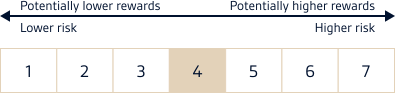
The fund is in the category shown due to historic volatility (how much and how quickly the value of shares in the fund may have risen and fallen in the past due to movements in markets, currencies and interest rates). It may not be a reliable indication of the future risk profile of the fund. The figure highlighted in the risk reward profile is the Synthetic Risk and Reward Indicator (SRRI). For more information visit our Glossary of terms.
Integrating investment and stewardship
We believe stewardship activities can contribute to better performing companies and therefore our return to clients. These activities encompass environmental, social and governance (ESG) integration, engagement and voting.
This strategy is managed jointly by our UK Select and High Yield investment teams and therefore draws on the ESG integration processes of these strategies.
Our TCFD (Task Force on Climate-Related Financial Disclosures) fund-level reports provide our clients with transparency on certain climate-related metrics for our investment products.
We have produced a consolidated report which includes TCFD disclosures for all of our UK funds, along with an explanation of the climate metrics which we are disclosing for each fund.
How to invest
There are several ways to invest in our funds. If you feel you might need advice before making an investment, we recommend you speak to a financial adviser. Advisers can help you plan your investments and can invest in Artemis funds on your behalf.
Find an adviser with unbiased.co.uk

Invest via a platform, including the following


Alternatively, you can invest directly with Artemis
Or on 0800 092 2051 if you already have an account with us
Contact us
General enquiries:
Tel: 0800 092 2051
Fund Service Centre
Artemis Fund Managers Limited
Sunderland SR43 4BH
Other information
This is a marketing communication. Before making any final investment decisions, and to understand the investment risks involved, refer to the fund prospectus and KIID/KID, available in English and in your local language (depending on local country registration) above or on the literature page. The documents can also be found on www.fundinfo.com.
Investment in a fund concerns the acquisition of units/shares in the fund and not in the underlying assets of the fund.
Reference to specific shares or companies should not be taken as advice or a recommendation to invest in them.
The fund is an authorised unit trust scheme. For further information, visit our fund structures page
Third parties (including FTSE, Russell, MSCI and Refinitiv) whose data may be included in this document do not accept any liability for errors or omissions. For information, visit our third party data page
Any research and analysis in this communication has been obtained by Artemis for its own use. Although this communication is based on sources of information that Artemis believes to be reliable, no guarantee is given as to its accuracy or completeness.
Any forward-looking statements are based on Artemis’ current expectations and projections and are subject to change without notice.
Visit our glossary for an explanation of investment terms.
Issued by Artemis Fund Managers Ltd which is authorised and regulated by the Financial Conduct Authority.