Investing for better, not worse



This is a marketing communication. Before making any final investment decisions, and to understand the investment risks involved, refer to the fund prospectus (or in the case of investment trusts, Investor Disclosure Document and Articles of Association), available in English, and KIID/KID, available in English and in your local language depending on local country registration, available in the literature library.
Key takeaways
We try to buy attractively priced companies that are getting better. We sell companies if they’re getting worse. It's that process that we're wedded to, rather than to the companies themselves. So we make no pledges of fidelity – we’re trying to help our clients to become richer, not poorer.
That approach may seem obvious, but millions of investors don’t follow it. The investment decisions of 'passive' investment funds – those that aim to match the returns from a specific market or index rather than beating it – make no reference to whether the companies they own are improving or deteriorating. Just one question drives what they buy and sell: how big are they?
The performance of passive funds has come to rest on returns from a handful of large tech companies
As a company’s market value rises relative to others, it comes to represent a larger share of the index – so more of the money invested in passive funds that track that index is allocated to it. The rise of the US technology giants, particularly the so-called 'Magnificent Seven' companies (Alphabet, Amazon, Apple, Meta, Microsoft, Nvidia and Tesla) and the AI boom have meant returns from the biggest companies have outpaced the rest of the US market in recent years. Passive funds both contributed to and benefitted from that trend.
If more people shift to passive investing – and they have been – then a cycle can build: the biggest companies get bought more heavily; their share prices rise; their market value increases; and passive funds automatically buy more of them.
So far, so good. In the past five years, the top 10 stocks in the S&P 500 index have risen by 380%, compared with 75% for the index1. Thanks to this, a greater proportion of passive investors' money is crowding into the market's biggest stocks. The top 10 stocks in the S&P 500 have grown to represent 37.6% of the index2. But here's the worry: we believe the share prices of some of these companies now look too high relative to their underlying profits. In other words, we think they are overvalued.
And that brings me to another important point about 'active' investors like us who, rather than simply copying a market index, choose which companies' shares to buy, sell or avoid. We look for companies where we believe the opportunity to make a return for our clients (the 'upside') is significantly greater than the potential downside risk. Valuations – the company’s share price relative to its underlying financial health, including its profits – are an important part of that.
A company may be getting neither better nor worse, but if the invisible piece of elastic that connects a company’s share price to its profits stretches too far – if it is overvalued – then the risk balance tilts the wrong way. The opportunity for its share price to rise shrinks and the risk of disappointment grows.
There are risks in the Magnificent Seven
So what happens if the world decides the large US technology companies have got poorer and are overpriced? What happens when a virtuous circle goes into reverse? And is such a reversal possible?
As a result of the Magnificent Seven's investments in AI, the cash they have left over after paying the costs of running and investing in their businesses ('free cashflow') has started to shrink. They are investing billions of dollars into a race in which there may be only one or two winners3.
Magnificent Seven - Slowing profit growth
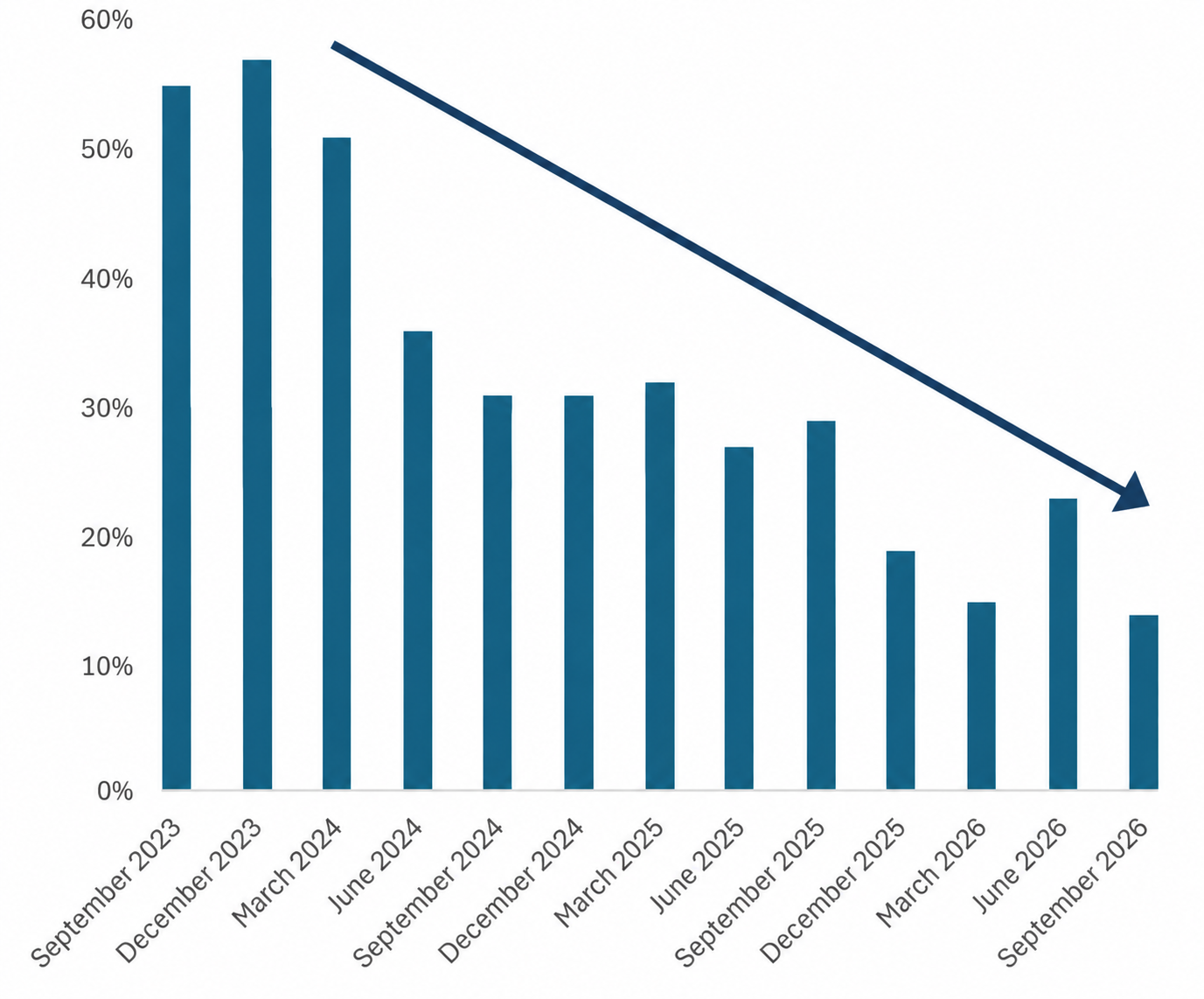
Hedgeye as at 5 May 2026. The Magnificent Seven stocks are Alphabet, Amazon, Apple, Microsoft, Meta, NVIDIA and Tesla. "Profit growth" is defined as year-on-year net income growth.
Their advantage over the rest of the market is already narrowing. The Magnificent Seven’s profits were growing at an annual rate of more than 60% at their peak in the final quarter of 20234. Those profits are still rising, but more slowly. FactSet, a global financial data company, expects profit growth among the other 493 companies in the S&P 500 to exceed 20% later this year – and to overtake the Magnificent Seven by the final quarter of 2026.5
In June, Alphabet said it would sell $80bn worth of new shares to fund its AI investments6. This came after it had borrowed almost $32bn from the bond market7. Alphabet and five other large technology companies – Amazon, Meta, Microsoft, Oracle and SpaceX – are expected to spend around $870bn this year on their AI investments8.
What happens if these companies struggle to make enough money from their AI products and services to justify their investments? Although we don’t believe there is an ‘AI bubble’, we don’t think all of these companies will necessarily be winners.
Because we are active investors, we try to discriminate between winners and losers. We can reduce or sell any holdings we have in any of the Magnificent Seven companies if their AI investments don't appear to be paying off in the way the market currently hopes. And we can add to them again if something positive happens to make us revisit our view.
What happens if the world decides the large US technology companies have got poorer and are overpriced? What happens when a virtuous circle goes into reverse?
Of these companies, we have been most positive about Amazon. We believe the combination of its well-established AWS 'cloud' business – through which it rents out computing power and data storage to other companies – combined with its expertise in designing chips used in AI applications leaves it well placed to be among the winners in the AI arms race.
Elsewhere, we were early to buy companies that act as suppliers to the AI investment boom, such as Advanced Micro Devices (semiconductors) and Seagate Technology (storage). Companies like these went through lean times after Covid but strong demand is allowing them to charge higher prices.9
We have also looked again at some software companies. In many cases, these companies' share prices fell as the market worried that their services could potentially be replaced by AI. We now see scope for their shares to rally as the market realises AI might actually benefit them. Increasingly, we’re also looking at areas outside of AI where share prices have been under pressure for several years but that are now showing signs of recovery, such as healthcare. In other words, we’re looking for companies that are improving. We believe investing “for better, for richer” beats investing purely on size.
Notes and references
2. S&P Global as at 31 July 2026
3. Financial Times, 8 May 2026, Big Tech’s $725bn AI spending spree sends free cash flow to a decade low
4. MarketWatch, 20 April 2024, This chart shows why the stock-market rally should broaden out later this year
5. FactSet 20 July 2026 "Are Magnificent 7” Companies Still Top Contributors to S&P 500 Earnings Growth for Q2?
6. Financial Times, 1 June 2026, Alphabet to sell $80bn in stock to fund AI spending spree.
7. Bloomberg, 10 February 2026, Alphabet Sells Almost $32 Billion Bonds as Tech Races to Fund AI
8. S&P Global, 17 August 2026, S&P Global Ratings' View on Artificial Intelligence and Hyperscalers
9. Seagate, July 28, 2026 Seagate Technology Reports Fiscal Fourth Quarter and Fiscal Year 2026 Financial Results; and AMD August 04, 2026 AMD Reports Second Quarter 2026 Financial Results
Artemis US Select Fund
Objective
To grow capital over a five-year period.
There is no guarantee that the fund will achieve a positive return over a five-year period or any other time period and your capital is at risk.
Risks specific to Artemis US Select Fund
- Market volatility risk The value of the fund and any income from it can fall or rise because of movements in stockmarkets, currencies and interest rates, each of which can move irrationally and be affected unpredictably by diverse factors, including political and economic events.
- Currency risk The fund’s assets may be priced in currencies other than the fund base currency. Changes in currency exchange rates can therefore affect the fund's value.
The intention of Artemis’ ‘investment insights’ articles is to present objective news, information, data and guidance on finance topics drawn from a diverse collection of sources. Content is not intended to provide tax, legal, insurance or investment advice and should not be construed as an offer to sell, a solicitation of an offer to buy, or a recommendation for any security or investment by Artemis or any third-party. Potential investors should consider the need for independent financial advice. Any research or analysis has been procured by Artemis for its own use and may be acted on in that connection. The contents of articles are based on sources of information believed to be reliable; however, save to the extent required by applicable law or regulations, no guarantee, warranty or representation is given as to its accuracy or completeness. Any forward-looking statements are based on Artemis’ current opinions, expectations and projections. Articles are provided to you only incidentally, and any opinions expressed are subject to change without notice. The source for all data is Artemis, unless stated otherwise. The value of an investment, and any income from it, can fall as well as rise as a result of market and currency fluctuations and you may not get back the amount originally invested.