
This page looks at the two main types of unit or share class within a fund, based on whether they pay income to investors.
In terms of income and how this is distributed to investors, there are two types of class in a fund available to investors: ‘income’ (also known as ‘distribution’) and ‘accumulation’. Income units pay income out; accumulation units reinvest it.
| Income classes (‘Inc’) | Accumulation classes (‘Acc’) |
| Pay income out. | Reinvest income. |
| May suit someone who relies on income from their investments; for example, a retiree. Which is appropriate will depend on an investor’s individual circumstances and objectives. | May suit someone who is investing for growth. Investors who do not require distributions may choose an accumulation class, which automatically reinvests income. |
| Can benefit from compounding income if manually reinvested. | Benefit from compounding income. |
- Income classes distribute the income received by the fund to its investors. This income usually comes from excess profits distributed in the form of dividends. For funds that invest in bonds, this income tends to come from coupon payments, which are similar to the interest paid on a loan. Distributions to investors are made at predetermined intervals, typically annually, semi-annually, quarterly or monthly. Income is expressed as a yield, which is the amount paid as a percentage of the unit price of the fund.
- Accumulation classes reinvest any income received from the underlying assets (shares, bonds and so on) back into the fund so its capital can grow. Income is ‘credited to the fund’s capital’, meaning it becomes part of the capital value of the fund. In practice, the value of each accumulation share increases as a result, but the number of accumulation shares remains unchanged.
Which class is more suitable?
For investors who rely on the income from their investments, such as those in retirement, income classes may be more appropriate as these can provide them with a regular amount of money paid to their bank account.
Investors who do not require distributions, such as those who are building up a pension pot and are many years away from retirement, may choose an accumulation class, which automatically reinvests income (also known as investing for growth). This allows them to benefit from compounding, or interest paid on top of interest already earned. Over long periods, reinvesting income can materially affect cumulative returns, although investment values can fall as well as rise.
For both income and accumulation classes, it’s worth noting that income incurs tax at the investor’s regular income tax rate, irrespective of dividends or interest distributions, unless they are held within a tax-efficient vehicle such as an Individual Savings Account (ISA) or a pension.
The difference between accumulation and income share classes
The following case study has been created to help you understand the difference between accumulation and income share classes.
Take two investors:
- Inc, who has already retired and is investing for income, and
- Acc, who is saving towards retirement and is reinvesting income rather than taking it as cash.
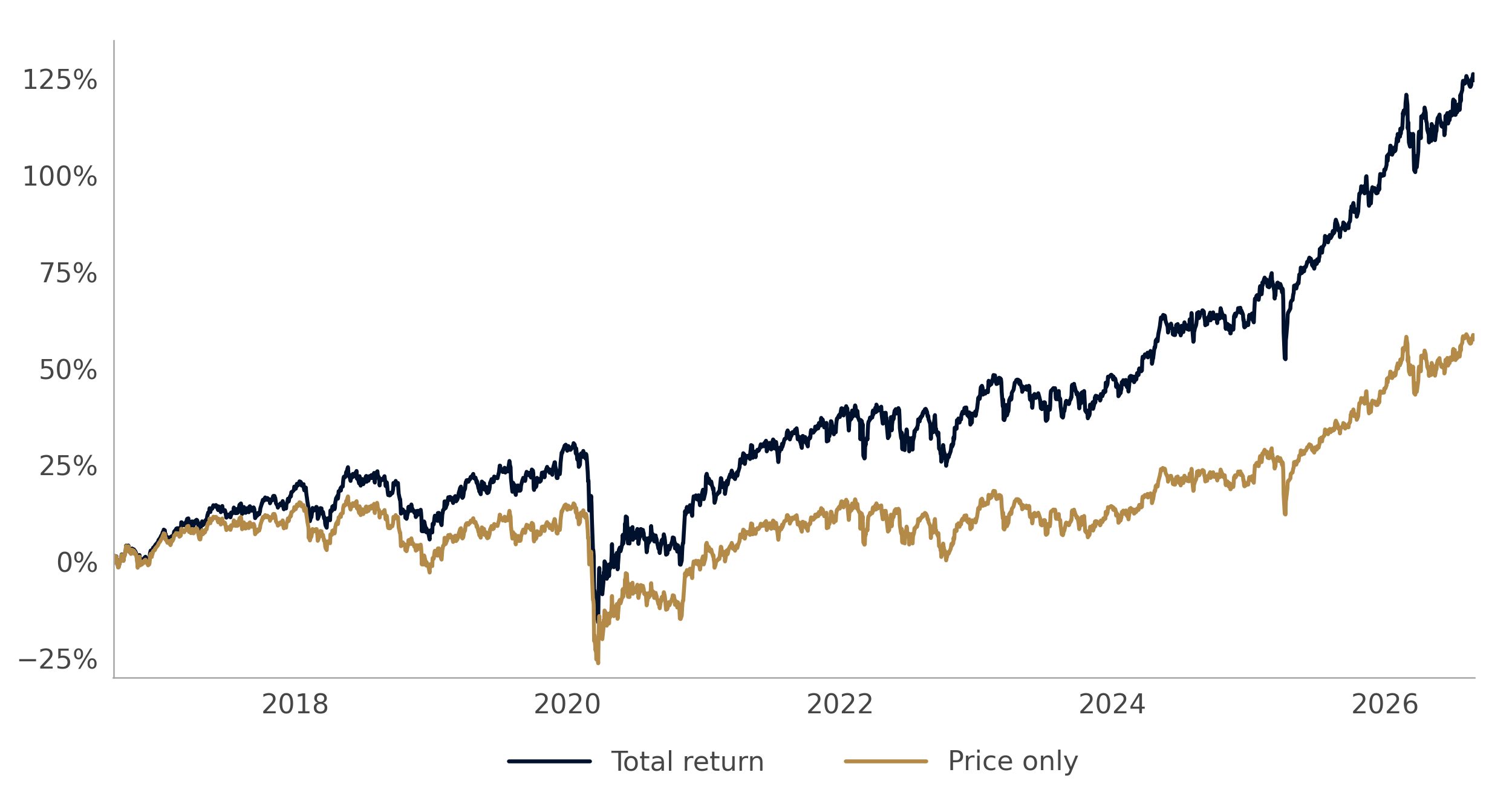
Both Inc and Acc invest their money in the FTSE All-Share index at the end of August 2016 and keep it there for the next 10 years.
Over this time, the price of the FTSE All-Share rises 58.0%*. Yet this ignores the impact of dividend payments, which over 10 years amount to 40.4%* of the original investment.
Performance of FTSE All-Share index, showing total return (with dividends reinvested) versus price only (excluding dividends) 31 August 2016 to 31 August 2026
Source: Bloomberg, GBP
Past performance is not a reliable indicator of future results. The examples are historical illustrations of the effect of reinvesting income only and are not investment recommendations.
Because Investor Inc is retired, they take the income as it is paid, which combined with the price rise in the index equates to a total return of 98.5%* - a significant increase on just the price return.
However, because Investor Acc doesn’t need the money just yet, they automatically reinvest the income paid out by the index. This means that when it is time for the second round of income, it is paid not just on the initial sum, but on the initial sum plus the first round of income.
When it is time for the third round of income, it is paid on the initial sum, the first round of income, the income received on the first round of income, the second round of income and the income received on the second round of income. And so on.
Because Investor Inc does not reinvest the distributions, those distributions do not themselves remain invested to generate further returns.
As a result, after 10 years, Investor Acc would have made a total return of 125.3%* compared with 98.5%* for Investor Inc.
Doubling up
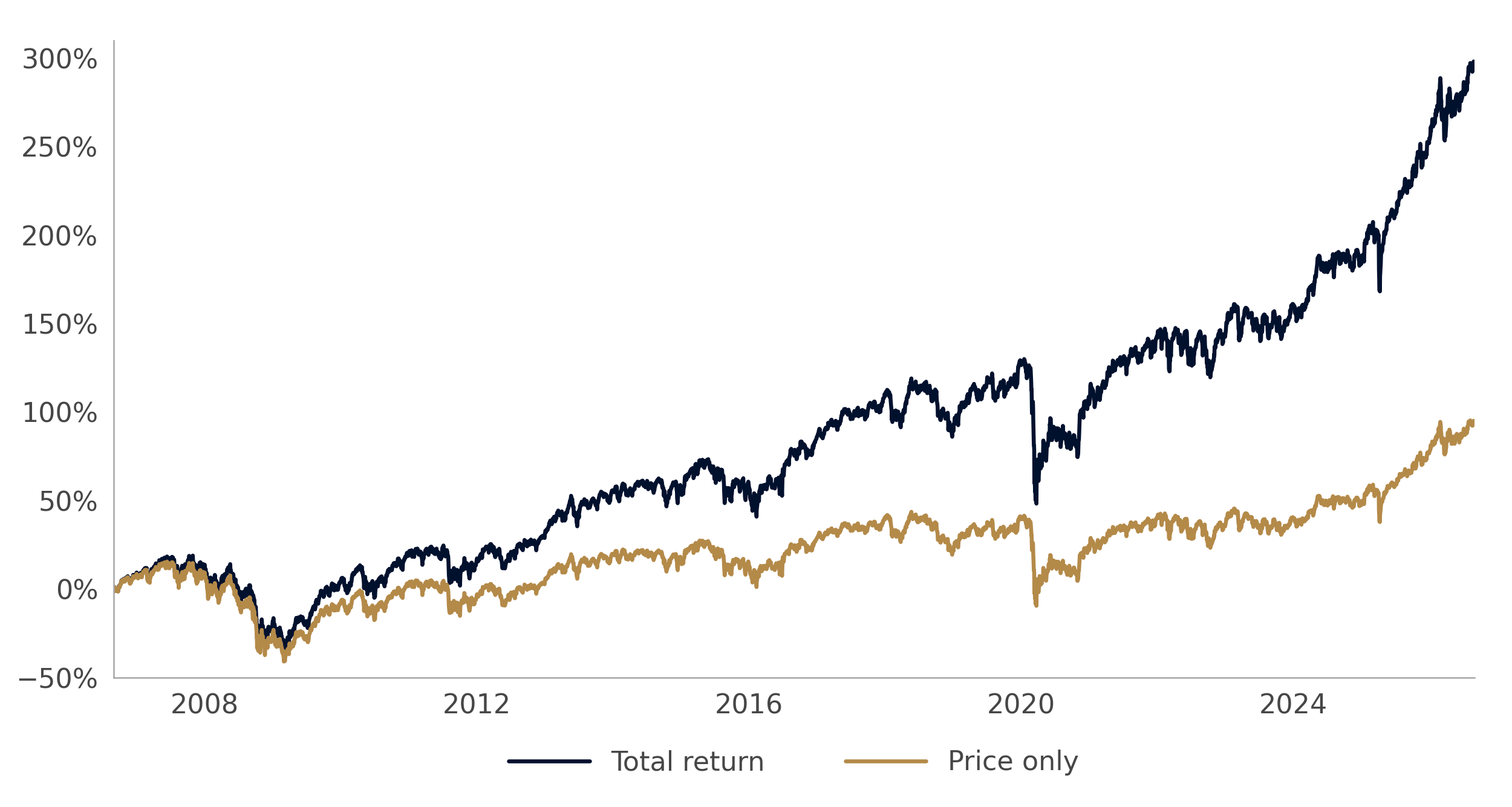
But what happens if instead of investing their money over 10 years, Acc and Inc did so over 20, from August 2006?
Over the next 20 years, the price of the FTSE All-Share rose 94.3%*. On top of this, it paid an income worth 86.5%* of the original investment, meaning Investor Inc would have made a total return of 180.7%*.
However, by reinvesting dividends, Investor Acc would have made a total return of 296.3%* – an extra 115.6 percentage points over Investor Inc.
Note that in this example, Investor Inc uses the income received to meet their outgoings, while Investor Acc reinvests it. The comparison therefore illustrates the effect of spending versus reinvesting income. An investor taking an income class could instead reinvest those distributions, either in the same fund or elsewhere.
Performance of FTSE All-Share index, showing total return (with dividends reinvested) versus price only (excluding dividends) 31 August 2006 to 31 August 2026
Source: Bloomberg, GBP
Past performance is not a reliable indicator of future results. The examples are historical illustrations of the effect of reinvesting income only and are not investment recommendations.
| FTSE All-Share 31/08/2016 to 31/08/2026 | FTSE All-Share 31/08/2006 to 31/08/2026 | |
| Price return only | 58.0% | 94.3% |
| Dividends paid out | 40.4% | 86.5% |
| Total return | 125.3% | 296.3% |
| Difference between total return and price + dividends | 26.9% | 115.5% |
Source: Bloomberg, GBP
Compounding has been referred to as the Eighth Wonder of the World, although of course investment values can fall as well as rise. But if you need the income from investments to, for example, pay your bills, then that’s not much use for you.
Whether an income or accumulation strategy/share class is right for you will depend on your individual circumstances. However, please bear in mind that all financial investments involve taking risk and the value of your investment may go down as well as up. In addition, the past performance of stock markets is not a guide to their future performance.
For further related information, please refer to:
What are fund share/unit classes?
How to take an income from a fund
How to assess fund performance
*Source: Bloomberg
This information is intended to provide you with help and guidance about investing generally and about investing with Artemis. It is not a marketing communication and should not be used to make investment decisions. You should always refer to the relevant fund prospectus and KIID/KID before making any final investment decisions.
Artemis does not provide investment advice on the advantages or suitability of its products and no information provided should be viewed in this way. Should you be unsure about the suitability of an investment, you should consult a suitably qualified professional adviser.