Artemis Monthly Distribution Fund
Q2 2025 update




Source for all information: Artemis as at 29 June 2025, unless otherwise stated.
The second quarter was one of the most action-packed in recent memory. Global equities sold off sharply and volatility spiked to levels not seen since the pandemic in the wake of ‘Liberation Day’ and the apparent beginning of a new era of US protectionism.
However, thanks to several last-minute tariff suspensions and robust hard macroeconomic data, US equities posted a jet-propelled recovery, with the S&P 500 notching its fastest ever recouping of a 15% drawdown.
Outside equities, there were significant moves in both fixed income and currency markets. Clear worries about fiscal sustainability – principally in the US, but also in much of the Western world – have manifested in steepening yield curves and sharp rises in long-dated government bond yields.
The dollar had its worst first half-year in more than five decades and weakened against every other G10 currency, boosting returns for US investors in international assets. For example, the Stoxx 600 Banks sector has outperformed the NASDAQ by 47% year to date in dollar terms, versus 29% in local currency terms.
Against this backdrop, the fund made 6.3%, compared with gains of 3.2% from its IA Mixed Investment 20-60% Shares sector peer group.
| Performance (%) | 3 m | 1 yr | 3 yrs | 5 yrs |
|---|---|---|---|---|
| Fund | 6.3 | 15.3 | 38.7 | 59.8 |
| IA Mixed Investment 20-60% Shares | 3.2 | 5.8 | 17.2 | 23.2 |
Past performance is not a guide to the future. Source: Lipper Limited to 30 June 2025 for class I Inc GBP. All figures show total returns with dividends and/or income reinvested, net of all charges. Performance does not take account of any costs incurred when investors buy or sell the fund. Returns may vary as a result of currency fluctuations if the investor’s currency is different to that of the class. Classes may have charges or a hedging approach different from those in the IA sector benchmark.
Contributors
Contributors to the fund’s strong performance were diverse in nature.
Our aerospace and defence companies continued to outperform, amid a step-change in attitudes towards the sector and talk of the NATO defence spending target rising to as much as 5% of GDP.
The gold price rose 25% versus the dollar in the first half, hitting several record highs. Shares of gold producer Kinross benefited from this.
Siemens Energy rose with a resurgent AI trade and reported strong quarterly earnings. It is also a beneficiary of a renaissance in nuclear power (manufactures turbines for nuclear power stations).
Our allocation to shorter-dated, higher-quality high-yield bonds (which account for the majority of the portfolio’s fixed income holdings) continued to generate a strong drumbeat of income for the portfolio. One bond of note was Foot Locker, which received an approach from Dick’s Sporting Goods in May.
Detractors
The most significant detractor over the quarter was our underweight to technology, with Nvidia, Microsoft and Broadcom (none of which we hold) the costliest individual names. Generally speaking, yields are low and valuations are high in the technology sector, so it is a challenging place to find appropriate investments for our fund.
Government bonds detracted, as yields climbed around the world. However, these were already a small allocation at the beginning of the quarter and we continued to trim the position.
Activity and positioning
Our exposure to government bonds has been falling for some time and is now less than 5% of portfolio capital. We do not see any credible plan to reduce fiscal deficits (with the One Big Beautiful Bill Act in the US set to fan the flames further), which alongside stubborn inflationary pressures constrains central banks’ ability to cut rates.
Another important change in recent years is the correlation between government bonds and equities. In the quantitative easing era of low rates, the two had a negative correlation and were therefore an effective combination in a multi-asset portfolio. However, this period was an exception to the rule.
'Tech and treasuries' no longer provides diversification
S&P 500 and long-term treasuries: rolling two-year correlation1
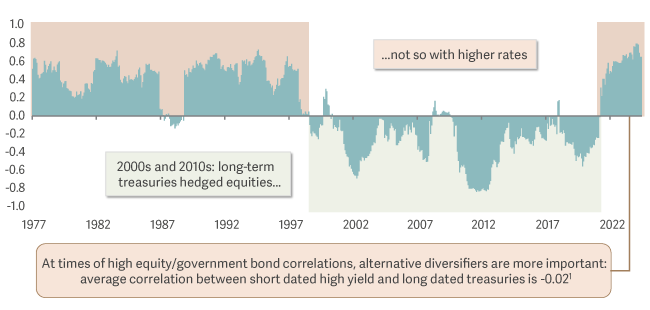
Source: Bloomberg, Artemis as at 24 June 2025. 1S&P 500 and Bloomberg US Long Treasury Total Return index, rolling 24-month correlation, USD. 1Correlation between Bloomberg US High Yield 1-5 Total Return and Bloomberg US Long Treasury Total Return indices. Monthly, September 1988 - May 2025.
Our significant fixed income allocation is to higher-quality shorter-dated high yield, where we can clip high single-digit yields that can compound over time while taking minimal duration/interest rate risk. When the correlation between government bonds and equities rises, it is important to have differentiated sources of diversification and returns, such as short-dated high yield.
In equities, much of the portfolio remains allocated to underheld areas that initially may not look like income stocks (such as financials and defence). However, many of these companies have de-levered and de-risked in recent years, while profitability and dividends have grown substantially (as have share buybacks in the case of banks). Those are the credentials that we seek as income investors so we are happy to hold these areas. Fund performance has benefited significantly as a result.
Conversely, the ‘traditional income’ areas have a) taken on debt and b) struggled to grow dividends. Nestlé – once a darling of income portfolios that at one point traded on almost 30 times earnings – posted its worst monthly share price return for 10 years in June.
Outlook
The speed with which US equities have recovered their sharp Liberation Day losses has broken records. Risk-on sentiment has returned as a result of falling uncertainty, robust macroeconomic data and positive earnings prints from several of the multi-trillion-dollar behemoths that sit atop US indices.
Despite this rally, however, something is clearly afoot across financial markets. As above, the dollar has had its worst first half in more than 50 years, South Korea is the best performing equity market in 2025 thus far and the gold price has risen by more than a quarter.
Long-dated bonds have sold off around the world as the fiscal taps remain jammed on (Germany has abandoned the world’s strictest set of fiscal rules with the release of the ‘debt brake’ to finance a huge programme of fiscal expansion with no appreciable means by which to reduce deficits anywhere).
In our view, uncertainty and volatility are defining characteristics of this new regime, so despite better sentiment around trade relations and economic growth, the outlook remains difficult to predict.
Yet we continue to believe that our differentiated approach is well suited to this new regime. We see plenty of attractive value and income across bonds and equities and believe the fund is well equipped to keep on delivering an attractive income and total return proposition for our investors.
Notes and references
CAPITAL AT RISK. All financial investments involve taking risk and the value of your investment may go down as well as up. This means your investment is not guaranteed and you may not get back as much as you put in. Any income from the investment is also likely to vary and cannot be guaranteed.
This is a marketing communication. Before making any final investment decisions, and to understand the investment risks involved, refer to the fund prospectus (or in the case of investment trusts, Investor Disclosure Document and Articles of Association), available in English, and KIID/KID, available in English and in your local language depending on local country registration, available in the literature library.

Risks specific to Artemis Monthly Distribution Fund
- Market volatility risk The value of the fund and any income from it can fall or rise because of movements in stockmarkets, currencies and interest rates, each of which can move irrationally and be affected unpredictably by diverse factors, including political and economic events.
- Currency risk The fund’s assets may be priced in currencies other than the fund base currency. Changes in currency exchange rates can therefore affect the fund's value.
- Bond liquidity risk The fund holds bonds which could prove difficult to sell. As a result, the fund may have to lower the selling price, sell other investments or forego more appealing investment opportunities.
- Higher-yielding bonds risk The fund may invest in higher-yielding bonds, which may increase the risk to capital. Investing in these types of assets (which are also known as sub-investment grade bonds) can produce a higher yield but also brings an increased risk of default, which would affect the capital value of the fund.
- Credit risk Investments in bonds are affected by interest rates, inflation and credit ratings. It is possible that bond issuers will not pay interest or return the capital. All of these events can reduce the value of bonds held by the fund.
- Charges from capital risk Because one of the key objectives of the fund is to provide income, the fund charges are taken from capital. This may constrain capital growth or erode capital.
- Emerging markets risk Compared to more established economies, investments in emerging markets may be subject to greater volatility due to differences in generally accepted accounting principles, less governed standards or from economic or political instability. Under certain market conditions assets may be difficult to sell.
- Income risk The payment of income and its level is not guaranteed.
The intention of Artemis’ ‘investment insights’ articles is to present objective news, information, data and guidance on finance topics drawn from a diverse collection of sources. Content is not intended to provide tax, legal, insurance or investment advice and should not be construed as an offer to sell, a solicitation of an offer to buy, or a recommendation for any security or investment by Artemis or any third-party. Potential investors should consider the need for independent financial advice. Any research or analysis has been procured by Artemis for its own use and may be acted on in that connection. The contents of articles are based on sources of information believed to be reliable; however, save to the extent required by applicable law or regulations, no guarantee, warranty or representation is given as to its accuracy or completeness. Any forward-looking statements are based on Artemis’ current opinions, expectations and projections. Articles are provided to you only incidentally, and any opinions expressed are subject to change without notice. The source for all data is Artemis, unless stated otherwise. The value of an investment, and any income from it, can fall as well as rise as a result of market and currency fluctuations and you may not get back the amount originally invested.