Artemis Monthly Distribution Fund
Q4 2025 update

Source for all information: Artemis as at 31 December 2025, unless otherwise stated.
Equity returns were robust almost everywhere in 2025, with indices around the world hitting new all-time highs. This strong performance was – of course – not without periods of significant volatility, most notably in the wake of ‘Liberation Day’ and apparent efforts from the Trump administration to reshape global trade favourably to the US. Nevertheless, the retreat from the worst-case tariff scenario, resilient global growth (led by the US, which saw real GDP expand by 4.3% in Q3), rate cuts and persistent excitement around artificial intelligence (AI) helped to sustain a broad rally.
The S&P 500, Nasdaq and Russell 2000 all rose to record highs in 2025. US mega-cap technology companies sold off early on but mounted a remarkable recovery post-Liberation Day, with the Magnificent Seven gaining 69% in local currency terms from the 8 April low to the end of the year, as enthusiasm around AI reached fever pitch and capex commitments accelerated.
Perhaps more interesting, however, was the strength outside the US: the IBEX 35 (Spain) and FTSE MIB (Italy) punched through previous highs from 2007 and a wide range of emerging markets delivered healthy gains. The KOSPI (South Korean index) was 2025’s best performing equity market, posting total local currency returns of 79%.
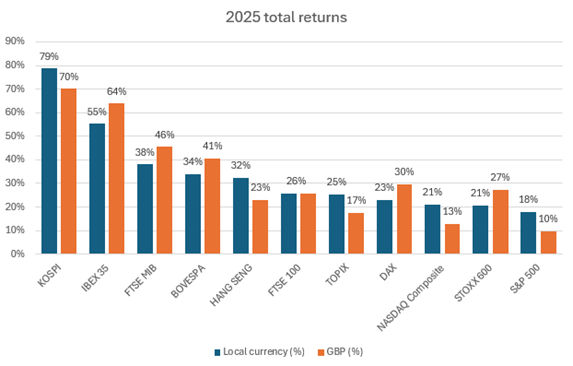
Source: Bloomberg as at 31 December 2025
We have been talking of ‘regime change’ in the global economy for a number of years and in 2025 this theme played out forcefully. Donald Trump’s clear messaging around NATO countries taking more responsibility for their own defence and security resulted in a raft of governmental pledges to increase spending. The health of government balance sheets continued to deteriorate: the US national debt has reached $38.5tn at the time of writing while Germany abandoned the world’s strictest fiscal rules to unlock €800bn to finance a huge programme of spending on infrastructure and military modernisation.
Concerns over government debt manifested in the best year of returns for precious metals since the late 1970s, with gold and silver prices rising by about 65% and 150% respectively versus the dollar. Although Treasury yields were largely flat over 2025, longer-dated bond yields look to have ended a multi-decade era of decline.
Towards the end of the period, analysts pared back rate-cut expectations in many different parts of the world. In Europe, a surprisingly resilient economy means the European Central Bank looks unlikely to reduce its policy rate in 2026, while in the US, strong growth and stubborn producer inflation have given the Federal Reserve cause to tread carefully. A significant stimulus package from the new Japanese prime minister, Sanae Takaichi, has continued to push up long-term yields and poignantly the Japanese 10-year yield rose above 2% in December for the first time since 1997.
Performance
Last year was the fund’s strongest ever for performance, with total returns of 23.1%, compared with 10.2% from the IA Mixed Investment 20-60% Shares sector average. The fund also comfortably outperformed global equities, with the MSCI ACWI returning 13.9%.
| Three months | Six months | One year | Three years | Five years | |
|---|---|---|---|---|---|
| Artemis Monthly Distribution Fund | 4.0% | 12.1% | 23.1% | 52.4% | 64.0% |
| IA Mixed Investment 20-60% Shares | 2.7% | 6.6% | 10.2% | 25.1% | 21.4% |
Past performance is not a guide to the future. Source: Lipper Limited to 31 December 2025 for class I Inc GBP. All figures show total returns with dividends and/or income reinvested, net of all charges. Performance does not take account of any costs incurred when investors buy or sell the fund. Returns may vary as a result of currency fluctuations if the investor’s currency is different to that of the class.
Contributors
Samsung Electronics made the most significant contribution to the fund’s performance during the fourth quarter, followed by Standard Chartered, Siemens Energy, Ping An Insurance Group, Societe Generale, Hyundai Motor and Kinross Gold.
Samsung is benefiting from a strong cycle in memory chips, as an AI-related surge in demand meets a shortage of supply, resulting in pricing power and healthy free cashflow (FCF) generation. Given Samsung’s policy of returning 50% of FCF to shareholders, this should also help to boost cash returns.
Banks have been strong performers for us, with Capital One Financial, Banca MPS and Citigroup also delivering compelling returns in Q4. A step-change in profitability from higher interest rates has enabled banks to distribute substantial amounts of cash to shareholders (in many cases more than 10% of their market capitalisation on an annual basis) through dividends and share buybacks.
Another area of the portfolio that rewarded shareholders in Q4 and throughout 2025 was AI ‘picks and shovels’. Siemens Energy and Mitsubishi Heavy – the two market leaders in gas turbines for power stations – have seen rapid order book growth thanks to the insatiable energy demands of ever-more powerful AI. These companies (unlike many of the best performing stocks in US tech) aren’t reliant on an ‘AI revolution’ unfolding, but have been able to benefit from the committed capex being put in place.
Kinross Gold made the largest contribution of any stock to our performance in 2025. A record gold price drove an acceleration in free cashflow and dividend growth for miners such as Kinross, while low oil prices fuelled margin expansion. The industry has also de-levered significantly in recent years, with the balance sheets of many gold miners moving to net cash.
Detractors
Within our equity portfolio, stocks that detracted from performance in Q4 included Abu Dhabi Commercial Bank, Hanwha Aerospace, BAE Systems, Contemporary Amperex Technology and Rheinmetall. We sold out of the latter during Q4 to take profits. Rheinmetall delivered a 172% total return in 2025 and has re-rated from a price-to-earnings (P/E) ratio of 20x to 40x over the past 12 months, so from a risk-management perspective, it made sense to scale back.
Fixed income
In fixed income, it was our allocation to shorter-dated, high-quality high-yield bonds that continued to generate consistent income for the portfolio during Q4. Spreads may be tight at a headline level but we have found no shortage of mis-priced securities, many of which offer high single-digit yields and are backed by good quality, cash-generative companies. By focusing on shorter-dated bonds we can avoid much of the volatility associated with higher duration, longer-dated securities.
Last year was another challenging one for long-duration fixed income, with rate cuts falling short of expectations and longer-dated yields breaking out. Our positioning towards the short end of the curve (average duration of three years as at the end of 2025) was also helpful to performance, as was our limited exposure to government bonds.
Positioning and market thoughts
The shape of the portfolio has not changed materially over the past 12 months. Defence, gold producers, banks and ‘picks and shovels’ have been significant equity themes in the portfolio for some time, as has a prominent allocation to short-dated high yield in fixed income.
We added Pfizer and Bristol Myers Squibb to the portfolio in November. Prior to Q4, healthcare had been the worst performing sector globally last year, due to too much leverage, tariffs and policy uncertainty in the US. It had been cast aside by long-only managers but single-digit P/E multiples were discounting a lot of bad news, in our view, and we were glad to be able to add some more defensive equity exposure to the portfolio.
We continued to look for income outside the most traditional areas during 2025. A good case study here is Japanese financials, which now account for about 5% of the portfolio. Rising bond yields and inflation in Japan – and the steepening of the yield curve – have transformed the sector’s profitability. A Japanese bank is probably not an investor’s first thought when looking for income, but they are not expensive and have attractive dividend yields that are growing. Take Japanese regional bank Mebuki, for example, which has a 3% yield and has grown dividends at 14% per annum over the past five years.
We remain broadly underweight the most typical income assets. Many of these – taking longer-dated government bonds and consumer staples equities as two pertinent examples – generated good returns in the now bygone era of easy money and low rates, but have significantly underperformed as the world has changed.
Outlook
We think this new regime – of indebted governments, sticky inflation, de-globalisation and a push for self-sufficiency (alongside self-defence) – is here to stay and we believe our portfolio is positioned to benefit from this ongoing paradigm shift in the global economy.
The fund delivered strong returns in 2025 and it is fair to question whether they can continue. It is difficult to say whether markets will go up or down over the short term, especially with an eye to the news flow from the first two weeks of 2026. Yet this volatile and unpredictable environment should lend itself to our small and nimble team and our approach of finding bonds and equities with good value and good income whatever country or sector they might reside in, even if they are outside the most typically held areas.
It is the characteristics of the portfolio that continue to give us comfort. Our equities are on an aggregate P/E of less than 12x with a 4% yield that is more than twice covered by free cashflow. Consensus data suggests that dividend growth could be greater than 9% over the next 12 months.
| Characteristics as at 14/01/26 | Artemis Monthly Distribution Fund (equities are 55% of the portfolio) |
| Median P/E (x) | 11.5x |
| Dividend yield (%) | 4.0% |
| Free cashflow yield (%) | 8.8% |
| Median dividend growth (%) | 9.4% |
The yield of the fixed income portion of the portfolio is about 5.5% with a duration of three years and, in turn, limited interest rate risk. This brings the aggregate yield of the portfolio to 4.7%. If we can grow this yield at mid-single digits – which we have managed to do historically and believe we are well equipped to continue doing going forward – then the set-up for good income and total returns remains compelling.
CAPITAL AT RISK. All financial investments involve taking risk and the value of your investment may go down as well as up. This means your investment is not guaranteed and you may not get back as much as you put in. Any income from the investment is also likely to vary and cannot be guaranteed.
This is a marketing communication. Before making any final investment decisions, and to understand the investment risks involved, refer to the fund prospectus (or in the case of investment trusts, Investor Disclosure Document and Articles of Association), available in English, and KIID/KID, available in English and in your local language depending on local country registration, available in the literature library.

Risks specific to Artemis Monthly Distribution Fund
- Market volatility risk The value of the fund and any income from it can fall or rise because of movements in stockmarkets, currencies and interest rates, each of which can move irrationally and be affected unpredictably by diverse factors, including political and economic events.
- Currency risk The fund’s assets may be priced in currencies other than the fund base currency. Changes in currency exchange rates can therefore affect the fund's value.
- Bond liquidity risk The fund holds bonds which could prove difficult to sell. As a result, the fund may have to lower the selling price, sell other investments or forego more appealing investment opportunities.
- Higher-yielding bonds risk The fund may invest in higher-yielding bonds, which may increase the risk to capital. Investing in these types of assets (which are also known as sub-investment grade bonds) can produce a higher yield but also brings an increased risk of default, which would affect the capital value of the fund.
- Credit risk Investments in bonds are affected by interest rates, inflation and credit ratings. It is possible that bond issuers will not pay interest or return the capital. All of these events can reduce the value of bonds held by the fund.
- Charges from capital risk Because one of the key objectives of the fund is to provide income, the fund charges are taken from capital. This may constrain capital growth or erode capital.
- Emerging markets risk Compared to more established economies, investments in emerging markets may be subject to greater volatility due to differences in generally accepted accounting principles, less governed standards or from economic or political instability. Under certain market conditions assets may be difficult to sell.
- Income risk The payment of income and its level is not guaranteed.
The intention of Artemis’ ‘investment insights’ articles is to present objective news, information, data and guidance on finance topics drawn from a diverse collection of sources. Content is not intended to provide tax, legal, insurance or investment advice and should not be construed as an offer to sell, a solicitation of an offer to buy, or a recommendation for any security or investment by Artemis or any third-party. Potential investors should consider the need for independent financial advice. Any research or analysis has been procured by Artemis for its own use and may be acted on in that connection. The contents of articles are based on sources of information believed to be reliable; however, save to the extent required by applicable law or regulations, no guarantee, warranty or representation is given as to its accuracy or completeness. Any forward-looking statements are based on Artemis’ current opinions, expectations and projections. Articles are provided to you only incidentally, and any opinions expressed are subject to change without notice. The source for all data is Artemis, unless stated otherwise. The value of an investment, and any income from it, can fall as well as rise as a result of market and currency fluctuations and you may not get back the amount originally invested.