
Artemis Strategic Bond Fund
Q3 2026 update




Source for all information: Artemis as at 30 September 2026, unless otherwise stated.
Market review
Interest rate expectations repriced significantly during the third quarter and government bond yields marched higher across most major markets. Oil, gas and refined-product prices remained elevated, inflation proved sticky and economic activity was robust. Add in enormous AI-related investment, defence spending and still-resilient domestic demand and the market was forced to accept that central banks may have to do more, not less.
To that end, several G10 central banks raised rates during the period and those that did not generally became more hawkish. The direction of travel was clear – less discussion about the lack of meaningful second-round effects and much more concern about inflation and stronger growth.
Longer-dated bonds had another problem as markets began to zone in on what higher rates would do to interest costs. Fiscal discipline remains an exception rather than the rule across developed market governments. The reality is that government debt levels are too high and supernormal growth is required to sustain rising debt service costs. Some countries are growing fast enough to outrun interest costs in the near term, but this is not the case for France. Markets are quickly realising that 2027 could pose significant risks for the eurozone’s second largest economy.
Performance
The fund returned -2.1% during the quarter, in line with the IA £ Strategic Bond sector. It remains ahead of its peer group over one, three, five and 10 years.
| Three months | Six months | One year | Three years | Five years | |
|---|---|---|---|---|---|
| Artemis Strategic Bond Fund | -2.1% | 1.3% | 1.6% | 22.8% | 9.6% |
| IA £ Strategic Bond Sector | -2.1% | 0.5% | 1.3% | 19.3% | 5.7% |
Past performance is not a guide to the future. Source: Lipper Limited, class I quarterly accumulation units in GBP to 30 September 2026. Sector is IA £ Strategic Bond NR. All figures show total returns with dividends and/or income reinvested, net of all charges. Performance does not take account of any costs incurred when investors buy or sell the fund. This class may have charges or a hedging approach different from those in the IA sector benchmark.
It has been a difficult period for duration. Markets have had to deal with tariffs, conflict in the Middle East and energy price spikes. The resulting inflation threat has dominated price action. On top of that, renewed fears about French debt sustainability have affected sentiment towards bonds across the eurozone. Government bonds have continually felt like they’re on the back foot.
On the other hand, at higher yields, bonds provide a strong level of income that can guard against volatility and rate moves in a way they could not prior to the pandemic. In the short term, an aggressive move higher in rates hurts duration/bonds, but over the longer term, higher yields enable investors to recapture upside quicker. To put this into context: on 30 September 2023 the 10-year gilt yield was 4.4%, compared with 5.4% three years later. Over that time, the Artemis Strategic Bond Fund returned 22.8% versus a sector average of 19.3%.
Our strategy remains unchanged; we do not look to take outsized directional bets on duration or sector allocation. We believe that higher yields (and increased dispersion and volatility) offer attractive opportunities to deliver value in bonds over the long term.
Rates activity
As yields repriced higher in September, we gradually increased duration to 5.65 years. (This was a change in direction from the second quarter of 2026, during which we reduced duration from about 6.0 to 4.6 years because we thought policy rates would move higher globally.)
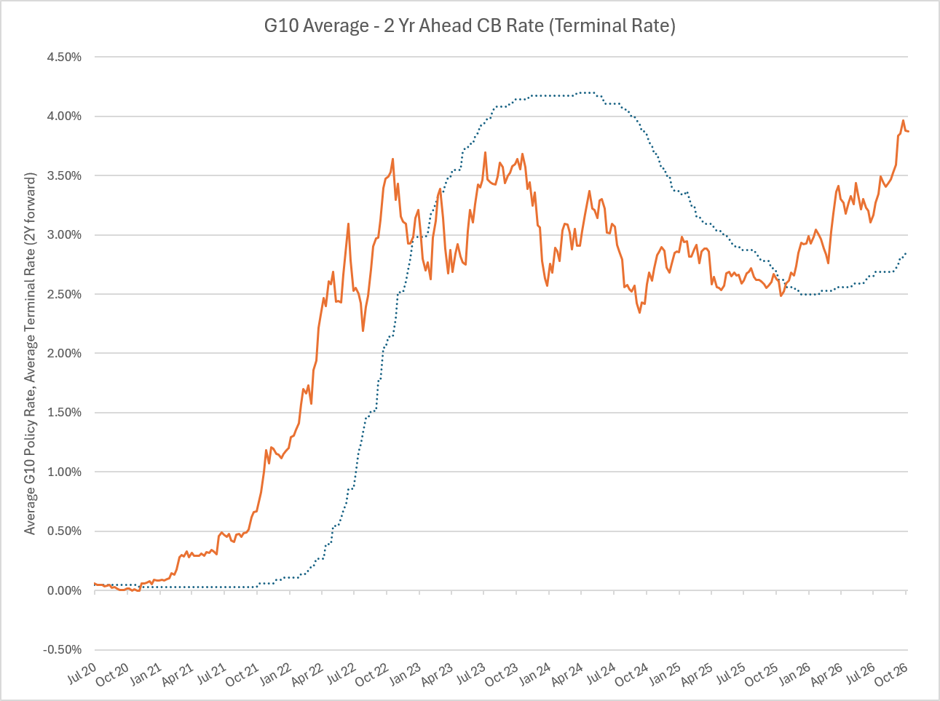
We maintain that this isn’t the right environment to take a big swing on long-dated duration. Yet the market is pricing in a significant adjustment to policy rates (as the chart below illustrates) that we do not believe will materialise. The blue line shows the actual rate, whereas the orange line represents the terminal rate, approximated by two-year forward market pricing.
Source: Bloomberg
In terms of other activity, we added to UK front-end rates and, at different points, US real yields and shorter-dated US and German government bonds. We remained cautious on France, where fiscal and political concerns pushed yields sharply higher, and by September we were also short Italy relative to Germany.
Credit activity
In the investment-grade space, the fund bought new issues from Babcock, The AA, Commonwealth Bank of Australia, Traton, Bupa, Hiscox, UBS and – despite our cautious stance on the tech sector – Amazon.
Tech bonds have a high hurdle to entry in the fund as we do not believe fixed income is the best place to play the AI theme (at least within equities you have significant upside as well as downside). But the fund did buy three-year Amazon sterling bonds in September, given the company’s strong cash flows, the bond’s near-term maturity and a general scarcity of supply in that part of the curve. There are very few three-year investment-grade bonds minted; most short-dated bonds are just older bonds than have seasoned over time.
Away from new issues, investment-grade activity was mostly about relative value. We continued to trim bonds that had become expensive and add where sectors or individual names had underperformed for reasons we thought were temporary.
High yield was similar. We stayed active, but this is not a market where we want to own risk just because the yield looks high. By September, the weakest part of the market was already beginning to feel the effect of higher borrowing costs. CCC-rated bonds materially underperformed BB and B-rated credits. That feels rational to us. Higher rates are manageable for businesses with decent cash flow and sensible leverage; they are much more painful for companies that need cheap refinancing to simply keep the capital structure working. We therefore continue to prefer stronger businesses and shorter-dated opportunities rather than chasing the highest headline yield.
Outlook
The big question is what will happen when this higher-rate environment starts to bite properly. We have already seen the weakest corporate credits falter but the more important story may concern weaker governments.
France is ground zero. By early October, French 10-year borrowing costs had risen to around 4.9%. The spread over Germany had widened sharply as investors questioned whether the French government could stabilise public finances. France’s draft budget for 2027 contains around €43bn of tax increases and spending restraint, aimed at bringing the deficit down towards 5% of GDP. The problem is that France has been here before… governments announce consolidation, parliament waters it down or rejects it, and the market becomes a little less willing to give them the benefit of the doubt.
Why does this matter for everyone else? Because bond markets can impose discipline long before politicians want it. Higher yields mean higher debt-service costs and less money for everything else. Governments then face an unpleasant choice between higher taxes, lower spending or even more borrowing at increasingly expensive rates. In other words, the market itself can create fiscal tightening. We think this is under-appreciated.
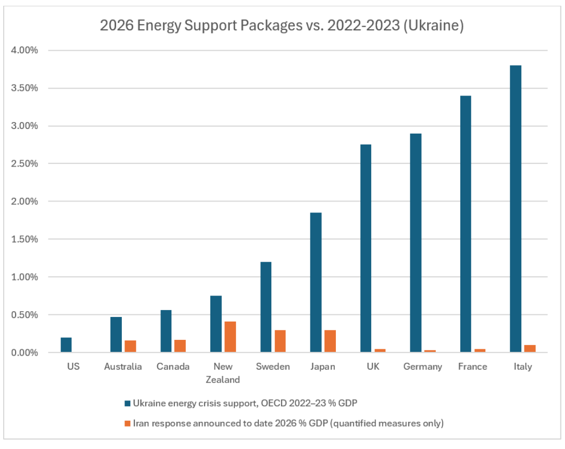
During the last energy price shock in 2022-23, after Russia invaded Ukraine, governments responded with enormous support packages because they had the fiscal headroom – or at least the market tolerance – to do so.
This time is different. In the chart below, the blue bars show the scale of support during the previous energy crisis, while the orange bars illustrate what has been announced this time, so far. They are not remotely comparable. Without governments cushioning the blow, the hit to households becomes more direct, squeezing real incomes and curtailing consumer spending.
Source: OECD, IMF, official government data as at 8 October 2026
This is the main reason we do not believe the policy-rate path currently priced by markets will be fully delivered, particularly in the UK and the eurozone. The market is effectively assuming that central banks can keep hiking while households absorb another energy shock, labour markets soften, financing costs rise and governments simultaneously become less able to provide support.
The European Central Bank also needs to think about what another 75 to 100bps of tightening would do to France, Italy and the wider sovereign complex. If French yields continue to rise and spreads widen, at some point monetary policy and financial stability would start to pull in opposite directions.
In the UK, the problem is slightly different but the conclusion may be similar. Labour-market momentum has weakened and households have far less fiscal protection from higher energy prices than they did in 2022-23.
There is one enormous offset: the AI capex super-cycle. It is one of the main reasons growth has remained so resilient, despite higher energy prices and tighter monetary policy. But it is important not to confuse extraordinary levels of capital expenditure with strength everywhere. The hyperscalers, semiconductor companies, utilities and infrastructure providers directly connected to the AI build-out are seeing huge investment. Plenty of households, smaller companies and heavily leveraged borrowers are seeing something completely different – namely higher energy bills, higher refinancing costs and less disposable income. Not everyone is participating in this boom.
Positioning
None of the above means that we suddenly want to own a glut of 10-year government bonds. Long-end supply is still huge, fiscal credibility remains a problem and inflation can stay uncomfortable for longer than anyone would like. For now, we still prefer the zero-to-five-year part of government bond curves, where we think yields are attractive.
In credit, we want to lend to companies that can live with higher rates, not those that need rates to fall. The recent sell-off has improved the opportunity set quite materially, but it has also increased the importance of being selective. Higher yields are creating opportunities; they are also beginning to expose who was only resilient when money was cheap.
FOR PROFESSIONAL INVESTORS AND/OR QUALIFIED INVESTORS AND/OR FINANCIAL INTERMEDIARIES ONLY. NOT FOR USE WITH OR BY PRIVATE INVESTORS.
CAPITAL AT RISK. All financial investments involve taking risk and the value of your investment may go down as well as up. This means your investment is not guaranteed and you may not get back as much as you put in. Any income from the investment is also likely to vary and cannot be guaranteed.
This is a marketing communication. Before making any final investment decisions, and to understand the investment risks involved, refer to the fund prospectus (or in the case of investment trusts, Investor Disclosure Document and Articles of Association), available in English, and KIID/KID, available in English and in your local language depending on local country registration, available in the literature library.

Risks specific to Artemis Strategic Bond Fund
- Market volatility risk The value of the fund and any income from it can fall or rise because of movements in stockmarkets, currencies and interest rates, each of which can move irrationally and be affected unpredictably by diverse factors, including political and economic events.
- Currency risk The fund’s assets may be priced in currencies other than the fund base currency. Changes in currency exchange rates can therefore affect the fund's value.
- Bond liquidity risk The fund holds bonds which could prove difficult to sell. As a result, the fund may have to lower the selling price, sell other investments or forego more appealing investment opportunities.
- Higher-yielding bonds risk The fund may invest in higher-yielding bonds, which may increase the risk to capital. Investing in these types of assets (which are also known as sub-investment grade bonds) can produce a higher yield but also brings an increased risk of default, which would affect the capital value of the fund.
- Credit risk Investments in bonds are affected by interest rates, inflation and credit ratings. It is possible that bond issuers will not pay interest or return the capital. All of these events can reduce the value of bonds held by the fund.
- Derivatives risk The fund may invest extensively in derivatives with the aim of profiting from falling (‘shorting’) as well as rising prices. Should the asset’s value vary in an unexpected way, the fund value could reduce. Refer to the investment policy in fund's prospectus for further details on how derivatives may be used.
- Leverage risk The fund may operate with a significant amount of leverage. Leverage occurs when the economic exposure created by the use of derivatives is greater than the amount invested. A leveraged portfolio may result in large fluctuations in its value and therefore entails a high degree of risk including the risk that losses may be substantial.
- Emerging markets risk Compared to more established economies, investments in emerging markets may be subject to greater volatility due to differences in generally accepted accounting principles, less governed standards or from economic or political instability. Under certain market conditions assets may be difficult to sell.
- Income risk The payment of income and its level is not guaranteed.
- Counterparty risk Investments such as derivatives are made using financial contracts with third parties. Those third parties may fail to meet their obligations to the fund due to events beyond the fund's control. The fund's value could fall because of loss of monies owed by the counterparty and/or the cost of replacement financial contracts.
Important information
The intention of Artemis’ ‘investment insights’ articles is to present objective news, information, data and guidance on finance topics drawn from a diverse collection of sources. Content is not intended to provide tax, legal, insurance or investment advice and should not be construed as an offer to sell, a solicitation of an offer to buy, or a recommendation for any security or investment by Artemis or any third-party. Potential investors should consider the need for independent financial advice. Any research or analysis has been procured by Artemis for its own use and may be acted on in that connection. The contents of articles are based on sources of information believed to be reliable; however, save to the extent required by applicable law or regulations, no guarantee, warranty or representation is given as to its accuracy or completeness. Any forward-looking statements are based on Artemis’ current opinions, expectations and projections. Articles are provided to you only incidentally, and any opinions expressed are subject to change without notice. The source for all data is Artemis, unless stated otherwise. The value of an investment, and any income from it, can fall as well as rise as a result of market and currency fluctuations and you may not get back the amount originally invested.