There's more to 'value' investing than valuations



Key takeaways
So, when we made the long-established, UK-based Artemis Global Income Fund strategy available to investors in Europe, we gave it a name that conformed to the local nomenclature. By describing it as a 'global value' strategy, we hoped to make it more readily understandable to investors unfamiliar with the global equity income funds popular in the UK.
In many ways, using the word 'value' made sense. Our focus on delivering income to our clients by passing on dividends means we buy companies that are generating a lot of free cashflow relative to their enterprise value. This has always pointed us towards 'value' stocks.
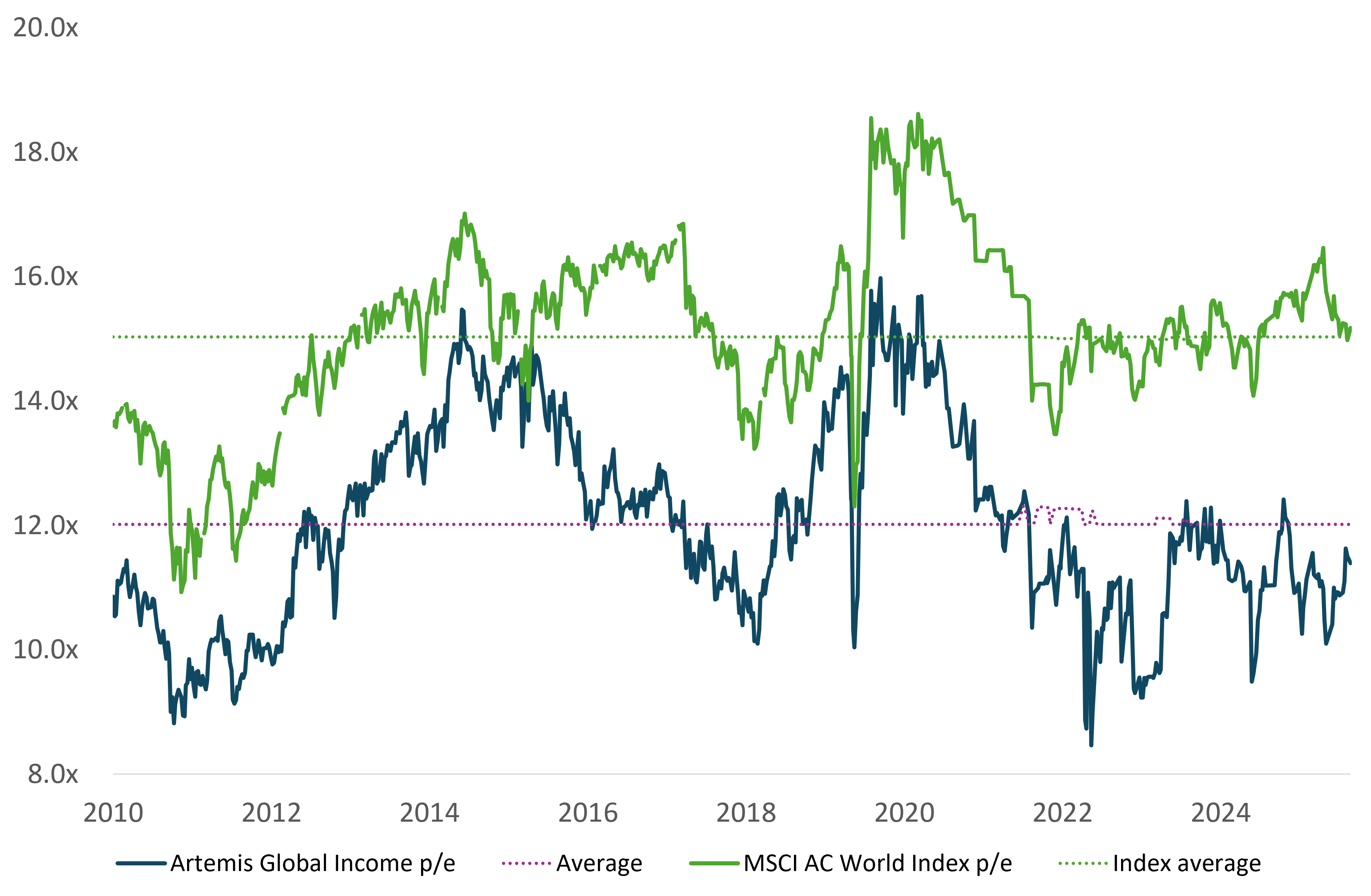
Our portfolio has always traded on a significant discount to the MSCI AC World Index
Source: Artemis as at 3 July 2026
Compared with the MSCI AC World index, the Artemis Global Income Fund is significantly cheaper: it trades on a forward price-to-earnings (p/e) of 14.0x versus 23.0x for the benchmark. Its holdings produce a dividend yield of 3.6%, more than double the 1.7% dividend yield on the index.1
Focus on these two blunt measures and our strategy has something in common with 'value' funds, when viewed from a distance. In aggregate, our portfolio has always traded at a significant discount to the market in price-to-earnings terms. But because our primary focus is not on p/e multiples but on identifying stocks where there is a solid investment thesis, not every company we invest in is cheaper than the market. Ours is a value strategy – but not as you may know it. Its aggregate p/e multiple is not a goal in itself. Instead, it is a by-product of how we construct the portfolio and how we generate returns.
Performance vs MSCI AC World, MSCI ACWI Value and MSCI ACWI High Dividend Yield indices since launch
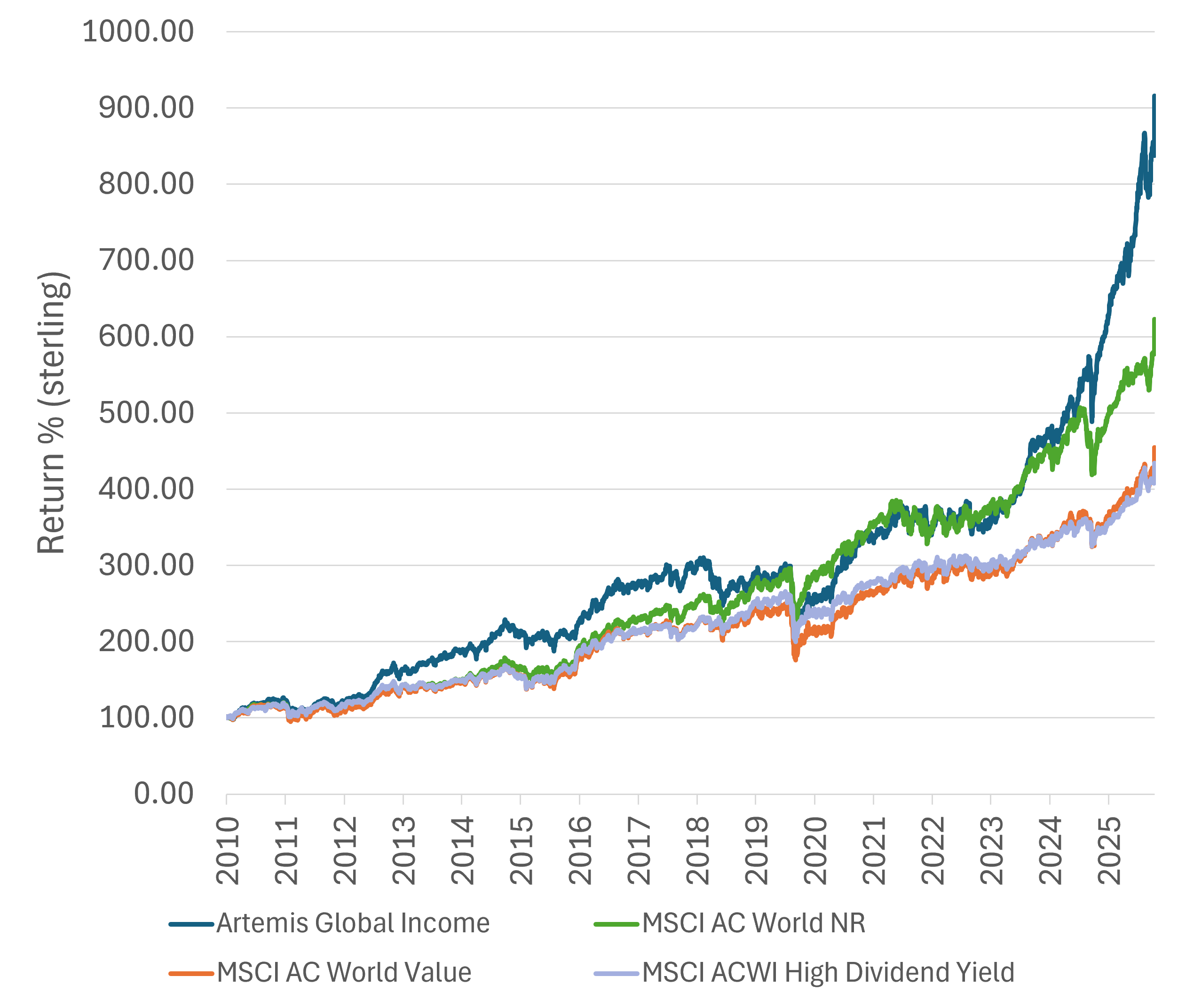
Source: Lipper Limited, class I distribution units in USD from 19 July 2010 to 30 June 2026. All figures show total returns with dividends and/or income reinvested, net of all charges. MSCI ACWI Value and MSCI ACWI High Dividend Yield are not the strategy benchmarks but are shown to provide additional information only.
The problem with relying on p/e
Low p/e multiples don’t always coincide with our conception of 'value'. Popularised by Benjamin Graham in the 1930s, p/e ratios are appealing in their simplicity and familiarity. They are easy to explain and easy to find – just look in the back of your newspaper. Yet while p/e multiples are a useful rule of thumb, they are flawed for at least two reasons.
1) They don’t adjust for leverage. Where debt is a consideration, investors are better served by looking at metrics such as EV/ebitda, which compares the value of a company’s equity (its market capitalisation) and its debt (including its bonds) relative to its cash earnings.
2) They fail to capture earnings growth. A p/e of 20x tells us something quite different about a company whose order book is full for the next decade than it does about an energy company whose earnings will fluctuate in sympathy with the price of crude oil. To understand value in the context of growth, investors are better served by the price/earnings to growth (PEG) ratio.
We are valuation pragmatists, not value purists
Ignoring valuation is the cardinal sin of investing: buying expensive and selling cheap has never been a good policy. Likewise, buying something simply because it is cheap is another road to poor returns.
Consider a consumer-goods company – perhaps a leading soup manufacturer – trading on a p/e of 7x and offering a dividend yield of 7%. Look solely at its p/e and it may appear to be a value stock. One could easily argue that it is cheap enough to buy even if its revenues are growing at a below-inflation rate. But would you buy it? Consider that:
- The price of aluminium needed to make cans has increased by 49% in the past 12 months.2
- Sales of snack foods are stagnating and consumers are showing less loyalty to brands than they once did.3
- Supermarkets' own-brand products offer similar quality to branded goods, tend to be cheaper and continue to take market share.4
If you mechanically buy the cheapest 10% or even 20% of the market on a p/e basis, you'll own stakes in businesses similar to this. These are companies that trade on low multiples for good reason – companies that aren’t growing, that are carrying too much leverage or delivering poor returns on capital. Sound appealing? Not to us. We want to avoid these 'melting ice cubes' – companies whose slow disintegration means they end up justifying their low multiples.
There's more to being a value investor than simply buying cheap stocks
So, although we like 'value', that is not our starting point. We don't apply hard p/e cutoffs to the stocks we buy and sell, and valuation is only one of the facets that our investment process considers.
We want to invest in companies where there is a solid investment thesis, that are aligned with our strategic and macro roadmap (including our regime-change thesis) and that generate above-average free cashflow yields. We also take care to build a portfolio that is diversified by geography, currency and by theme. The result is a strategy that has little in common with value indices and with most value funds.
| Country | p/e (*) | Held in our strategy? | |
| Microsoft | US | 25x | No |
| Micron Technology | US | 22x | No |
| Meta Platforms | US | 17x | No |
| JP Morgan Chase | US | 16x | No |
| Berkshire Hathaway | US | 23x | No |
| Samsung Electronics | South Korea | 25x | Yes |
| TSMC | Taiwan | 33x | No |
| Intel | US | 479x | No |
| Johnson & Johnson | US | 29x | No |
| Exxon Mobil | US | 24x | No |
Source: Artemis, MSCI as at 30 June 2026 and (*) Bloomberg as at 3 July 2026.
We acknowledge that, most of the time, markets are not at a turning point; they are following a trend. But we are conscious that valuation can provide a safety net when markets suddenly turn. At a time of extreme and growing concentration in equity markets, and with long-term valuation multiples in the US close to the highs last seen in the dotcom bubble, we're happy to be described as ‘value investors’. But definitions matter. In our view, there's more to being a 'value investor' than simply buying cheap stocks – and there's more to 'value' than valuations alone.
Notes and references
2 Source: International Monetary Fund, Global price of Aluminium (PALUMUSDM) to 1 May 2026, retrieved from FRED, Federal Reserve Bank of St. Louis
3 Financial Times 21 February 2026 "Packaged food producers turn to price cuts as US sales stagnate"
4 Financial Times 16 November 2025 "Aldi effect sweeps US supermarkets as shoppers embrace private label"
CAPITAL AT RISK. All financial investments involve taking risk and the value of your investment may go down as well as up. This means your investment is not guaranteed and you may not get back as much as you put in. Any income from the investment is also likely to vary and cannot be guaranteed.
This is a marketing communication. Before making any final investment decisions, and to understand the investment risks involved, refer to the fund prospectus (or in the case of investment trusts, Investor Disclosure Document and Articles of Association), available in English, and KIID/KID, available in English and in your local language depending on local country registration, available in the literature library.
Risks specific to Artemis Global Income Fund
- Market volatility risk The value of the fund and any income from it can fall or rise because of movements in stockmarkets, currencies and interest rates, each of which can move irrationally and be affected unpredictably by diverse factors, including political and economic events.
- Currency risk The fund’s assets may be priced in currencies other than the fund base currency. Changes in currency exchange rates can therefore affect the fund's value.
- Charges from capital risk Where charges are taken wholly or partly out of a fund's capital, distributable income may be increased at the expense of capital, which may constrain or erode capital growth.
- Emerging markets risk Compared to more established economies, investments in emerging markets may be subject to greater volatility due to differences in generally accepted accounting principles, less governed standards or from economic or political instability. Under certain market conditions assets may be difficult to sell.
- Income risk The payment of income and its level is not guaranteed.
The intention of Artemis’ ‘investment insights’ articles is to present objective news, information, data and guidance on finance topics drawn from a diverse collection of sources. Content is not intended to provide tax, legal, insurance or investment advice and should not be construed as an offer to sell, a solicitation of an offer to buy, or a recommendation for any security or investment by Artemis or any third-party. Potential investors should consider the need for independent financial advice. Any research or analysis has been procured by Artemis for its own use and may be acted on in that connection. The contents of articles are based on sources of information believed to be reliable; however, save to the extent required by applicable law or regulations, no guarantee, warranty or representation is given as to its accuracy or completeness. Any forward-looking statements are based on Artemis’ current opinions, expectations and projections. Articles are provided to you only incidentally, and any opinions expressed are subject to change without notice. The source for all data is Artemis, unless stated otherwise. The value of an investment, and any income from it, can fall as well as rise as a result of market and currency fluctuations and you may not get back the amount originally invested.