
High Yield Happenings: From ‘junk’ to ‘high yield’



Key takeaways
Naturally, it was buried in a slightly obscure corner of the FT’s website. Positive articles about high-yield bonds do not earn the same billing as those that warn of imminent disaster. But it is well worth the scroll. It makes several important points about how the high-yield market has changed:
- Credit quality is materially higher
- Its sensitivity to moves in government bond yield curves is lower
- A greater proportion of the market is secured
- Direct exposure to the two areas attracted the most concern, software and AI-related financing, is limited.
These are all important points. But chief among them is the improvement in credit quality. BB-rated bonds now represent 64% of the global high-yield market, up from around a third in the late 1990s1.
As the weighting towards higher-quality issuers has increased, so the market’s implied default rate, calculated by applying historic default rates to each rating category, has fallen.
Increasing quality reduces chance of large default cycle in HY
Highest quality part of the market – BBs – have significantly increased their share of the market:
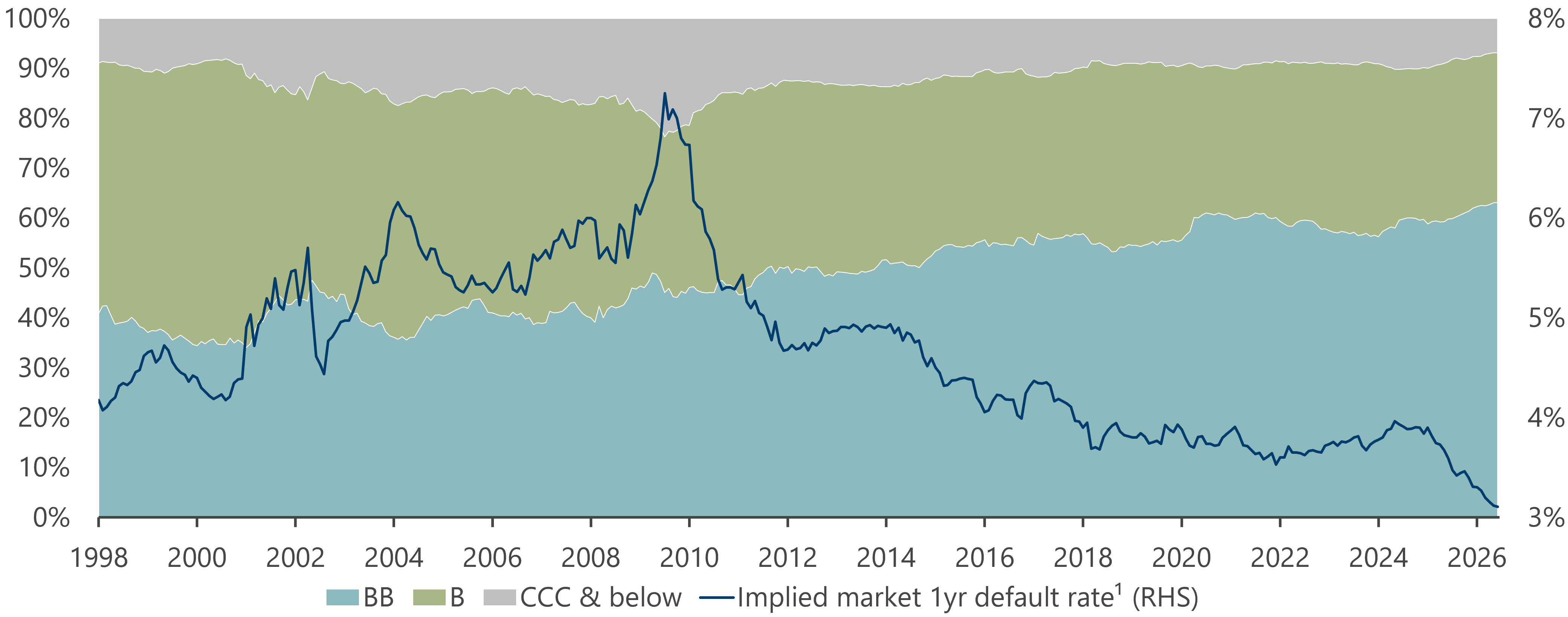
Source: ICE BofA Merrill Lynch Global High Yield Constrained Index as at 30 June 2026. The implied market one-year default rate is based on the median default rate for the period from 1981 to 2021 on data provided by S&P Global2.
A higher-quality market should, of course, experience fewer defaults. The more interesting question is whether investors are being adequately compensated for taking on what risk remains.
According to data from S&P Global going back to 1981, the average annual default rate on BB-rated bonds has been just 0.6%2. Assuming a 40% recovery rate, which is broadly in line with the historic average, that equates to an average annual credit loss of 0.36%, or 36 basis points. The current spread on global BB-rated bonds, meanwhile, is approximately 185 basis points3.
In other words, even with spreads towards the tight end of their historic range, investors are currently receiving extra yield equivalent to more than five times the long-run average annual credit loss.
Spreads in high yield are equivalent to more than five times the average annual credit loss
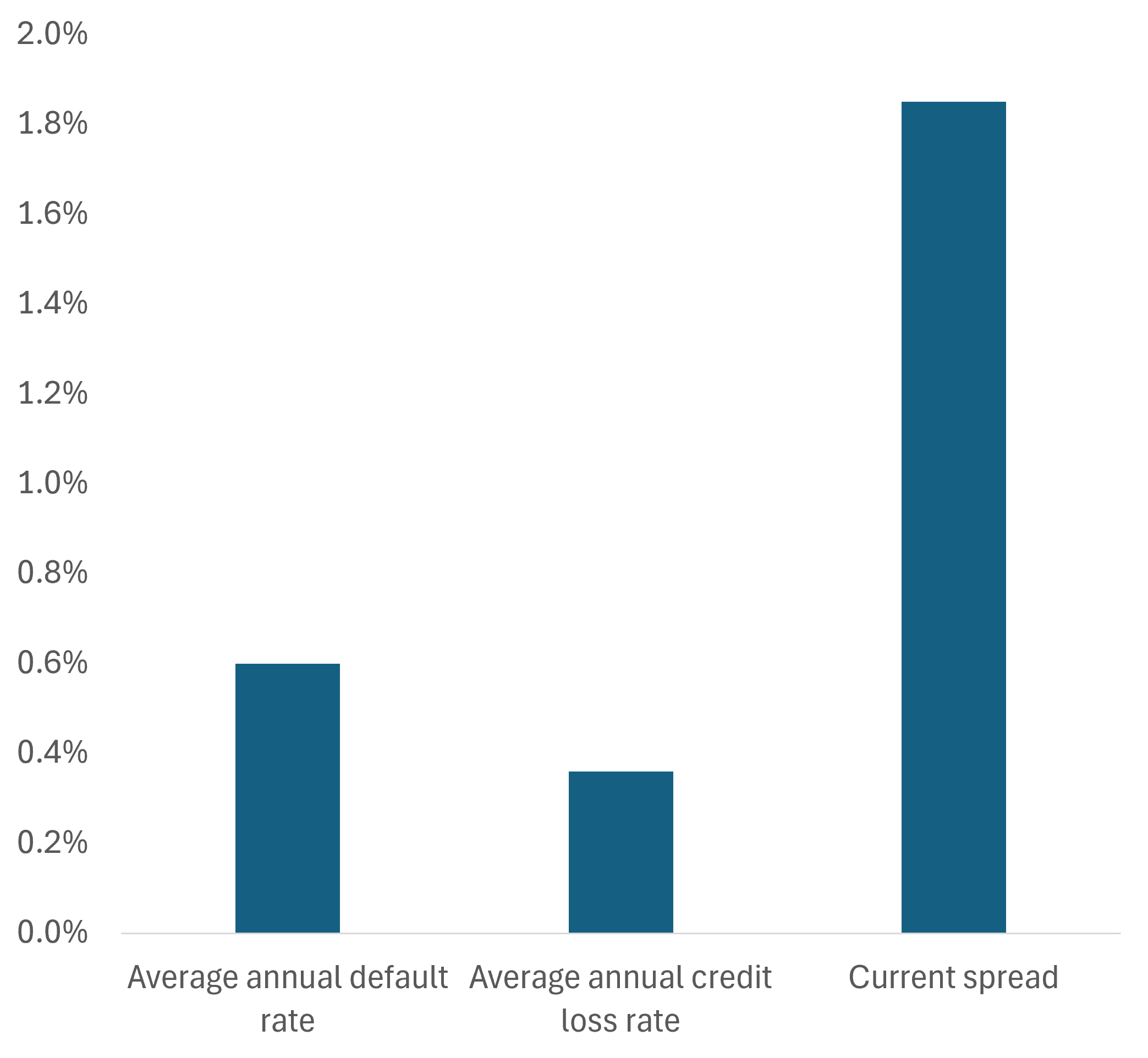
Source: Artemis, S&P Global ratings (default rate) and ICE BofA Merrill Lynch Global High Yield Constrained Index (credit spread). Credit loss rate estimated using the historic average 40% recovery rate on defaults.
That does not mean the difference between spreads and credit losses is ‘free’ money. Credit spreads also compensate investors for uncertainty, market volatility, lower liquidity, and the fact that defaults tend to arrive in clusters rather than in a slow, steady stream of 0.6% per year. And, of course, bonds that are BB-rated today can slip to become B-rated tomorrow.
This is, however, a useful reality check on the idea that tight spreads automatically mean investors are receiving too little compensation for taking credit risk. This compensation, moreover, is being earned in a market that is higher quality, less sensitive to moves in government bond yields and has limited direct exposure to the areas (such as AI) currently generating anxiety-inducing headlines.
Perhaps the FT is right, and high yield is entering its second act. Or perhaps ‘high yield’ has simply become a more accurate description than ‘junk’.
Read more about recent happenings in high-yield: Why we steer clear of bonds directly tied to AI
Notes and references
2. S&P Global Ratings, Default, Transition, and Recovery: 2024 Annual Global Corporate Default and Rating Transition Study, 27 March 2025
3. ICE BofA indices as at 3 August 2026
CAPITAL AT RISK. All financial investments involve taking risk and the value of your investment may go down as well as up. This means your investment is not guaranteed and you may not get back as much as you put in. Any income from the investment is also likely to vary and cannot be guaranteed.
This is a marketing communication. Before making any final investment decisions, and to understand the investment risks involved, refer to the fund prospectus (or in the case of investment trusts, Investor Disclosure Document and Articles of Association), available in English, and KIID/KID, available in English and in your local language depending on local country registration, available in the literature library.
Risks specific to Artemis Funds (Lux) – Short-Dated Global High Yield Bond
- Market volatility risk The value of the fund and any income from it can fall or rise because of movements in stockmarkets, currencies and interest rates, each of which can move irrationally and be affected unpredictably by diverse factors, including political and economic events.
- Currency hedging risk The fund hedges with the aim of protecting against unwanted changes in foreign exchange rates. The fund is still subject to market risks, may not be completely protected from all currency fluctuations and may not be fully hedged at all times. The transaction costs of hedging may also negatively impact the fund’s returns.
- Bond liquidity risk The fund holds bonds which could prove difficult to sell. As a result, the fund may have to lower the selling price, sell other investments or forego more appealing investment opportunities.
- Higher-yielding bonds risk The fund may invest in higher-yielding bonds, which may increase the risk to capital. Investing in these types of assets (which are also known as sub-investment grade bonds) can produce a higher yield but also brings an increased risk of default, which would affect the capital value of the fund.
- Credit risk Investments in bonds are affected by interest rates, inflation and credit ratings. It is possible that bond issuers will not pay interest or return the capital. All of these events can reduce the value of bonds held by the fund.
- Derivatives risk The fund may invest in derivatives with the aim of profiting from falling (‘shorting’) as well as rising prices. Should the asset’s value vary in an unexpected way, the fund value could reduce.
- Charges from capital risk Where charges are taken wholly or partly out of a fund's capital, distributable income may be increased at the expense of capital, which may constrain or erode capital growth.
- Emerging markets risk Compared to more established economies, investments in emerging markets may be subject to greater volatility due to differences in generally accepted accounting principles, less governed standards or from economic or political instability. Under certain market conditions assets may be difficult to sell.
- Income risk The payment of income and its level is not guaranteed.
- ESG risk The fund may select, sell or exclude investments based on ESG criteria; this may lead to the fund underperforming the broader market or other funds that do not apply ESG criteria. If sold based on ESG criteria rather than solely on financial considerations, the price obtained might be lower than that which could have been obtained had the sale not been required.
Risks specific to Artemis Funds (Lux) – Global High Yield Opportunities
- Market volatility risk The value of the fund and any income from it can fall or rise because of movements in stockmarkets, currencies and interest rates, each of which can move irrationally and be affected unpredictably by diverse factors, including political and economic events.
- Currency hedging risk The fund hedges with the aim of protecting against unwanted changes in foreign exchange rates. The fund is still subject to market risks, may not be completely protected from all currency fluctuations and may not be fully hedged at all times. The transaction costs of hedging may also negatively impact the fund’s returns.
- Bond liquidity risk The fund holds bonds which could prove difficult to sell. As a result, the fund may have to lower the selling price, sell other investments or forego more appealing investment opportunities.
- Higher-yielding bonds risk The fund may invest in higher-yielding bonds, which may increase the risk to capital. Investing in these types of assets (which are also known as sub-investment grade bonds) can produce a higher yield but also brings an increased risk of default, which would affect the capital value of the fund.
- Credit risk Investments in bonds are affected by interest rates, inflation and credit ratings. It is possible that bond issuers will not pay interest or return the capital. All of these events can reduce the value of bonds held by the fund.
- Derivatives risk The fund may invest in derivatives with the aim of profiting from falling (‘shorting’) as well as rising prices. Should the asset’s value vary in an unexpected way, the fund value could reduce.
- Leverage risk The fund may operate with a significant amount of leverage. Leverage occurs when the economic exposure created by the use of derivatives is greater than the amount invested. A leveraged portfolio may result in large fluctuations in its value and therefore entails a high degree of risk including the risk that losses may be substantial.
- Charges from capital risk Where charges are taken wholly or partly out of a fund's capital, distributable income may be increased at the expense of capital, which may constrain or erode capital growth.
- Emerging markets risk Compared to more established economies, investments in emerging markets may be subject to greater volatility due to differences in generally accepted accounting principles, less governed standards or from economic or political instability. Under certain market conditions assets may be difficult to sell.
- Income risk The payment of income and its level is not guaranteed.
- Counterparty risk Investments such as derivatives are made using financial contracts with third parties. Those third parties may fail to meet their obligations to the fund due to events beyond the fund's control. The fund's value could fall because of loss of monies owed by the counterparty and/or the cost of replacement financial contracts.
- ESG risk The fund may select, sell or exclude investments based on ESG criteria; this may lead to the fund underperforming the broader market or other funds that do not apply ESG criteria. If sold based on ESG criteria rather than solely on financial considerations, the price obtained might be lower than that which could have been obtained had the sale not been required.
The intention of Artemis’ ‘investment insights’ articles is to present objective news, information, data and guidance on finance topics drawn from a diverse collection of sources. Content is not intended to provide tax, legal, insurance or investment advice and should not be construed as an offer to sell, a solicitation of an offer to buy, or a recommendation for any security or investment by Artemis or any third-party. Potential investors should consider the need for independent financial advice. Any research or analysis has been procured by Artemis for its own use and may be acted on in that connection. The contents of articles are based on sources of information believed to be reliable; however, save to the extent required by applicable law or regulations, no guarantee, warranty or representation is given as to its accuracy or completeness. Any forward-looking statements are based on Artemis’ current opinions, expectations and projections. Articles are provided to you only incidentally, and any opinions expressed are subject to change without notice. The source for all data is Artemis, unless stated otherwise. The value of an investment, and any income from it, can fall as well as rise as a result of market and currency fluctuations and you may not get back the amount originally invested.