Why turnover can be a potent source of alpha


Key takeaways
We see it differently. We think turnover can be a potent source of alpha. We also see it as an integral part of our SmartGARP investment process.
One of the eight factors our SmartGARP stock-screening tool measures is ‘revisions’, i.e. changes to analysts’ corporate earnings estimates. We want to own stocks whose profit forecasts are being revised upwards by the analyst community and avoid those being downgraded.
Across the SmartGARP European Equity Fund’s 25-year history, our revisions factor has proven to be the most effective at pointing us towards those companies that subsequently go on to deliver superior fundamental growth.
Analysts amend their earnings forecasts when companies report results, which in Europe is quarterly or every six months. This is the cadence at which companies’ revisions scores change within SmartGARP. So if we are to gain exposure to stocks seeing upgrades, we need to adjust our portfolios frequently.
For the Artemis SmartGARP European Equity Fund, our average holding period is about a year, but it has been as short as six months – or as long as two years. Turnover tends to be higher when markets experience seismic change, such as during the Covid pandemic or the Global Financial Crisis. But even a two-year holding period is probably shorter than many of our peers.
The merits of moving on
Owning stocks where the relative fundamentals are improving is important. But so is selling out of positions where fundamentals are weakening. This sounds simple enough.
Yet behaviourally, jettisoning stocks is not easy for many fund managers. If a company has made your clients a lot of money you might be inclined to trust it will keep delivering. And if an investment has not worked out, it’s hard to admit you made a mistake. (Perhaps you were right all along and it will eventually come good…) This is why having a proven, systematic, data-driven process is helpful when it comes to pulling the trigger.
If a stock gets downgraded, we trust the data and our process. We don’t wait around to see what happens.
We don’t try to be heroes. We get out, move on, and either cut our losses or take profits.
Relative value trades
One of the ways in which we have added value over the years is by switching stocks within sectors, continually moving towards where we see the best risk/reward trade-off.
For example, we took profits in Novartis earlier this year and bought Sanofi instead. The two healthcare stocks have similar industry, currency and economic sensitivity, but SmartGARP showed us that Sanofi had a more attractive valuation and growth rate.
Over the past decade, Novartis’ earnings relative to the European stock market have grown by 50% (the green line in the chart below) and its share price has increased as a result (the blue line). By the start of this year, it was trading at a slight premium to the market and its earnings growth had started to slow, so we sold out. Sanofi, by contrast, is trading at a significant discount to the market and has stronger earnings.
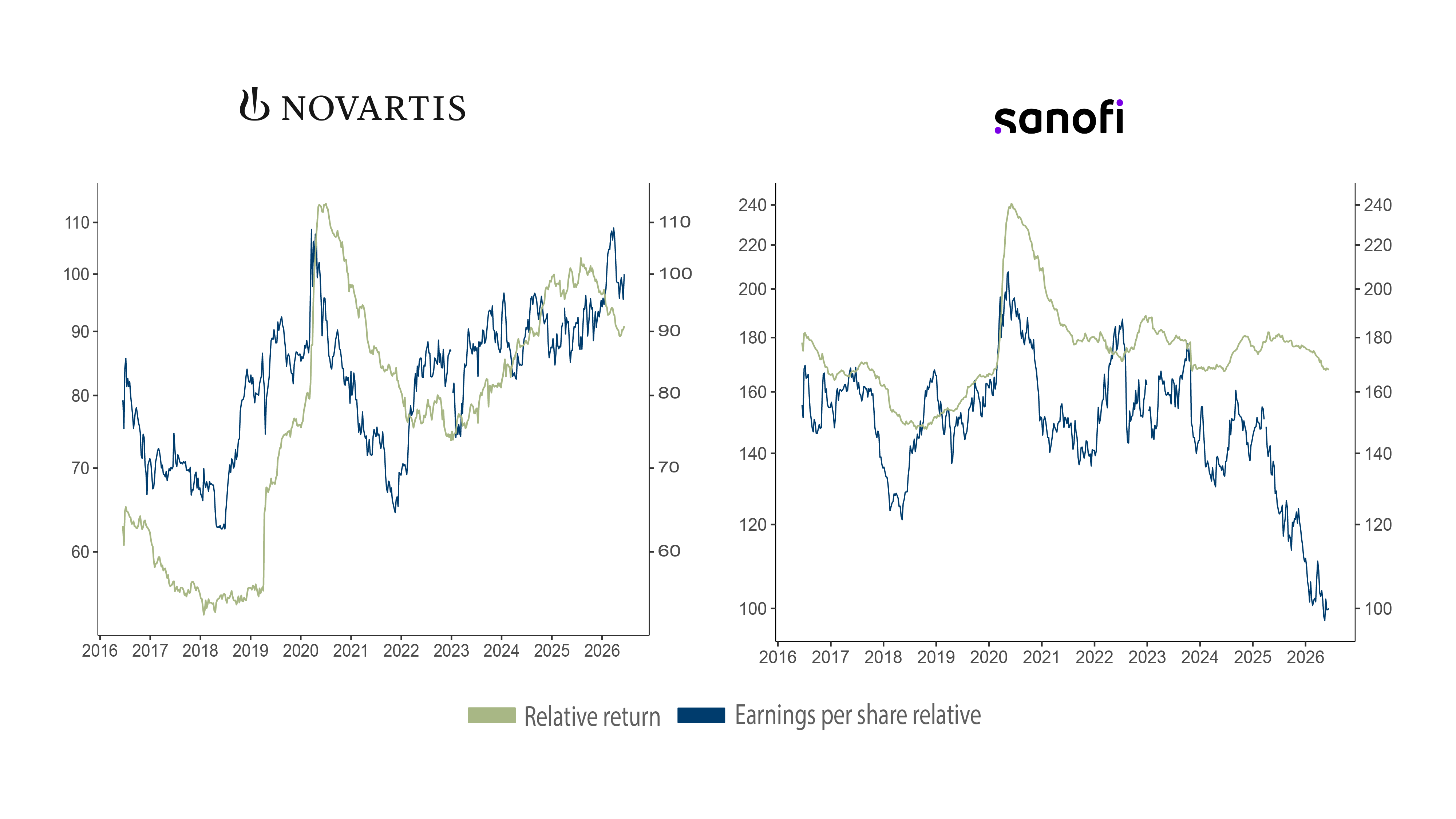
Source: Factset as at 11 June 2026. Reference to specific stocks should not be taken as advice or a recommendation to invest in them.
As the facts changed, we changed our portfolio. Making that change incurred a modest fee (transaction costs and commissions have come down a long way in recent years). But this strategy’s history suggests transactions like these deliver value to our clients significantly in excess of the charges they incur.
Is turnover adding value?
Our fund has performed well over the long term because our process steers us towards stocks that subsequently outgrow the market. The vast majority of our returns since inception (88%) have come from stock selection rather than country or sector decisions1.
That matters in the context of turnover because stock selection is not a one-off decision. The financial characteristics that make a company attractive can change as market conditions, valuations and earnings expectations evolve. Ensuring the fund continues to hold companies with attractive characteristics, those that are cheap and growing faster than the market, means the portfolio needs to evolve as facts change.
Over the past five years to 30 June 2026, stocks bought by the fund returned 19.7% in the 12 months after purchase, while stocks sold returned -3.6% in the 12 months after sale2. That is a 23.3 percentage point spread between what we bought and what we sold. So there would have been a significant opportunity cost had we not traded.
Standing pat would have prevented us from recycling capital into more attractive opportunities.
Over the same five-year period, the fund achieved an annualised return of 19.8% compared to 10.6% for its benchmark, the FTSE World Europe ex UK index, and 8.0% for the IA Europe Excluding UK sector3.
During this time, the fund outperformed in 63% of months, with a 68% hit rate in up markets and a 55% hit rate in down markets4. At the individual stock level, the hit rate was close to 50%, which is an important point: successful active management does not require every stock decision to be right. It requires a process that sizes opportunities sensibly, cuts deteriorating positions and allows the better ideas to contribute more than the mistakes detract.
Continually refining the portfolio and ensuring that it owns companies with the most compelling financial characteristics is integral to a process that has delivered market-beating returns over the course of 25 years. For us, buying and selling is a fundamental part of being an active investor.
Notes and references
2 Source: Artemis to 30 June 2026
3 Source: Lipper Limited to 30 June 2026, mid to mid in sterling for class I acc. All figures show total returns with dividends reinvested. Past performance is not a guide to the future.
4 Source: Artemis to 30 June 2026
CAPITAL AT RISK. All financial investments involve taking risk and the value of your investment may go down as well as up. This means your investment is not guaranteed and you may not get back as much as you put in. Any income from the investment is also likely to vary and cannot be guaranteed.
This is a marketing communication. Before making any final investment decisions, and to understand the investment risks involved, refer to the fund prospectus (or in the case of investment trusts, Investor Disclosure Document and Articles of Association), available in English, and KIID/KID, available in English and in your local language depending on local country registration, available in the literature library.
Risks specific to Artemis SmartGARP European Equity Fund
- Market volatility risk The value of the fund and any income from it can fall or rise because of movements in stockmarkets, currencies and interest rates, each of which can move irrationally and be affected unpredictably by diverse factors, including political and economic events.
- Currency risk The fund’s assets may be priced in currencies other than the fund base currency. Changes in currency exchange rates can therefore affect the fund's value.
- Charges from capital risk Where charges are taken wholly or partly out of a fund's capital, distributable income may be increased at the expense of capital, which may constrain or erode capital growth.
The intention of Artemis’ ‘investment insights’ articles is to present objective news, information, data and guidance on finance topics drawn from a diverse collection of sources. Content is not intended to provide tax, legal, insurance or investment advice and should not be construed as an offer to sell, a solicitation of an offer to buy, or a recommendation for any security or investment by Artemis or any third-party. Potential investors should consider the need for independent financial advice. Any research or analysis has been procured by Artemis for its own use and may be acted on in that connection. The contents of articles are based on sources of information believed to be reliable; however, save to the extent required by applicable law or regulations, no guarantee, warranty or representation is given as to its accuracy or completeness. Any forward-looking statements are based on Artemis’ current opinions, expectations and projections. Articles are provided to you only incidentally, and any opinions expressed are subject to change without notice. The source for all data is Artemis, unless stated otherwise. The value of an investment, and any income from it, can fall as well as rise as a result of market and currency fluctuations and you may not get back the amount originally invested.