Regime change: from roadmap to reality

CAPITAL AT RISK. All financial investments involve taking risk and the value of your investment may go down as well as up. This means your investment is not guaranteed and you may not get back as much as you put in. Any income from the investment is also likely to vary and cannot be guaranteed.
This is a marketing communication. Before making any final investment decisions, and to understand the investment risks involved, refer to the fund prospectus (or in the case of investment trusts, Investor Disclosure Document and Articles of Association), available in English, and KIID/KID, available in English and in your local language depending on local country registration, available in the literature library.
Key takeaways
- A process the Artemis Global Income team describes as ‘regime change’ has had a dramatic impact on some companies’ share prices.
- As the process evolves, the team has moved on from some of the companies it was investing in five years ago.
- Their focus now is on those companies where the effects of regime change have yet to be reflected in share prices.
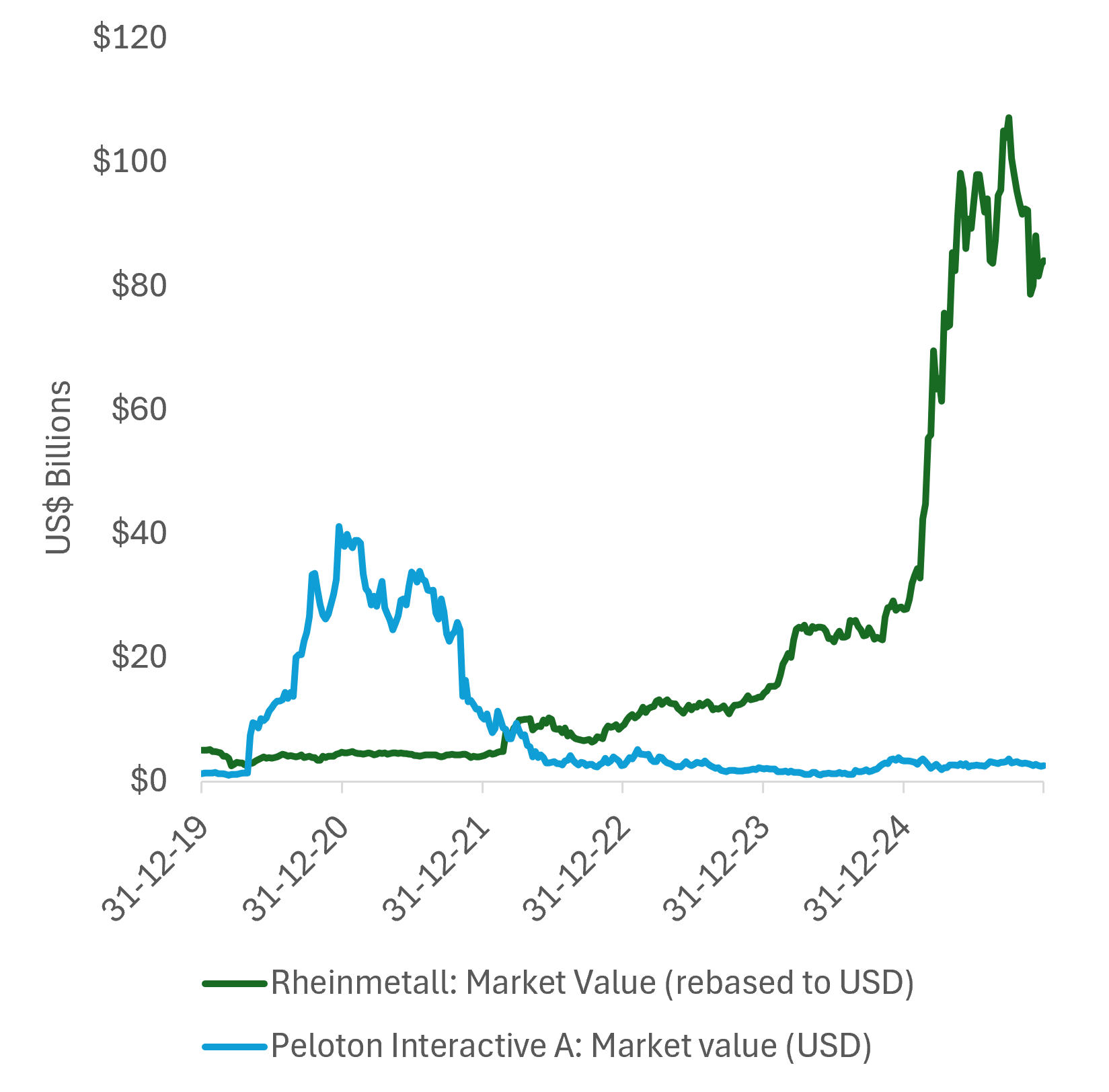
Which of these companies' shares would you rather own? Peloton – an 'interactive fitness platform', selling static bicycles and subscriptions to online exercise and wellness classes which recorded losses in four of the last five years1? Or Rheinmetall – mainland Europe's biggest defence contractor, a business with a €80.5 billion order backlog that envisages its sales quintupling by 20302?
Today, the answer might appear self-evident. Five years ago, however, it was less clear-cut. Peloton's share price rose by 434% in 2020. Rheinmetall's fell by 11%3. Back then, we were in a world where people were sitting at home fighting Covid. Today we are in a world where countries are fighting each other.
Charting five years of regime change: Peloton vs Rheinmetall
Source: FactSet, Artemis as at 31 December 2025
We didn’t hold Peloton's shares in 2021. Our attention was elsewhere: on miners (such as Glencore); on companies that make semiconductors (such as Samsung Electronics); and on defence contractors (such as Rheinmetall and Korea’s Hanwha Aerospace). In part, that was because we believed their share prices looked attractive relative to measures such as their profits ('earnings') and their dividends (the regular payments through which companies share some of their profits with their shareholders). We also saw scope for investors to place a higher value on these businesses, which could lift their share prices relative to their profits – a process investors describe as a 're-rating'.
One important way of looking for companies with the potential to be re-rated was to refer to our strategic roadmap, which describes the major 'big picture' changes we see taking place in the world. In 2021, as the contours of the post-pandemic world began to emerge, we updated that roadmap to describe several powerful, long-term trends that we believed would shape returns from stock markets over the coming years.
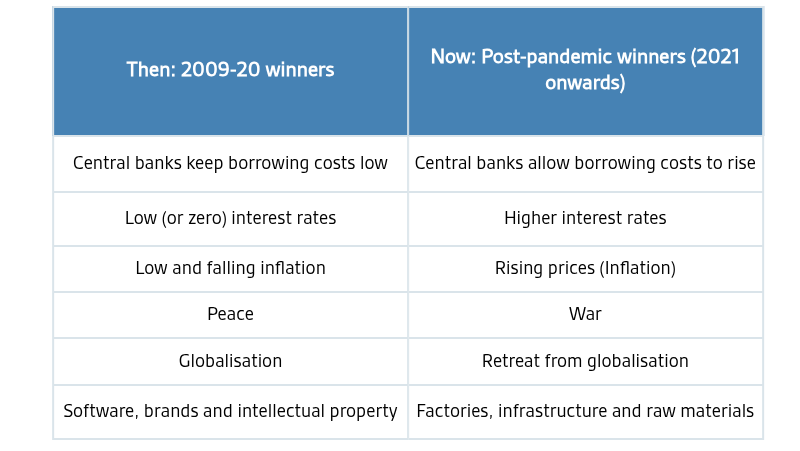
Many of those processes were interrelated. Collectively they formed a break with the recent past – a 'regime change' for companies and financial markets. We consciously invested in companies that we believed would benefit from it.
Two aspects of ‘regime change’ and its early beneficiaries
1. Higher interest rates (banks)
One important component of the new environment we anticipated was that the world was moving away from a long era in which prices were either stable or falling (disinflation) and towards a time of higher and more volatile inflation. In turn, we envisaged higher inflation would oblige central banks to push borrowing costs higher to control prices, marking the end of a decade of low interest rates. We saw banks, particularly in Europe, as being clear beneficiaries of that shift.
In the decade after the financial crisis, regulators required banks to rely less heavily on borrowed money, hold larger financial buffers and prove that they could survive a severe downturn. Those changes made some riskier lending activities more expensive for banks, encouraging them to focus on more traditional deposit-taking and lending.
For many years, that made banks relatively unattractive in the eyes of some investors. But as interest rates rose from 2022 onwards, that changed dramatically. Banks found they could charge higher rates to lend but the interest they paid on deposits increased more slowly. The profits European banks generate for their shareholders have returned to levels not seen for many years. As a result, the Artemis Global Income Fund has enjoyed particularly strong returns from its holdings in European banks such as Germany's Commerzbank and Italy's Banco BPM4 over the past five years.
2. Geopolitical tensions and war (defence stocks)
When national governments began stockpiling vaccines during the pandemic, it hinted at the transition to a world more focused on national self-sufficiency and security than on co-operation. Russia's invasion of Ukraine, meanwhile, may have marked the end of the peace dividend Europe had been harvesting since the end of the Cold War.
Guided by our roadmap, we invested in defence companies before governments across Europe committed to re-arming. And although we have since locked in profits on our holdings in companies such as Rheinmetall and Mitsubishi Heavy Industries, they have been among the fund’s strongest performers over the past five years5.
‘Regime change’ isn’t over – but it is evolving
We do not expect a return to the pre-pandemic conditions of low inflation, expanding global trade and falling interest rates. We are conscious that the outlines of the new regime have become more widely understood – the ‘new normal’. Our task now is to find areas where investors are still underestimating how large or long-lasting these changes may be. A number of these opportunities fall into one of the following themes.
We do not expect a return to the pre-pandemic regime of low inflation, expanding global trade and falling rates. Although we took profits on Rheinmetall in the first half of 2026, we still invest in defence stocks and banks. But parts of the new regime have now become the new normal. Our task is to identify where the extent and duration of change continues to be underestimated or where its second-order effects are yet to be reflected in share prices. A number of these opportunities are aligned to one of the following three themes.
1. Building resilience in the energy sector
For many years, too little was invested in building and renewing the physical infrastructure needed to produce and transport energy. Energy companies often chose to return cash to their shareholders or to spend it on the transition to clean energy rather than developing new fields or replacing ageing equipment6. As a consequence, proven oil and gas reserves have been depleted, and rusting infrastructure needs to be replaced.
That need for investment is underscored by concerns around global energy security. The vulnerabilities that result from depending on energy produced in unstable regions became clear when Russia launched its full-scale invasion of Ukraine. And as the attack on the Ras Laffan energy complex in Qatar earlier this year made clear, it might be unwise to depend too heavily on the Middle East7. Instead, countries that import energy might need to turn to friendly nations such as the US or Norway. That, in turn, points to the need for more investment in the energy sector across the West.
Stocks aligned to this area of our roadmap: Tenaris, Baker Hughes, AkerBP, Var Energy, Diversified Energy.
2. Supplying the technology investment boom
Long before large US technology companies committed to investing an additional $725 billion in building AI infrastructure this year8, we had positioned our portfolio in anticipation of a wave of reindustrialisation. Tensions between the US and China were already changing where governments wanted to manufacture strategically important products such as advanced semiconductors. Cost was no longer the only consideration. Governments and companies increasingly valued security and reliability of supply. That meant building new factories closer to home.
In 2022, the Biden administration's Chips Act gave companies financial incentives to assemble semiconductors at plants in the US9. The pressure to move production back to the US has intensified during the second Trump administration, while the boom in AI data centres has created additional demand for new manufacturing capacity. In our fund, we tend to focus not on the companies making these multi-billion investments. Instead, we invest in their suppliers – companies that make the gas turbines needed to power data centres, the semiconductors and memory chips needed to run AI systems and the cabling to wire them up.
Stocks aligned to this area of our roadmap: Prysmian, Samsung Electronics, Dongfang Electric, Harbin Electric, Nexans.
3. Raw materials and emerging markets
Building all this physical infrastructure – refineries and data centres – requires vast quantities of raw materials, particularly industrial metals. BHP estimates the amount of copper used in data centres globally will grow six-fold by 2050 – from around half a million tonnes a year today, to around three million tonnes a year by 205010. That is equivalent to the combined annual output of the world's four largest copper mines.
Many of the metals needed for this investment are mined and processed in emerging economies. Building new mines and processing plants should therefore bring more investment and jobs to countries such as Brazil and South Africa. As more investment flows into emerging economies, it should, in turn, benefit emerging-market consumers, banks and other financial companies.
Stocks aligned to this area of our roadmap: Freeport-McMoRan, Glencore, Grupo Mexico, Ternium.
As regime change evolves, so does our fund
Many of the underlying trends we identified five years ago remain in place. But those insights have less value to us once other investors have begun to recognise and respond to them. So, as regime change evolves, we have moved on from some of the names we held five years ago.
As we look into 2027 and into the next decade, we cannot simply position the fund in anticipation of the transition to a new regime and wait for share prices of our holdings to rise as markets catch up with reality. No trend moves in a perfectly straight line and there will be periods when miners, banks and semiconductor stocks perform poorly. As active investors, we must be ready to react to that and, where we can, anticipate it.
So our task is to take advantage of periods when market uncertainty creates attractive prices without losing sight of the overall direction of travel. The ongoing, long-term processes of change highlighted by our roadmap persist. It takes 10 years to develop an offshore oil field; it can take up to 18 years to develop a new mine11. While roadmaps need to be updated regularly, they remain indispensable to careful drivers.
Discrete calendar-year performance
| 2025 | 2024 | 2023 | 2022 | 2021 | |
| Artemis Global Income I Inc GBP | 45.2% | 26.8% | 9.7% | -2.5% | 26.5% |
| MSCI AC World NR GBP | 13.9% | 19.6% | 15.3% | -8.1% | 19.6% |
| IA Global Equity Income average | 12.5% | 11.2% | 9.9% | -1.4% | 19.2% |
Past performance is not a guide to the future.
Source: Lipper Limited, class I income units, to 30 June 2026. All figures show total returns with dividends and/or income reinvested, net of all charges. Performance does not take account of any costs incurred when investors buy or sell the fund. Returns may vary as a result of currency fluctuations if the investor's currency is different to that of the class. This class may have charges or a hedging approach different from those in the IA sector benchmark.
Fund objective
To grow both income and capital over a five-year period.
Notes and references
1. StockAnalysis.com Peloton Interactive, Inc. (PTON) https://stockanalysis.com/stocks/pton/financials/
2. Rheinmetall, 6 August 2026, H1: Strong sales growth and record profitability
3. Artemis, FactSet as at 30 June 2026
4. Artemis, FactSet as at 30 June 2026
5. Artemis, FactSet as at 30 June 2026
6. McKinsey & Company, April 2026, The discovery gap: What it means for oil and gas exploration
7. Reuters, 19 March 2026, Iran attacks wipe out 17% of Qatar’s LNG capacity for up to five years, QatarEnergy CEO says
8. Bloomberg, April 30 2026, US Big Tech Ratchets Up AI Spending Past $700 Billion This Year
9. National Institute of Standards and Technology – Frequently Asked Questions: Preventing the Improper Use of CHIPS Act Funding
10. BHP Why AI tools and data centres are driving copper demand
11. S&P Global 10 April 2024 Average lead time almost 18 years for mines started in 2020–23
Risks specific to Artemis Global Income Fund
- Market volatility risk The value of the fund and any income from it can fall or rise because of movements in stockmarkets, currencies and interest rates, each of which can move irrationally and be affected unpredictably by diverse factors, including political and economic events.
- Currency risk The fund’s assets may be priced in currencies other than the fund base currency. Changes in currency exchange rates can therefore affect the fund's value.
- Charges from capital risk Where charges are taken wholly or partly out of a fund's capital, distributable income may be increased at the expense of capital, which may constrain or erode capital growth.
- Emerging markets risk Compared to more established economies, investments in emerging markets may be subject to greater volatility due to differences in generally accepted accounting principles, less governed standards or from economic or political instability. Under certain market conditions assets may be difficult to sell.
- Income risk The payment of income and its level is not guaranteed.
Important information
The intention of Artemis’ ‘investment insights’ articles is to present objective news, information, data and guidance on finance topics drawn from a diverse collection of sources. Content is not intended to provide tax, legal, insurance or investment advice and should not be construed as an offer to sell, a solicitation of an offer to buy, or a recommendation for any security or investment by Artemis or any third-party. Potential investors should consider the need for independent financial advice. Any research or analysis has been procured by Artemis for its own use and may be acted on in that connection. The contents of articles are based on sources of information believed to be reliable; however, save to the extent required by applicable law or regulations, no guarantee, warranty or representation is given as to its accuracy or completeness. Any forward-looking statements are based on Artemis’ current opinions, expectations and projections. Articles are provided to you only incidentally, and any opinions expressed are subject to change without notice. The source for all data is Artemis, unless stated otherwise. The value of an investment, and any income from it, can fall as well as rise as a result of market and currency fluctuations and you may not get back the amount originally invested.