Artemis High Income Fund
Q3 2024 update




Source for all information: Artemis as at 29 September 2024, unless otherwise stated.
Over a choppy quarter for financial markets, the fund generated a total return of 4.1%, outperforming its peer group, the IA’s £ Strategic Bond sector, where the average return was 3.7%. That strong performance capped off a good start to 2024: over the year to date it has produced a total return of 9.5% versus an average return of 5.0% from its peers.
As the table shows, the fund’s commitment to delivering a high level of income has resulted in a significant margin of outperformance relative to its peers over the long term. Thanks to the rise in yields seen over the past two-and-a-half years, we believe focusing on income will continue to pay dividends going forward.
| Performance (%) | Q2 2024 | YTD | 1 yr | 3 yrs | 5 yrs |
|---|---|---|---|---|---|
| Fund | 4.1 | 9.5 | 16.4 | 9.5 | 20.8 |
| IA £ Strategic Bond NR | 3.7 | 5.0 | 12.4 | -0.3 | 7.8 |
| Quartile | 2 | 1 | 1 | 1 | 1 |
Past performance is not a guide to future returns. Source: Artemis/Lipper Limited, class I Inc GBP to 30 September 2024. All figures show total returns with dividends and/or income reinvested, net of all charges. Performance does not take account of any costs incurred when investors buy or sell the fund. Returns may vary as a result of currency fluctuations if the investor's currency is different to that of the class. This class may have charges or a hedging approach different from those in the IA sector benchmark.
The chart below shows the performance of the fund against UK gilts (as measured by FTSE Actuaries UK Conventional Gilts All Stocks Index) over the past 12 months. Clearly, the return of 7.9% from gilts has been a respectable outcome. Equally, however, the 16.4% return from our strategy shows the additional return that can be delivered by being slightly more adventurous in your fixed-income allocation.
Returns from gilts have been lacklustre since the turn of the year
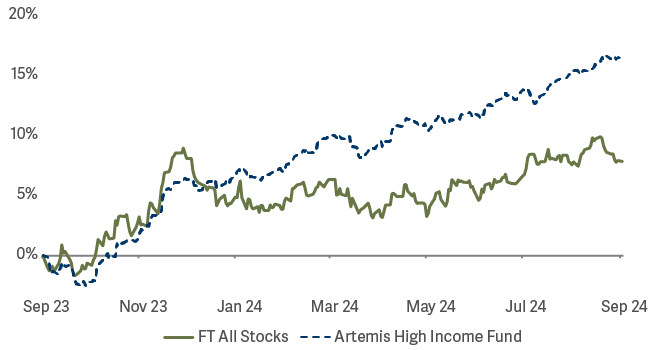
Past performance is not a guide to the future. Source: Artemis/ LSEG Datastream, class I Inc GBP to 30 September 2024. Performance is presented versus FTSE Actuaries UK Conventional Gilts All Stocks Index on a total return basis as a proxy for investing in UK government bonds. The purpose is to demonstrate the performance of the strategy versus making an allocation to gilts. Please note that the Artemis High Income Fund has a different risk profile to UK government bonds. All figures show total returns with dividends and/or income reinvested, net of all charges. Performance does not take account of any costs incurred when investors buy or sell the fund.
The other thing the chart shows is how consistent returns from our strategy have been. The UK government bond market delivered a healthy slug of returns in the last few months of 2023, when investors began to anticipate rate cuts. Since the new year, however, gilts have fallen slightly (by 0.2%) – while our strategy has returned 9.5%. That reflects the regular stream of income that our high-yield bonds have delivered along with strong stock selection.
Our interpretation is that our strategy could potentially work well alongside an allocation to government bonds, simultaneously diversifying and improving returns.
Contributors and detractors
Some of the key drivers to the fund’s returns over the quarter included useful contributions from the equity portion of the portfolio, which accounts for 15% of the fund. These included:
- Tesco;
- Barclays;
- NatWest; and
- National Grid.
On the credit side, meanwhile, some of the biggest contributions came from the European real estate sector, where we saw rebound in property prices and a rise in rents. As such, we saw healthy returns from our holdings in bonds from:
- Heimstaden (Swedish residential landlord); and
- CPI Property (Czech landlord).
Elsewhere, bonds issued by Sotheby's, the global auction house, responded well after it announced a combined $1 billion equity injection from its existing owner, Patrick Drahi and Abu Dhabi-based sovereign wealth fund ADQ. Most of the funds will be used to repay debt.
Inevitably, not every holding outperformed over the quarter. On the negative side, underperformers included:
- Southern Water, (bonds);
- Melrose, aerospace (equities);
- Isabel Marant, French luxury goods (bonds); and
- BMW, the carmaker (equities).
Activity
James Hardie (bonds, new holding) – We bought high-yield bonds from this building materials company. This business appears to combine a strong market position with low leverage and strong cashflows. It has a market capitalisation of $16.4 billion while its net debt is $800 million. Effectively, the company's market value would need to fall by 95% to burn through the equity cushion. Over the past decade, the company has generated $2.3 billion of free cashflows and grown its top line by 140%. Frankly, this shouldn't be a 'high yield' company. But we still get paid high-yield levels of income. This seems a like a good deal to us.
IHO Verwaltungs (bonds, new holding) – We added a new holding in this family-owned holding company for German auto parts/tyre manufacturers Schaeffler, Continental and Vitesco. We believe these bonds are comfortably covered by the large equity holdings in these three companies. The bonds we bought mature in 2028 with a very healthy yield of almost 9% in sterling terms.
Melrose (equities, addition) – We added to the fund's existing holding in aerospace group Melrose after its shares fell in response to a 'bear attack' from a hedge fund based on what we view as an overly cynical interpretation of its accounting practices.
InPost (bonds, new holding) – You may have seen parcel-collection machines ('lockers') belonging to this Dutch delivery business in your local supermarket or retail park. We bought bonds that are due to mature in July 2027 and which, at the time purchase, offered a healthy-if-unspectacular yield to maturity of 5.6%. Our belief, however, is that there is a good chance that InPost will, like many high-yield issuers, opt to refinance its bonds at least a year early. Under this assumption, a 5.6% yield to maturity moves up to 6.5%. This is not a guarantee, but even if InPost chooses not to redeem this bond early, we would still receive almost 1.5x the return on a gilt of a similar maturity. So, this seems like a good deal to us.
Ocado (bonds, sale) – While we still believe in Ocado’s mission to become a high-margin, high-cashflow technology services company, this was increasingly reflected in the price of its bonds. We sold our position following a successful refinancing operation.
Victoria Carpets (bonds, sale) – Rumours that this UK flooring company was considering a potentially disruptive fundraising prompted us to sell its bonds. While our bonds were relatively insulated from the potential negative implications of this fundraising, this action fundamentally changed our view of the company’s value and options.
Outlook
Towards the end of the summer, growing optimism that interest rates - particularly in the US - were likely to fall boosted returns from both government bonds (falling rates should bring bond yields down, driving prices up) and equities (lower yields drive investors' 'animal spirits' and fuel their appetite for risk). These returns did not reflect any fundamental change in the expectations of investors around the cashflow profile of these investments; lower interest rates simply drove up valuations.
Today, credit spreads are reasonably tight and, while we are reasonably comfortable that they are unlikely to widen significantly in the near future, there is not a huge amount of room for them to narrow much further. We are therefore looking for idiosyncratic opportunities to enhance returns on an individual company level while broadly staying in shorter-dated bonds of companies that we believe would be able to make their way through a meaningful recession without impairment (while also paying us attractive levels of income).
Our focus on generating a high current level of income (with some long-term growth through our small allocation to dividend-growing equities) is one that we feel can add diversification to many portfolios in the current environment. Our portfolio has a low duration (it is relatively less sensitive to changes in government bond yields) so it did not benefit from the significant rally in US government bonds in the way that many of its peers did. But that it nevertheless managed to keep up with its peers over the summer shows that diversification need not come at the expense of returns.
Returns from this fund will be correlated to changes in risk appetite and movements in bond markets. Equally, however, we believe that our focus on income means this fund's primary driver of returns differs from many of the funds in its peer group, which tend to carry significantly more duration risk. In a world where global equities and bonds rose in unison as expectations for rate cuts were brought forward, it is not impossible that they will fall in unison too – and, under those conditions, a fund like ours can provide useful diversification to investors.
Notes and references
CAPITAL AT RISK. All financial investments involve taking risk and the value of your investment may go down as well as up. This means your investment is not guaranteed and you may not get back as much as you put in. Any income from the investment is also likely to vary and cannot be guaranteed.
This is a marketing communication. Before making any final investment decisions, and to understand the investment risks involved, refer to the fund prospectus (or in the case of investment trusts, Investor Disclosure Document and Articles of Association), available in English, and KIID/KID, available in English and in your local language depending on local country registration, available in the literature library.

Risks specific to Artemis High Income Fund
- Market volatility risk The value of the fund and any income from it can fall or rise because of movements in stockmarkets, currencies and interest rates, each of which can move irrationally and be affected unpredictably by diverse factors, including political and economic events.
- Currency risk The fund’s assets may be priced in currencies other than the fund base currency. Changes in currency exchange rates can therefore affect the fund's value.
- Bond liquidity risk The fund holds bonds which could prove difficult to sell. As a result, the fund may have to lower the selling price, sell other investments or forego more appealing investment opportunities.
- Higher-yielding bonds risk The fund may invest in higher-yielding bonds, which may increase the risk to capital. Investing in these types of assets (which are also known as sub-investment grade bonds) can produce a higher yield but also brings an increased risk of default, which would affect the capital value of the fund.
- Credit risk Investments in bonds are affected by interest rates, inflation and credit ratings. It is possible that bond issuers will not pay interest or return the capital. All of these events can reduce the value of bonds held by the fund.
- Charges from capital risk Where charges are taken wholly or partly out of a fund's capital, distributable income may be increased at the expense of capital, which may constrain or erode capital growth.
- Emerging markets risk Compared to more established economies, investments in emerging markets may be subject to greater volatility due to differences in generally accepted accounting principles, less governed standards or from economic or political instability. Under certain market conditions assets may be difficult to sell.
- Income risk The payment of income and its level is not guaranteed.
The intention of Artemis’ ‘investment insights’ articles is to present objective news, information, data and guidance on finance topics drawn from a diverse collection of sources. Content is not intended to provide tax, legal, insurance or investment advice and should not be construed as an offer to sell, a solicitation of an offer to buy, or a recommendation for any security or investment by Artemis or any third-party. Potential investors should consider the need for independent financial advice. Any research or analysis has been procured by Artemis for its own use and may be acted on in that connection. The contents of articles are based on sources of information believed to be reliable; however, save to the extent required by applicable law or regulations, no guarantee, warranty or representation is given as to its accuracy or completeness. Any forward-looking statements are based on Artemis’ current opinions, expectations and projections. Articles are provided to you only incidentally, and any opinions expressed are subject to change without notice. The source for all data is Artemis, unless stated otherwise. The value of an investment, and any income from it, can fall as well as rise as a result of market and currency fluctuations and you may not get back the amount originally invested.