Artemis High Income Fund
Q2 2025 update




Source for all information: Artemis as at 29 June 2025, unless otherwise stated.
The second quarter began with the shock of ‘Liberation Day’ and tariff-induced market trauma, but May and June saw a welcome recovery. We believe this was warranted, given the strength of macro data and comments from management teams on recent earnings calls.
Tariff concerns and subsequent ‘deals’ will continue to rumble on, but we feel their ability to torment risk markets has waned, not least because markets now have a response function in the so-called TACO trade (Trump always chickens out).
Performance
Against this backdrop, the fund returned 3.7% during the second quarter – the second-best return in the entire IA Strategic Bond sector and considerably higher than the peer group average of 2.3%.
May was a particularly strong month for the fund, during which it delivered a 1.8% total return, well above the 0.1% made by its peer group average. The fund’s holdings in short-dated high yield and equities, along with its relatively light government bond exposure and avoidance of longer-dated bonds, contributed significantly to performance. It also benefited from strong stock selection.
The fund’s long-term track record remains robust: it is the best performer in the IA Strategic Bond sector over three years and the second best over five, illustrating the benefits of allowing higher income to compound. These returns have been unlocked by higher bond yields over the past three years.
| Performance (%) | 3 m | 6 m | 1 yr | 3 yrs | 5 yrs |
|---|---|---|---|---|---|
| Fund | 3.7 | 5.4 | 10.3 | 31.1 | 32.4 |
| IA Strategic Bond | 2.3 | 3.8 | 6.9 | 15.6 | 9.7 |
| Sector quartile | 1 | 1 | 1 | 1 | 1 |
Past performance is not a guide to future returns. Source: Artemis/Lipper Limited, class I Inc GBP to 30 June 2025. All figures show total returns with dividends and/or income reinvested, net of all charges. Performance does not take account of any costs incurred when investors buy or sell the fund. Returns may vary as a result of currency fluctuations if the investor's currency is different to that of the class. This class may have charges or a hedging approach different from those in the IA sector benchmark.
Contributors
Our top-performing holdings during the quarter included bonds issued by game-maker Asmodee, shipping company Seaspan and footwear retailer Foot Locker. Additionally, healthcare logistics provider Owens & Minor saw its bonds rally after it cancelled a proposed acquisition of Rotech, a peer in the medical-supply distribution industry.
On the equity side, our top contributors were Barclays, NatWest, private equity company 3i Group, Tesco and the sports betting and gaming group Entain, whose share price jumped following improved guidance from its joint venture with MGM Resorts, BetMGM.
Detractors
Mobico, the UK and US transport operator formerly known as National Express, was a poor performer during the quarter. It has suffered from difficulties in its US school bus business as well as its German bus networks, but we see the sell-off as being overdone. The company has successfully disposed of its US school transport business and plans to use the proceeds to deleverage. While its German business remains in a restructuring phase, earnings are dominated by Mobico’s strong Spanish operation, which continues to see good growth and earnings.
Our small, distressed position in the US budget furniture retailer At Home, which announced it had entered Chapter 11 bankruptcy, was another detractor.
Equities that disappointed this quarter included oil & gas company TotalEnergies, biopharma company Sanofi and Deutsche Telekom.
Activity
The new issue market roared back into life in May and June, and we bought bonds from the following companies:
- Aggreko, the producer of industrial generators
- Arqiva, the UK communications infrastructure owner, which benefits from long-term inflation-linked contracts with broadcasters and telecom operators
- Clariane, the French care-home provider
- Clarivate, which provides a range of data sets and services for use in academia, life sciences and the intellectual property management sectors; we like the high barriers to entry and mission-critical nature of its offering
- Currenta, which owns the largest chemical production facility in Europe
- Cvent, the US event-management software provider
- DNO, the Norwegian oil & gas company
- Flutter, the online gaming company
- Shift4, the US payment processing company
- TeamSystem, the Italian software development company
- Together, the UK specialist lender
- Urbaser, the Spanish waste management business
- Voyager, which was formed after Apollo Global Management acquired gaming company Everi and IGT’s gaming and digital business, then merged them together
Elsewhere, we topped up our position in W&T Offshore, the oil & gas producer, at the start of May given it had significantly lagged the broader recovery. We also increased our exposure to Nufarm, the Australian crop science specialist, which we believe is getting closer to disposing of its seed business in a potentially deleveraging transaction.
Meanwhile, we switched our shorter-dated (2027) exposure to the video game producer Ubisoft Entertainment into longer-dated (2031) bonds, given the underperformance of the latter, which in our view was unjustified.
In the secondary market, we added some new exposure in US sports apparel maker Under Armour, which we see as benefiting from a strategic turnaround and growing strength in its category. We also added a position in 2028 bonds issued by UK and US transport operator Mobico.
Alongside these additions, we bought some short-dated bonds in Energean, the Mediterranean oil & gas producer. Its bonds have underperformed since a deal to dispose of its non-core assets to private equity firm Carlyle fell through. This deal would have allowed the business to focus on its Israeli fields, which are highly profitable with low lifting costs (post-drilling extraction costs). However, while this was undoubtedly a disappointment, the underperformance of the bonds looks extreme considering the high levels of underlying cash generation.
In terms of sales, we trimmed our position in Cloud Software, which owns the Citrix remote login software. We have held these bonds for the past few years and initially believed investors were underestimating the massive cashflow generation potential of this business under its new owners. It appears the market has come to agree with us and these bonds have performed well. They now offer lower levels of potential excess return than when we bought them.
We made a few sales in June where valuations had become too stretched to ignore, including US domestic services website Angi, desktop game maker Asmodee, North American waste disposal operator GFL Environmental, German tier 1 auto supplier IHO and US agricultural and mining chemical producer LSB Industries.
We also trimmed our holdings in the government bond space given the strong performance seen over the past few months, reducing our holdings of US Treasury Inflation-Protected Securities (TIPS) and UK gilts.
Outlook
One of the questions we are often asked is whether in a world of higher ‘risk free’ rates, we should be owning fewer high-yield bonds and instead focusing our efforts on government bonds. In effect, if we can get a decent income on government bonds, why take the additional risk from going into corporate bonds?
We are firmly of the belief that in periods such as today when interest rates are higher, investors should be leaning into higher-yielding bonds, not away from them.
Why? Well, somewhat counterintuitively, investors actually benefit more from the beauty of compounding the same additional spread on high yield if base rates are higher.
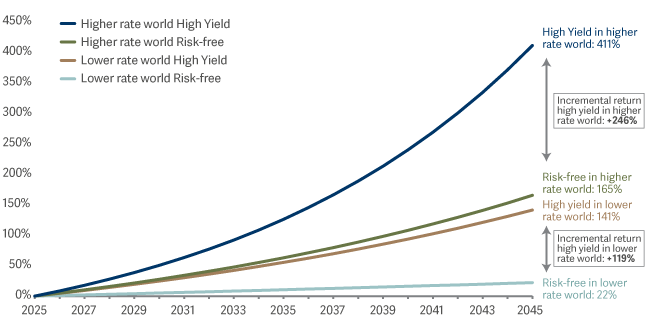
By way of example, let’s look at two different environments: a ‘higher rate’ world (5% risk-free rate, 8.5% high yield) and a ‘lower rate’ world (1% risk-free rate, 4.5% high yield). The additional spread from high yield is exactly the same in both of these scenarios.
However, the additional return from being in high yield in the higher-rate scenario would be 246% over the next 20 years, compared with 119% for the lower-rate environment, as the chart below illustrates.
Counter-intuitively, the additional yield from high yield matters more in a higher interest rate environment
Source: Artemis
Granted, risk-free rates give a more respectable return on government bonds in a higher rate environment – but investors are losing out on a lot more in this environment by not holding high-yield bonds.
We retain our conviction that investing in high-yielding assets in a diversified fashion with strong security selection – and increasing the income over time with the equity allocation – is a compelling strategy, enabling investors to benefit from the compounding of high levels of income for years to come.
Notes and references
CAPITAL AT RISK. All financial investments involve taking risk and the value of your investment may go down as well as up. This means your investment is not guaranteed and you may not get back as much as you put in. Any income from the investment is also likely to vary and cannot be guaranteed.
This is a marketing communication. Before making any final investment decisions, and to understand the investment risks involved, refer to the fund prospectus (or in the case of investment trusts, Investor Disclosure Document and Articles of Association), available in English, and KIID/KID, available in English and in your local language depending on local country registration, available in the literature library.

Risks specific to Artemis High Income Fund
- Market volatility risk The value of the fund and any income from it can fall or rise because of movements in stockmarkets, currencies and interest rates, each of which can move irrationally and be affected unpredictably by diverse factors, including political and economic events.
- Currency risk The fund’s assets may be priced in currencies other than the fund base currency. Changes in currency exchange rates can therefore affect the fund's value.
- Bond liquidity risk The fund holds bonds which could prove difficult to sell. As a result, the fund may have to lower the selling price, sell other investments or forego more appealing investment opportunities.
- Higher-yielding bonds risk The fund may invest in higher-yielding bonds, which may increase the risk to capital. Investing in these types of assets (which are also known as sub-investment grade bonds) can produce a higher yield but also brings an increased risk of default, which would affect the capital value of the fund.
- Credit risk Investments in bonds are affected by interest rates, inflation and credit ratings. It is possible that bond issuers will not pay interest or return the capital. All of these events can reduce the value of bonds held by the fund.
- Charges from capital risk Where charges are taken wholly or partly out of a fund's capital, distributable income may be increased at the expense of capital, which may constrain or erode capital growth.
- Emerging markets risk Compared to more established economies, investments in emerging markets may be subject to greater volatility due to differences in generally accepted accounting principles, less governed standards or from economic or political instability. Under certain market conditions assets may be difficult to sell.
- Income risk The payment of income and its level is not guaranteed.
The intention of Artemis’ ‘investment insights’ articles is to present objective news, information, data and guidance on finance topics drawn from a diverse collection of sources. Content is not intended to provide tax, legal, insurance or investment advice and should not be construed as an offer to sell, a solicitation of an offer to buy, or a recommendation for any security or investment by Artemis or any third-party. Potential investors should consider the need for independent financial advice. Any research or analysis has been procured by Artemis for its own use and may be acted on in that connection. The contents of articles are based on sources of information believed to be reliable; however, save to the extent required by applicable law or regulations, no guarantee, warranty or representation is given as to its accuracy or completeness. Any forward-looking statements are based on Artemis’ current opinions, expectations and projections. Articles are provided to you only incidentally, and any opinions expressed are subject to change without notice. The source for all data is Artemis, unless stated otherwise. The value of an investment, and any income from it, can fall as well as rise as a result of market and currency fluctuations and you may not get back the amount originally invested.