Artemis SmartGARP European Equity Fund
Q3 2024 update


Source for all information: Artemis as at 29 September 2024, unless otherwise stated.
- Fund treads water after a strong previous year.
- We believe European equities offer low risk and the potential for high returns.
- The fund is biased towards European value stocks.
| Performance (%) | 3 m | 6 m | 1 yr | 3 yrs | 5 yrs |
|---|---|---|---|---|---|
| Fund | 0.1 | 2.1 | 18.5 | 36.1 | 57.8 |
| FTSE World Europe ex UK TR | 0.0 | 0.3 | 15.3 | 21.2 | 48.4 |
| IA Europe Excluding UK NR | 0.1 | -0.3 | 14.3 | 12.9 | 43.1 |
Past performance is not a guide to the future. Source: Lipper Limited/Artemis as at 30 September 2024 for class I accumulation GBP. All figures show total returns with dividends and/or income reinvested, net of all charges. Performance does not take account of any costs incurred when investors buy or sell the fund. Returns may vary as a result of currency fluctuations if the investor's currency is different to that of the class. Classes may have charges or a hedging approach different from those in the IA sector benchmark.
The market and fund ended the quarter unchanged over the quarter with a return of 0.0% in sterling terms. Nevertheless, over the past one, three, five years and since inception, the fund is substantially ahead of the index.
Despite ending the period at the same level, markets went through considerable volatility. There was a mini panic attack in August when fears of a US slowdown took hold. In September, investors got positively excited by easier monetary and fiscal policy in China.
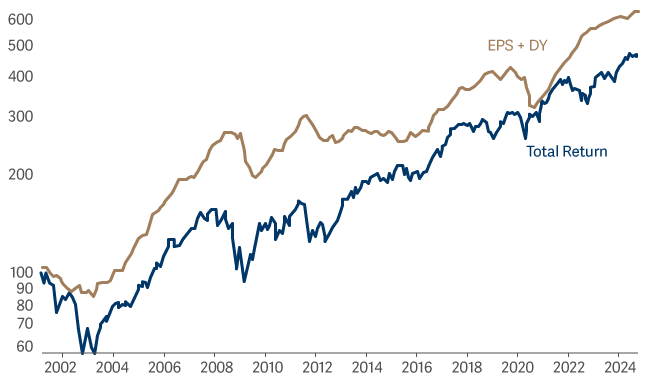
Ultimately, equity returns are driven not by sentiment but by the combination of income and growth (see Chart 1). Over the past 23 and a half years (since we launched this fund), European fundamentals1 have grown by 8.1% per annum while equity markets have returned 6.7% per annum. Returns lagged fundamentals because markets started off very expensive (a prospective price/earnings ratio of 18x) and ended up normally valued (14x). Over time we would expect returns to largely mimic the trend in income plus growth.
For the moment, markets appear to be priced about right, and growth continues to chug along. As such there are no obvious warning signs that European equities are dramatically exposed nor about to embark on a major bull market. That is not to say it cannot happen, but rather to say we should probably focus on the nuts and bolts of running money rather than forecasting major shifts.
Chart 1: MSCI Europe ex UK
Source: LSEG Datastream 31 August 2024.
Over the same period, our fund has seen its fundamentals grow by about 10% and returned 7.8% (net of fees) per annum. Basically, we have delivered higher returns because we ended up owning companies that grew 2% per annum faster than the market. This 2% gap does not seem huge, but it is a significant amount of 'alpha' over that time.
When we launched the fund in 2001, markets were expensive and investors were crowded into overpriced technology stocks (sounds familiar?). It turned out that owning dull but undervalued companies was less risky and more profitable than owning the market. My sense is that the next few years may well be similar to that of the 2001-2003 period.
The major difference of now vs. then is that while most US stocks are 'expensive' and US growth stocks 'very expensive', markets outside the US are 'normally priced' and value stocks outside the US are 'abnormally cheap'.
It is not clear what markets will do over the next few years, but our portfolio should be capable of outperforming the benchmark. The fund's aggregate price/earnings ratio is about half the market's, our companies are buying back their shares, debt levels are low, and profit forecasts are going up. This is a good starting point.
While the overall structure of the fund is largely unchanged from a few months ago, the holdings do shift. Over the past few months, we have raised our exposure to the pharmaceutical sector by buying Teva, Novartis and Roche. We have also bought other fairly economically insensitive stocks such as Lottomatica (Italian lottery), ACS (toll roads), Engie (French electric utility) and Essity (consumer paper products). Making way for this we sold holdings in various cyclical and oil stocks such as Heidelberg Materials (cement), Repsol (oil), Stellantis and Renault (autos).
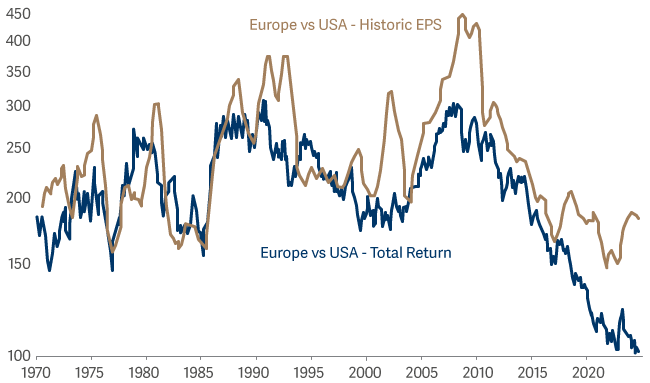
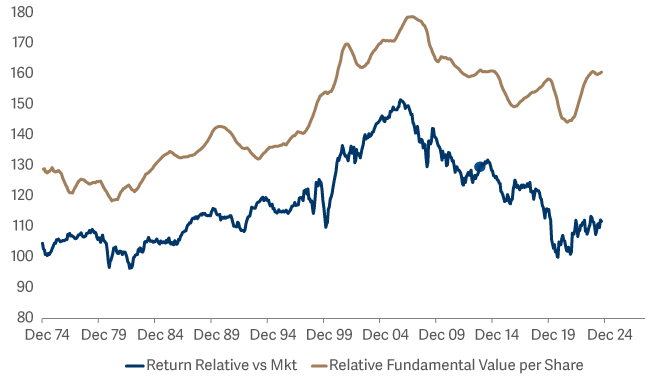
The following two charts illustrate two of the more extreme features of financial markets right now. Chart 2 shows that European equities are very undervalued vs USA – especially since earnings growth is similar. Likewise, Chart 3 shows that within Europe, lowly priced (value) stocks are abnormally cheap and growing.
Chart 2: European equities compared to the US
Source: LSEG Datastream 30 August 2024.
Chart 3: European value stocks
Source: LSEG Datastream 30 August 2024.
What will be the catalyst for change? Who knows… What I do believe is that investing is about doing sensible things in a diligent fashion. For long periods it might seem pointless, but over the years it makes a big difference. Having exposure to European value stocks at this juncture seems like a relatively low risk/high return strategy.
Notes and references
- 'Value per share' - a combined measure of earnings, cash flow, operating profits, dividends and asset value per share.
Benchmarks: FTSE World Europe ex UK TR; A widely-used indicator of the performance of European stockmarkets, in which the fund invests. IA Europe Excluding UK NR; A group of other asset managers’ funds that invest in similar asset types as this fund, collated by the Investment Association. These act as ‘comparator benchmarks’ against which the fund’s performance can be compared. Management of the fund is not restricted by these benchmarks.
FOR PROFESSIONAL INVESTORS AND/OR QUALIFIED INVESTORS AND/OR FINANCIAL INTERMEDIARIES ONLY. NOT FOR USE WITH OR BY PRIVATE INVESTORS.
CAPITAL AT RISK. All financial investments involve taking risk and the value of your investment may go down as well as up. This means your investment is not guaranteed and you may not get back as much as you put in. Any income from the investment is also likely to vary and cannot be guaranteed.
This is a marketing communication. Before making any final investment decisions, and to understand the investment risks involved, refer to the fund prospectus (or in the case of investment trusts, Investor Disclosure Document and Articles of Association), available in English, and KIID/KID, available in English and in your local language depending on local country registration, available in the literature library.

Risks specific to Artemis SmartGARP European Equity Fund
- Market volatility risk The value of the fund and any income from it can fall or rise because of movements in stockmarkets, currencies and interest rates, each of which can move irrationally and be affected unpredictably by diverse factors, including political and economic events.
- Currency risk The fund’s assets may be priced in currencies other than the fund base currency. Changes in currency exchange rates can therefore affect the fund's value.
- Charges from capital risk Where charges are taken wholly or partly out of a fund's capital, distributable income may be increased at the expense of capital, which may constrain or erode capital growth.
Important information
The intention of Artemis’ ‘investment insights’ articles is to present objective news, information, data and guidance on finance topics drawn from a diverse collection of sources. Content is not intended to provide tax, legal, insurance or investment advice and should not be construed as an offer to sell, a solicitation of an offer to buy, or a recommendation for any security or investment by Artemis or any third-party. Potential investors should consider the need for independent financial advice. Any research or analysis has been procured by Artemis for its own use and may be acted on in that connection. The contents of articles are based on sources of information believed to be reliable; however, save to the extent required by applicable law or regulations, no guarantee, warranty or representation is given as to its accuracy or completeness. Any forward-looking statements are based on Artemis’ current opinions, expectations and projections. Articles are provided to you only incidentally, and any opinions expressed are subject to change without notice. The source for all data is Artemis, unless stated otherwise. The value of an investment, and any income from it, can fall as well as rise as a result of market and currency fluctuations and you may not get back the amount originally invested.