Artemis SmartGARP European Equity Fund
Q3 2025 update

Source for all information: Artemis as at 30 September 2025, unless otherwise stated.
Review of the quarter to 30 September 2025
The fund had a good quarter, returning 7.5% compared with 5.1% from its FTSE World Europe ex UK benchmark. Over the past five years, the fund is up 164.5% while the index is up 70.8%. The question on many people's minds is whether the party is over and if they should take profits. I suspect not – the market looks to be fairly priced, inflation is not a major issue and there is no sign that profits are heading south. As such, I am relaxed about the market overall. Meanwhile, the fund sits on a prospective price-to-earnings (P/E) ratio that is about 39% below that of the market, analysts keep raising profit forecasts for many of our holdings and the SmartGARP process has a long history of delivering above-average growth. So, my inclination is to stay invested.
Performance
| Three months | Six months | One year | Three years | Five years | |
| Artemis SmartGARP European Equity Fund | 7.5% | 22.4% | 43.0% | 123.9% | 164.5% |
| FTSE World Europe ex UK index | 5.1% | 11.6% | 15.5% | 60.4% | 70.8% |
| IA Europe Excluding UK NR | 2.6% | 10.4% | 11.6% | 50.9% | 54.3% |
Past performance is not a guide to the future. Source: Lipper Limited/Artemis for class I accumulation GBP to 30 September 2025. All figures show total returns with dividends and/or income reinvested, net of all charges. Performance does not take account of any costs incurred when investors buy or sell the fund. Returns may vary as a result of currency fluctuations if the investor's currency is different to that of the class. Classes may have charges or a hedging approach different from those in the IA sector benchmark.
Activity
We started the year overweight in the banking, insurance and construction sectors. This has broadly worked out well. We have cut our position in the construction sector, selling Bilfinger, Heidelberg Materials and Buzzi in the past quarter (prices had risen faster than EPS [earnings per share] and momentum in the latter measure has slowed).
The biggest purchases in the past quarter (and year to date) have been in the healthcare sector. A combination of high multiples, a weak dollar, Donald Trump's desire to reduce drug prices and stock-specific bad news has pushed down share prices. This has helped us from a relative point of view as we were underweight, but nevertheless some companies in this area have delivered good growth and pleasant surprises. Hence, we have added to our positions in Novartis, Lundbeck and Ipsen plus we have initiated a holding in Genmab.
At the start of the year, we held 28.6% of our fund in the top 10 names. Those names now account for 18.7% of the fund. As new information comes out, we tweak the portfolio, reducing our positions where our conviction is declining and edging them up where we have more confidence. The outcome is that the fund remains focused on stocks that are cheap and growing faster than the market. It is this focus that keeps us going in the right direction.
Outlook
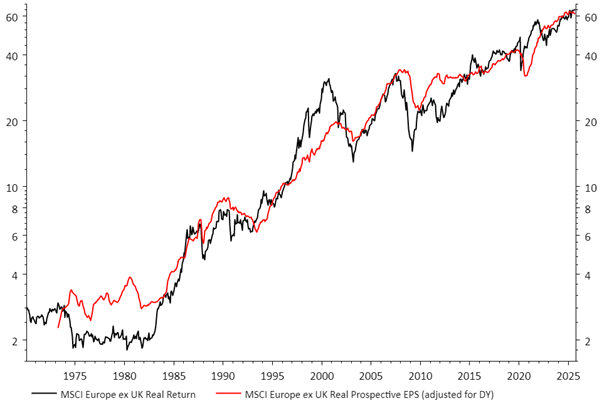
Over the past 50 years or so, the dividend yield (DY) for the FTSE World Europe ex UK index has averaged 3% and EPS has grown at about 3 percentage points per annum faster than inflation. A rough approximation would suggest investors should have seen real returns of about 6% (DY plus EPS growth) and indeed it has been about 7.2% per annum (equities have re-rated since the depths of despair in the mid-1970s). The chart below would suggest that the performance of the European market broadly correlates with the trend in EPS. It is not obvious that it is clearly under- or overvalued.
Europe ex UK Market - in line with trend
Source: LSEG Datastream
What do we do differently?
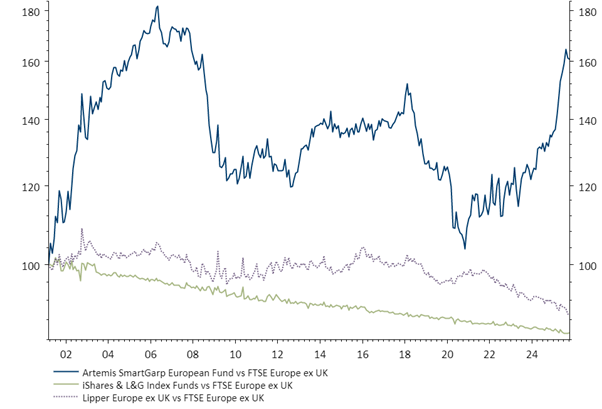
An investor who did not want to buy individual stocks could buy an active or passively managed fund. The chart below illustrates the outcome of investing relative to the benchmark.
Spot the difference
Source: LSEG Datastream
Low-cost index trackers have trailed the market by about 0.6 percentage points per annum since we launched our fund. Active funds (represented in the above chart by the Lipper Europe ex UK sector) have trailed the market by 0.5 percentage points per annum and by more than this in the past few years. Our own fund has outperformed by 2.0 percentage points per annum over the same period. So clearly, we have been doing something differently.
Index funds buy stocks that should match the market. The fees they have charged have averaged 60bps over the years (although fees will be lower nowadays). Active managers are trying to beat the market but charge higher fees. The universe of Europe ex UK managers has not done a bad job, but nevertheless it has hardly been a fantastic advert for active managers (and Europe ex UK represents one of the better outcomes).
A typical active manager meets company management teams, carries out in-depth research and invests in maybe 50 of their best ideas, probably holding these stocks for about three years. The outcome would suggest that on average their best ideas are not good enough.
Our approach is somewhat different. Using a combination of theory, logic and academic evidence, we have built a process that mimics what active managers say they do but executes it in a systematic fashion.
Just like them, we look at growth, valuations, accounting quality and the economic backdrop, then add another layer of insights (changes in profit forecasts, price momentum and the ownership of stocks by active managers).
Our conviction is in our factors rather than the stocks: we want to own the ones with good financial characteristics. If the data changes, we change our holdings. The result is that our portfolio tends to have persistently good financial characteristics, but we have more names (nearer 80) and higher portfolio turnover (on average, we hold stocks for less than one year) than many of our peers.
Higher EPS growth
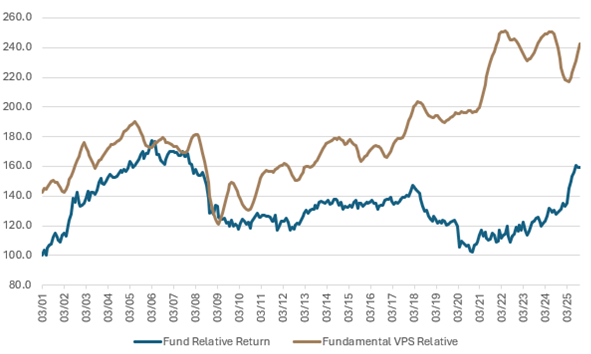
The portfolio has raised its EPS by more than 3 percentage points per annum faster than the market. I believe this is why our fund has outperformed. Even after taking account of transaction costs and other fees, the end investor will have effectively seen their share of EPS grow by about 2.2 percentage points per annum faster than the market – roughly in line with the long-term outperformance of the fund.
Artemis SmartGARP European Equity vs FTSE World Europe ex UK index
Source: LSEG Datastream
For a few years after early 2018, the fund's performance lagged well behind its relative EPS performance. In the past few years, the gap has narrowed but it has not fully closed. Given that our process still seems to alight on companies that are delivering superior growth, my belief is that we should continue to beat the market. The surprise is not so much that we are doing well but that everyone else persists with their own models that show little evidence of success.
Notes and references
Benchmarks: FTSE World Europe ex UK TR; A widely-used indicator of the performance of European stockmarkets, in which the fund invests. IA Europe Excluding UK NR; A group of other asset managers’ funds that invest in similar asset types as this fund, collated by the Investment Association. These act as ‘comparator benchmarks’ against which the fund’s performance can be compared. Management of the fund is not restricted by these benchmarks.
FOR PROFESSIONAL INVESTORS AND/OR QUALIFIED INVESTORS AND/OR FINANCIAL INTERMEDIARIES ONLY. NOT FOR USE WITH OR BY PRIVATE INVESTORS.
CAPITAL AT RISK. All financial investments involve taking risk and the value of your investment may go down as well as up. This means your investment is not guaranteed and you may not get back as much as you put in. Any income from the investment is also likely to vary and cannot be guaranteed.
This is a marketing communication. Before making any final investment decisions, and to understand the investment risks involved, refer to the fund prospectus (or in the case of investment trusts, Investor Disclosure Document and Articles of Association), available in English, and KIID/KID, available in English and in your local language depending on local country registration, available in the literature library.

Risks specific to Artemis SmartGARP European Equity Fund
- Market volatility risk The value of the fund and any income from it can fall or rise because of movements in stockmarkets, currencies and interest rates, each of which can move irrationally and be affected unpredictably by diverse factors, including political and economic events.
- Currency risk The fund’s assets may be priced in currencies other than the fund base currency. Changes in currency exchange rates can therefore affect the fund's value.
- Charges from capital risk Where charges are taken wholly or partly out of a fund's capital, distributable income may be increased at the expense of capital, which may constrain or erode capital growth.
Important information
The intention of Artemis’ ‘investment insights’ articles is to present objective news, information, data and guidance on finance topics drawn from a diverse collection of sources. Content is not intended to provide tax, legal, insurance or investment advice and should not be construed as an offer to sell, a solicitation of an offer to buy, or a recommendation for any security or investment by Artemis or any third-party. Potential investors should consider the need for independent financial advice. Any research or analysis has been procured by Artemis for its own use and may be acted on in that connection. The contents of articles are based on sources of information believed to be reliable; however, save to the extent required by applicable law or regulations, no guarantee, warranty or representation is given as to its accuracy or completeness. Any forward-looking statements are based on Artemis’ current opinions, expectations and projections. Articles are provided to you only incidentally, and any opinions expressed are subject to change without notice. The source for all data is Artemis, unless stated otherwise. The value of an investment, and any income from it, can fall as well as rise as a result of market and currency fluctuations and you may not get back the amount originally invested.