Artemis SmartGARP Global Emerging Markets Equity Fund
Q4 2025 update


Source for all information: Artemis as at 31 December 2025, unless otherwise stated.
Performance
Emerging market equities finished 2025 strongly, extending a recovery that gathered pace through the year. Meanwhile the fund delivered a solid return in Q4 and outperformed over the full 12-month period, benefiting from disciplined stock selection and differentiated positioning away from consensus exposures. We achieved this outperformance without a heavy reliance on the most popular themes, reinforcing the benefits of diversification and valuation discipline as market leadership broadened.
- Artemis SmartGARP Global Emerging Markets Equity returned 6.4% during the fourth quarter of 2025 in sterling terms, beating its benchmark by 1.6 percentage points.
- Performance for the 2025 calendar year was strong, with the fund gaining 30.3% versus 24.4% for the MSCI Emerging Markets index.
- The fund is the best performer in its IA Global Emerging Markets sector over five and 10 years.
| Three months | Six months | One year | Three years | Five years | |
|---|---|---|---|---|---|
| Artemis SmartGARP Global Emerging Markets Equity | 6.4% | 21.7% | 30.3% | 67.7% | 84.0% |
| MSCI Emerging Markets NR | 4.8% | 18.1% | 24.4% | 41.0% | 24.8% |
| IA Global Emerging Markets average | 4.4% | 16.8% | 21.9% | 37.7% | 23.1% |
Past performance is not a guide to the future. Source: Lipper Limited/Artemis as at 31 December 2025 for class I accumulation GBP. All figures show total returns with dividends and/or income reinvested, net of all charges. Performance does not take account of any costs incurred when investors buy or sell the fund. Returns may vary as a result of currency fluctuations if the investor's currency is different to that of the class. Classes may have charges or a hedging approach different from those in the IA sector benchmark.
Summary
- The recovery in emerging markets is firmly underway, supported by monetary easing, resilient growth and improving earnings momentum.
- Strong contributions to performance have come from commodities, industrials and selective China exposure.
- The fund remains meaningfully differentiated, with a clear value bias and limited exposure to crowded growth themes.
- Its valuation remains attractive at around a 25% discount to the MSCI Emerging Markets index, alongside improving earnings trends and strong cash generation.
- Watch a brief video giving our outlook for emerging markets in 2026.
If the fund were a stock...
Key financial characteristics
Source: Artemis, Lipper Limited, Morningstar from 5 September 2018 to 31 December 2025. All figures show total returns with dividends and/or income reinvested, net of all charges. Performance does not take account of any costs incurred when investors buy or sell the fund. Returns may vary as a result of currency fluctuations if the investor's currency is different to that of the class. Benchmark is MSCI EM (Emerging Markets) NR.
Attribution: Patience in fundamentals mattered more than fashionable themes
Returns during the fourth quarter were driven by a shift in focus towards companies linked to essential materials and industries, rather than long-dated growth narratives.
Holdings in metals and materials performed well as commodity prices strengthened, supply remained tight after years of underinvestment and demand from electrification, infrastructure and industrial activity continued to grow. China Hongqiao (an aluminium producer) and Western Mining (a state-owned metal mining company in China) benefited from stronger pricing and disciplined cost structures, supported by their scale and market positions in scarce resources.
In technology, performance reflected selectivity rather than theme exposure. Wiwynn (a cloud IT infrastructure provider for hyperscale data centres, headquartered in Taiwan) and Samsung contributed positively to returns as investors differentiated between businesses with execution and balance sheet strength versus those where expectations had already moved too far ahead of fundamentals.
Several domestic market leaders also performed well, including Indus Towers (a mobile-tower installation company in India), Grupo Cibest (a Colombian financial services company) and Kia (a South Korean car manufacturer). These names were supported by steady operational progress rather than market excitement.
On the weaker side, performance was influenced as much by sentiment as by fundamentals. Underweights in Taiwan Semiconductor Manufacturing Company (TSMC) and SK Hynix (a Korean semiconductor manufacturer) detracted as enthusiasm for semiconductors returned late in the year.
Elsewhere, Geely (a Chinese automobile manufacturer) and Sino Biopharm (a pharmaceutical conglomerate in China) came under pressure despite continued progress in their underlying businesses. We view this weakness as being cyclical or sentiment-driven rather than reflecting a change in long-term prospects.
Activity: Recycling capital towards improving businesses
Portfolio activity reflected our SmartGARP investment process, which uses data to identify companies where earnings are improving, share prices have yet to reflect that improvement and investor behaviour is starting to change – while valuations remain sensible.
We initiated a position in WT Microelectronics, an electronic components distributor in Taiwan, even though there is already widespread enthusiasm for technology stocks. The company is growing rapidly, yet trades on a forward price-to-earnings (P/E) ratio of about 10x, alongside strong value per share growth of around 20% and a clear positive change in earnings forecasts over the past three months – a rare combination in today’s market. We also initiated a position in LG Innotek, a South Korean electronic components manufacturer, which offers an attractive valuation, strong long-term returns on capital and improving earnings expectations further down the technology supply chain.
Other new positions reflected similar characteristics across different parts of emerging markets. South African miner Northam Platinum offers exposure to tight supply conditions in platinum group metals; Chinese online discount retailer Vipshop provides a disciplined and differentiated method of accessing Chinese consumption; and steel manufacturer Hoa Phat benefits from Vietnam’s infrastructure and industrial build-out following a cyclical downturn.
We increased positions in the following companies, where improving fundamentals and supportive market behaviour persist:
- Huayu Automotive Systems, a Chinese automotive parts manufacturer
- Bharat Petroleum, an Indian oil producer
- Tüpraş, a petroleum refineries company in Turkey
- Ultrapar, a Brazilian energy and logistics infrastructure conglomerate
- Samsung, the Korean electronics and technology company
- Sunny Optical, a Chinese optical components supplier
- Eicher Motors, which manufactures motorcycles and commercial vehicles in India
- Grupo México, a mining, transportation and infrastructure conglomerate
We exited Alpha Bank, JD.com, Dr Reddy’s, PKO Bank, Gree Electric, Richter and Qfin, and reduced exposure to Alibaba, Emaar, CMOC, Kasikornbank and JB Financial, where prices had moved ahead of fundamentals or momentum had faded.
Positioning: Exposure focused where sentiment is low and opportunities underappreciated
The portfolio remains positioned differently to peers. We are overweight China, where policy support is in place but patience is still required as confidence rebuilds. We are also overweight Latin America, particularly Brazil, alongside commodities and industrials, where cyclical recovery is meeting longer-term demand. In addition, we have exposure to South Africa, where valuations remain depressed despite improving fundamentals. We remain underweight India and Taiwan, where optimism is high and valuations leave little room for disappointment.
A differentiated value profile: Low valuations, improving earnings and strong cash generation
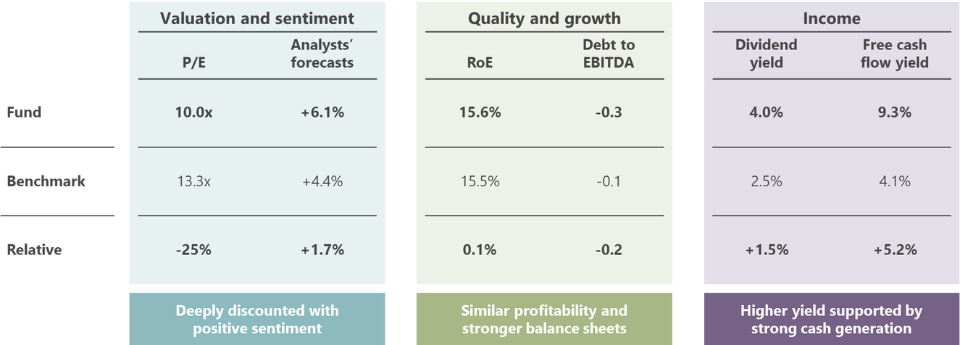
The fund remains heavily biased towards value. It trades on around 10x earnings, a discount of about 25% to the market, despite delivering similar profitability and carrying stronger balance sheets at the aggregate level.
Earnings forecasts continue to rise faster than those of the benchmark, while income is meaningfully higher, with a 4% dividend yield and a free cashflow yield of more than 9%, supported by solid cash generation. With many active managers still concentrated in higher-growth areas, the fund offers a distinct and complementary exposure within emerging markets.
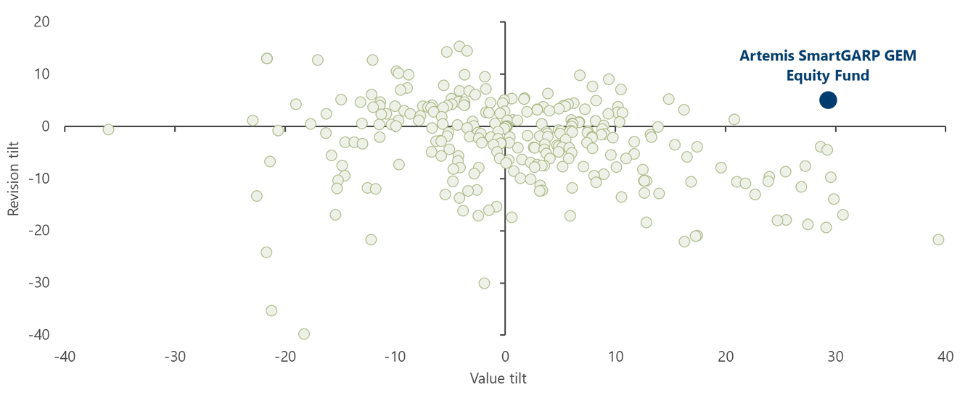
The chart below highlights the fund’s positioning. While many value peers sit in areas of weak valuation support or earnings downgrades, our fund is concentrated in cheap stocks benefiting from upgrades. This combination of value and improving fundamentals is rare.
What sets us apart from other value funds?
Good value and upgrades
Source: Morningstar, Artemis as at 31 December 2025
The emerging markets recovery is underway, but investors are still catching up
The recovery in emerging markets is now well established. US rate cuts have taken place without a crisis, growth has proven resilient, the dollar has weakened and emerging market central banks have begun to ease. This combination has underpinned a strong advance over the past year.
Yet global investors remain structurally under-allocated. Even after a powerful rally, positioning remains light and flows have lagged the improvement in fundamentals. The recovery is real, but ownership has not yet caught up.
China remains central and still requires patience. While the economy is uneven, policy support is now visible across infrastructure, services and household measures, and valuations remain low despite the market’s recovery. Latin America illustrates how quickly sentiment can turn, with Brazil benefiting from falling inflation expectations, lower real yields and improving domestic demand.
Outlook: Consistency, patience and discipline provide an edge as volatility persists
As markets continue to recover, we remain focused on disciplined capital allocation through volatility, guided by a repeatable framework rather than short-term emotion. Strong performance can quickly give way to overconfidence, particularly when leadership narrows and sentiment becomes one-sided.
It is now five years since Covid reshaped the global economy. Inflation rose, interest rates moved sharply higher and long-held assumptions were challenged. Investors were slow to adapt and many misjudged where durable returns would emerge. A patient, valuation-aware approach has proved to be more effective as the cycle evolved.
Looking ahead, several themes continue to support emerging markets. Commodity demand remains underpinned by infrastructure investment, electrification and energy transition. Domestic recovery, particularly in Brazil and South Africa, is supported by high real interest rates, improving real incomes and scope for policy easing. In Asia, rising household wealth is driving consumption in more selective ways, while infrastructure build-out continues across multiple regions.
At the same time, risks are emerging elsewhere. Political uncertainty in the US (including renewed policy volatility), rising debt levels in developed economies and concentrated equity markets all raise the risk of sharper swings in sentiment. These conditions reinforce the case for diversification and discipline rather than chasing late-cycle enthusiasm.
Volatility is likely to persist, but with attractive valuations, improving fundamentals and wide dispersion across markets, we believe a consistent, process-driven approach remains well suited to the next phase of the emerging market cycle.
FOR PROFESSIONAL INVESTORS AND/OR QUALIFIED INVESTORS AND/OR FINANCIAL INTERMEDIARIES ONLY. NOT FOR USE WITH OR BY PRIVATE INVESTORS.
CAPITAL AT RISK. All financial investments involve taking risk and the value of your investment may go down as well as up. This means your investment is not guaranteed and you may not get back as much as you put in. Any income from the investment is also likely to vary and cannot be guaranteed.
This is a marketing communication. Before making any final investment decisions, and to understand the investment risks involved, refer to the fund prospectus (or in the case of investment trusts, Investor Disclosure Document and Articles of Association), available in English, and KIID/KID, available in English and in your local language depending on local country registration, available in the literature library.

Risks specific to Artemis SmartGARP Global Emerging Markets Equity Fund
- Market volatility risk The value of the fund and any income from it can fall or rise because of movements in stockmarkets, currencies and interest rates, each of which can move irrationally and be affected unpredictably by diverse factors, including political and economic events.
- Currency risk The fund’s assets may be priced in currencies other than the fund base currency. Changes in currency exchange rates can therefore affect the fund's value.
- Charges from capital risk Where charges are taken wholly or partly out of a fund's capital, distributable income may be increased at the expense of capital, which may constrain or erode capital growth.
- Emerging markets risk Compared to more established economies, investments in emerging markets may be subject to greater volatility due to differences in generally accepted accounting principles, less governed standards or from economic or political instability. Under certain market conditions assets may be difficult to sell.
- China risk The fund can invest in China A-shares (shares traded on Chinese stock exchanges in Renminbi). There is a risk that the fund may suffer difficulties or delays in enforcing its rights in these shares, including title and assurance of ownership.
Important information
The intention of Artemis’ ‘investment insights’ articles is to present objective news, information, data and guidance on finance topics drawn from a diverse collection of sources. Content is not intended to provide tax, legal, insurance or investment advice and should not be construed as an offer to sell, a solicitation of an offer to buy, or a recommendation for any security or investment by Artemis or any third-party. Potential investors should consider the need for independent financial advice. Any research or analysis has been procured by Artemis for its own use and may be acted on in that connection. The contents of articles are based on sources of information believed to be reliable; however, save to the extent required by applicable law or regulations, no guarantee, warranty or representation is given as to its accuracy or completeness. Any forward-looking statements are based on Artemis’ current opinions, expectations and projections. Articles are provided to you only incidentally, and any opinions expressed are subject to change without notice. The source for all data is Artemis, unless stated otherwise. The value of an investment, and any income from it, can fall as well as rise as a result of market and currency fluctuations and you may not get back the amount originally invested.