Artemis SmartGARP Global Emerging Markets Equity Fund
Q1 2026 update

Source for all information: Artemis as at 30 March 2026, unless otherwise stated.
Summary
- The fund made a strong start to the year, returning 5.3% versus 1.8% from its benchmark index
- Returns were driven by a diverse group of holdings, including energy companies and financials
- Our differentiated portfolio offers meaningful exposure to China, Latin America and commodities
- Read our latest insight: Why it's not too late to invest in emerging markets
Performance
Although emerging markets weakened in March as investors responded to geopolitical tension by moving into perceived safe havens, the fund returned 5.3% over the quarter. It thereby outperformed the MSCI Emerging Markets index (up 1.8%) and its peer group average (up 2.1%).
This return placed the fund in the top quartile of its peer group, the Investment Association's Global Emerging Markets sector, and it continues its strong run of performance across longer time horizons. Over the past 12 months, the fund has delivered 35.5%, versus a return of 26.8% from the benchmark index. It has also outperformed the index over three, five and 10 years as well as since its launch in 2015.
| Three months | Six months | One year | Three years | Five years | |
|---|---|---|---|---|---|
| Artemis SmartGARP Global Emerging Markets Equity | 5.3% | 12.1% | 35.5% | 72.4% | 76.6% |
| MSCI Emerging Markets NR | 1.8% | 6.7% | 26.8% | 42.0% | 25.4% |
| IA Global Emerging Markets average | 2.1% | 6.6% | 26.2% | 38.3% | 23.0% |
Past performance is not a guide to the future. Source: Lipper Limited/Artemis as at 31 March 2026 for class I accumulation GBP. All figures show total returns with dividends and/or income reinvested, net of all charges. Performance does not take account of any costs incurred when investors buy or sell the fund. Returns may vary as a result of currency fluctuations if the investor's currency is different to that of the class. Classes may have charges or a hedging approach different from those in the IA sector benchmark.
Commentary: The rally is broadening but some investors are still chasing the obvious
During the first quarter, growth in corporate earnings continued to broaden out beyond a narrow group of stocks. This dynamic was reflected in our fund's returns, which came from a range of sectors, particularly financials, energy and industrials. And while parts of the market associated with AI have continued to perform well – and remain a significant driver of index returns – a number of companies outside the main technology complex are delivering improving results. This is not yet fully reflected in their share prices or in investor positioning. We prefer to have more exposure to these overlooked stocks and remain cautious on more popular areas of the market.
China remains a good example of this. Its recovery is not straightforward and confidence remains fragile, but policy support is becoming more visible and activity appears to be stabilising in some parts of the economy. Many Chinese companies continue to trade on low valuations despite their improving fundamentals. Elsewhere, high real interest rates and improving economic conditions in markets such as Brazil and South Africa are attracting inflows.
Periods of volatility, such as those seen in March, are a reminder that sentiment can shift quickly, particularly when investor positioning is concentrated. However, they do not alter the underlying direction of travel. Overall, the environment remains supportive for a more balanced market, one in which returns are driven by a wider range of companies. While this process may take time, it is increasingly evident in both corporate earnings and share price performance.
Attribution: Broad-based gains, not reliant on crowded trades
The fund's strong performance was driven by a broad range of holdings. Samsung Electronics was one key contributor as earnings expectations increased and its valuation remained supportive. Our underweight exposure to Alibaba and Tencent also helped. Both stocks were weak over the period, with their increased investment in AI weighing on near-term cashflows.
Elsewhere, WT Microelectronics and Geely Auto performed well on strong earnings. Holdings in the energy sector such as Petrobras, Tupras and Orlen benefited from higher oil prices and strong cash generation. Brazilian energy conglomerate Ultrapar also contributed as domestic conditions in Brazil improved.
On the negative side, Wiwynn weakened following a strong run. Our underweight to semiconductors detracted, with TSMC and SK Hynix continuing to perform strongly. Ping An Insurance weakened alongside financial stocks in China. CMOC, Eicher Motors and Muyuan Foods were weaker due to cyclical factors.
Activity: Backing winners but cutting positions when fundamentals weaken
Overall, our activity over the quarter reflects a consistent approach. We run our winners for as long as the fundamentals continue to hold, but are prompt to reduce our exposure when the investment case weakens.
Activity during the quarter was focused on increasing our exposure to financials, energy stocks and to the recovery in domestic demand in China. As such, additions included Chinese banks such as ICBC and Bank of China and energy stocks PetroChina and Petrobras. We also increased the fund's exposure to industrials, including Weichai Power. We added to holdings in CICC, Haier Smart Home and Sinopharm, reflecting improving domestic activity.
On the sell side, we cut Tencent, Naspers and Alibaba, where earnings and the outlook for cashflows had weakened. We trimmed holdings in Samsung Electronics and Asustek. We took profits on the position in CMOC following its strong performance and sold Muyuan Foods because its fundamentals had deteriorated.
Positioning: Focusing where sentiment is weak and opportunities are underappreciated
The portfolio continues to be positioned quite differently to most of its peers. For example, we have relatively little exposure to Taiwan, where investor positioning – particularly in the technology sector – tends to be crowded. We also remain underweight in India, where valuations tend to be higher than in other Asian markets.
Offsetting this, we are overweight in China, where we believe policy support and stabilising demand have yet to be fully reflected in valuations. We are also overweight in Brazil, where high real interest rates support financials. Low valuations and real yields are helping to make a number of South African stocks look attractive. At a sector level, we favour financials, energy, materials and industrials, where earnings are improving but valuations remain undemanding.
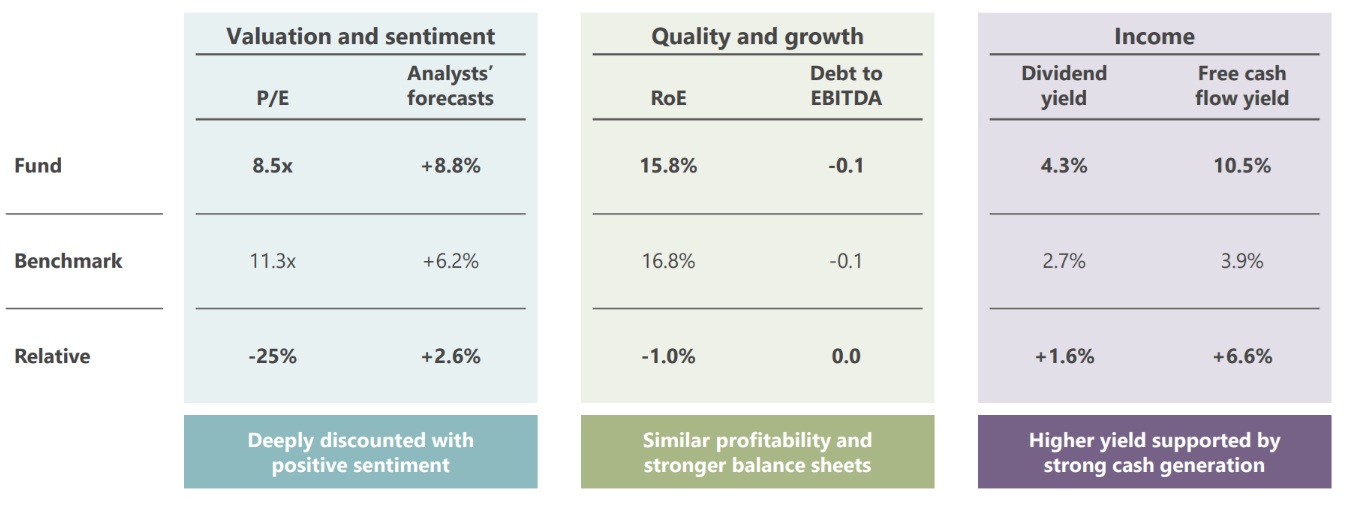
At the portfolio level, this results in a fund that trades on a meaningful valuation discount to the MSCI Emerging Markets Index, with strong cash generation and resilient balance sheets relative to the broader market.
If the fund were a stock: Key financial characteristics
Source: Artemis as at 31 March 2026. Benchmark is MSCI Emerging Markets. All figures show total returns with dividends and/or income reinvested, net of all charges. Performance does not take account of any costs incurred when investors buy or sell the fund. Returns may vary as a result of currency fluctuations if the investor's currency is different to that of the class. Benchmark is MSCI EM (Emerging Markets) NR.
Outlook: Amid volatility, we prize consistency, patience and discipline
Periods of volatility, such as those seen towards the end of the quarter, tend to reflect the behavioural biases of investors more than fundamentals. A common pattern is that investors become more cautious after markets fall, reducing risk at precisely the point where valuations are becoming more attractive. Over time, this tendency to react to prices rather than fundamentals helps to explain why the average investor earns weaker returns than the market.
Our approach is to remain disciplined throughout these periods of volatility. SmartGARP provides a consistent framework to identify companies whose earnings are improving, where valuations remain supportive and where investor expectations are still low. This helps us to avoid behavioural biases and ensures decisions are grounded in data rather than sentiment.
Portfolio construction is equally important. Many risks are difficult to predict, particularly those driven by geopolitics. We believe a portfolio that is well diversified across sector and by country, and which has multiple drivers to returns, provides the most robust way to manage these uncertainties.
We consistently focus on maintaining exposure to companies with improving fundamentals, while being disciplined in reducing positions whenever the investment case weakens. Over time, this combination of process, diversification and discipline has proven to be a more effective way of navigating volatility than attempting to anticipate short-term market movements.
FOR PROFESSIONAL INVESTORS AND/OR QUALIFIED INVESTORS AND/OR FINANCIAL INTERMEDIARIES ONLY. NOT FOR USE WITH OR BY PRIVATE INVESTORS.
CAPITAL AT RISK. All financial investments involve taking risk and the value of your investment may go down as well as up. This means your investment is not guaranteed and you may not get back as much as you put in. Any income from the investment is also likely to vary and cannot be guaranteed.
This is a marketing communication. Before making any final investment decisions, and to understand the investment risks involved, refer to the fund prospectus (or in the case of investment trusts, Investor Disclosure Document and Articles of Association), available in English, and KIID/KID, available in English and in your local language depending on local country registration, available in the literature library.

Risks specific to Artemis SmartGARP Global Emerging Markets Equity Fund
- Market volatility risk The value of the fund and any income from it can fall or rise because of movements in stockmarkets, currencies and interest rates, each of which can move irrationally and be affected unpredictably by diverse factors, including political and economic events.
- Currency risk The fund’s assets may be priced in currencies other than the fund base currency. Changes in currency exchange rates can therefore affect the fund's value.
- Charges from capital risk Where charges are taken wholly or partly out of a fund's capital, distributable income may be increased at the expense of capital, which may constrain or erode capital growth.
- Emerging markets risk Compared to more established economies, investments in emerging markets may be subject to greater volatility due to differences in generally accepted accounting principles, less governed standards or from economic or political instability. Under certain market conditions assets may be difficult to sell.
- China risk The fund can invest in China A-shares (shares traded on Chinese stock exchanges in Renminbi). There is a risk that the fund may suffer difficulties or delays in enforcing its rights in these shares, including title and assurance of ownership.
Important information
The intention of Artemis’ ‘investment insights’ articles is to present objective news, information, data and guidance on finance topics drawn from a diverse collection of sources. Content is not intended to provide tax, legal, insurance or investment advice and should not be construed as an offer to sell, a solicitation of an offer to buy, or a recommendation for any security or investment by Artemis or any third-party. Potential investors should consider the need for independent financial advice. Any research or analysis has been procured by Artemis for its own use and may be acted on in that connection. The contents of articles are based on sources of information believed to be reliable; however, save to the extent required by applicable law or regulations, no guarantee, warranty or representation is given as to its accuracy or completeness. Any forward-looking statements are based on Artemis’ current opinions, expectations and projections. Articles are provided to you only incidentally, and any opinions expressed are subject to change without notice. The source for all data is Artemis, unless stated otherwise. The value of an investment, and any income from it, can fall as well as rise as a result of market and currency fluctuations and you may not get back the amount originally invested.