Artemis Monthly Distribution Fund
Q3 2026 update



Source for all information: Artemis as at 29 September 2026, unless otherwise stated.
Summary
- The fund returned 0.8% over the quarter, compared with an average return of -0.1% from the IA Mixed Investment 20-60% Shares sector
- Equities made a positive contribution, led by banks, energy holdings and IT services companies. A rise in government bond yields weighed on the fund's fixed-income positions
- We reduced the fund's exposure to equities and selectively added to holdings in shorter-dated, higher-quality high-yield bonds
Overview
The third quarter saw a number of competing narratives pulling in different directions. The result was elevated volatility across asset classes and on an individual stock level. On one side, the AI super-cycle continued, with exceptionally high capital expenditure supporting corporate earnings growth, particularly in parts of the technology sector. Survey data and other indicators continued to point to resilient economic growth.
On the other side, renewed hostilities in the Middle East pushed oil prices higher, adding to inflationary pressures. The US Federal Reserve raised interest rates for the first time in three years and government bond yields rose to multi-decade highs. The rise in government bond yields became particularly pronounced in September and was accompanied by a widening in high-yield credit spreads.
Against this volatile backdrop, the fund returned 0.8% in sterling terms over the quarter, compared with an average -0.1% return from the IA's Mixed Investment 20-60% Shares sector. Equities were the main contributor to the fund’s positive return, led by banks, energy and IT services. Set against that, the fund's fixed income holdings detracted as government bonds sold off and credit spreads widened, although our relatively short-duration positioning helped to limit the impact.
Performance
The fund's performance was ahead of its peer group over the quarter and remains strong over longer timeframes. It is in the top quartile of the IA Mixed Investment 20-60% Shares sector over the year to date and over one, two, three, four and five years.
| Three months | Year to date | One year | Three years | Five years | |
|---|---|---|---|---|---|
| Artemis Monthly Distribution | 0.8% | 11.3% | 15.8% | 67.5% | 67.0% |
| IA Mixed Investment 20-60% Shares | -0.1% | 5.3% | 8.2% | 30.3% | 21.1% |
Past performance is not a guide to the future. Source: Lipper Limited to 30 September 2026 for class I Inc GBP. All figures show total returns with dividends and/or income reinvested, net of all charges. Performance does not take account of any costs incurred when investors buy or sell the fund. Returns may vary as a result of currency fluctuations if the investor’s currency is different to that of the class.
Contributors
Accenture was the largest individual contributor, while Cognizant also performed strongly. Over the previous 12-to-18 months, both IT services companies had de-rated as investors became concerned that generative AI could threaten their business models. We added them to the fund because we thought those concerns were overdone. Both rallied during the third quarter as the market's view moved closer to ours and, even after those gains, we believe these companies’ shares remain attractively valued relative to their history. They could also benefit from the investment that will be required to implement AI across large organisations.
Vår Energi performed strongly following its agreement to acquire BlueNord, a smaller North Sea energy producer. The transaction strengthens Vår's reserve base. Its shares offer a high dividend yield, which we regard as an attractive starting point even before allowing for potential growth in its earnings or dividends.
Banks were another important source of returns. Banco de Sabadell, Lion Finance and Standard Chartered were among our stronger performers. Higher interest rates have supported the banks' profitability, their balance sheets are generally strong and many continue to return excess capital to their shareholders through a combination of dividends and share buybacks.
Positive contributions from the bond portfolio included the high-yield bonds of ZipRecruiter, Ubisoft and Mobico.
Detractors
Some of the fund's investments connected to the AI capital-expenditure cycle weakened. Prysmian was among the larger detractors, while Samsung Electronics also fell. This partly represented a reversal of a theme that had been highly profitable for the fund over the preceding two-to-three years. As investors begin to question the prospective returns from the extraordinary sums being invested in AI infrastructure, we are conscious that the 'picks and shovels' beneficiaries may have less room to run.
Other South Korean holdings, including Samsung Life, Samsung C&T and SK Inc, also detracted. We have been reducing the fund’s exposure to South Korea, where share prices have become more sensitive to changing perceptions about the durability of the AI investment cycle.
Within fixed income, the price of the fund's holdings in US Treasury Inflation-Protected Securities (TIPS) fell as real yields rose. Real yields – the return investors receive above inflation over the bonds' lifetime – have increased to levels last seen in the early 2000s. Although this hurt returns during the quarter, we are attracted to the combination of high real yields and the diversification that TIPS can provide in a risk-off environment.
Our holdings in Accendra Health’s debt also detracted from returns. Disappointing earnings sent the US medical-distribution company's bonds into distressed territory. Although we are conscious of the risks, we believe their price significantly understates the possibility of an improvement in operating performance. The size of our position is deliberately small and we believe the company has sufficient liquidity to give it time to demonstrate the value that could emerge through an operational recovery.
Activity and positioning
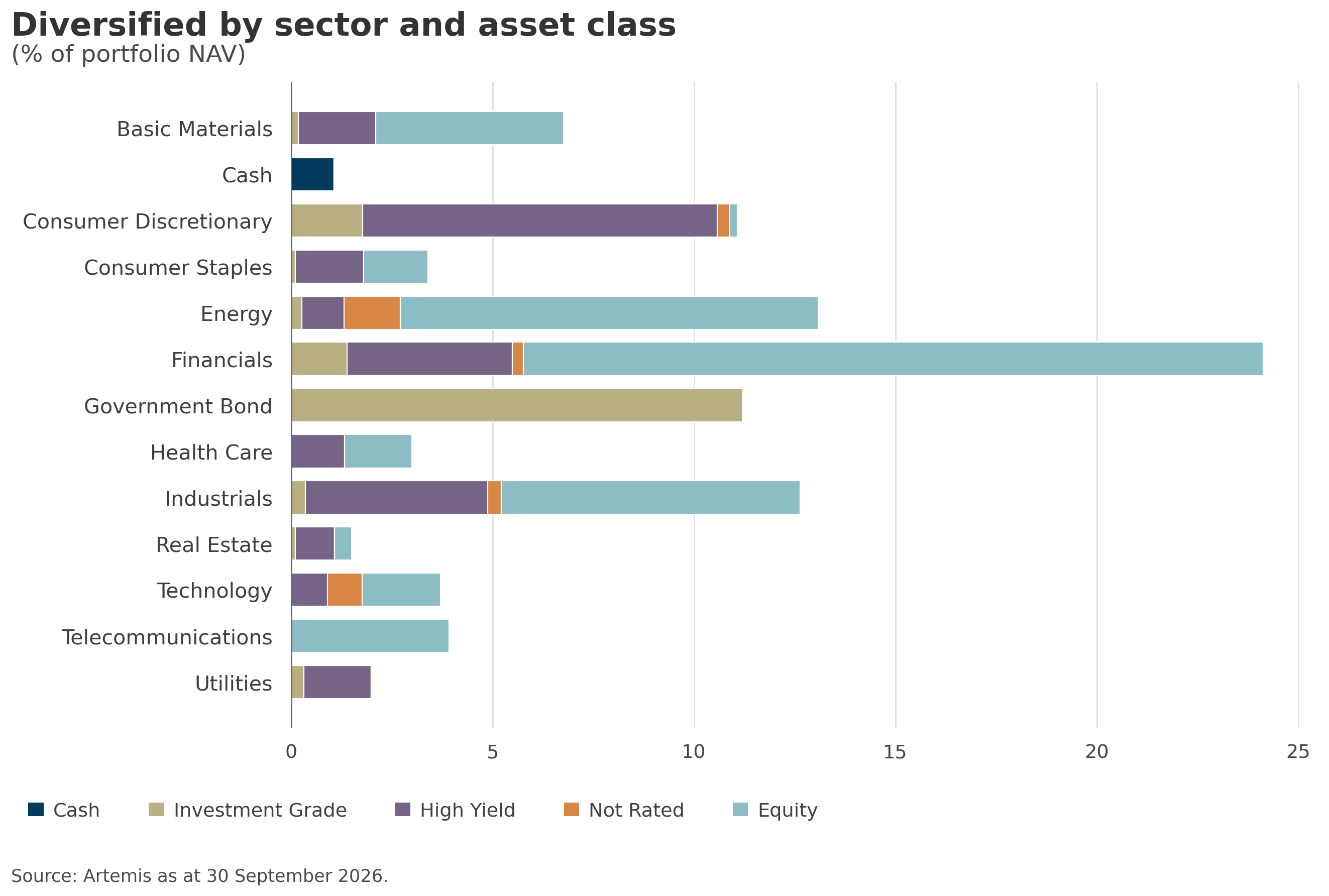
Over the quarter, we reduced the fund’s equity allocation from 53% to 48%, while increasing its exposure to bonds.
This partly reflected profit-taking in areas that had performed strongly, including some AI-related beneficiaries and South Korean equities. Reducing the fund's holding in Samsung Electronics lowered its exposure to the Korean market, which had become volatile. It also reflected our concern that higher yields at both the long and short end of the bond market could begin to draw liquidity away from risk assets.
Beyond this, the broad shape of the fund’s equity portfolio remained unchanged. We continue to favour banks and other 'old economy', asset-intensive industries, while maintaining relatively limited exposure to technology.
The broad positioning of the bond portfolio remained largely unchanged. Around 30% of the overall fund, equivalent to more than 60% of its bond allocation, remains invested in shorter-dated, higher-quality high-yield bonds. Focusing on bonds with relatively short maturities limits the fund's exposure to movements in long-term government bond yields. The sell-off in September increased the number of shorter-dated bonds trading below par, creating the potential for an additional capital return if issuers redeem them ahead of maturity.
Within credit, one of the larger additions was FMC. The price of this US agricultural-chemicals company's bonds fell due to a difficult industry backdrop, higher input costs, the expiry of intellectual-property protection on two products and complications surrounding its Indian business. Set against that, it remains cash-generative and has a promising pipeline of new products and several options to strengthen its balance sheet.
We also added shorter-dated secured bonds issued by Whirlpool. The investment case rests on better execution, a cleaner business following disposals, an improving product cycle and relatively low leverage rather than on the assumption of a strong recovery in the US housing market.
We remain wary of the rapid growth in AI-related debt issuance seen this year. Bondholders participate in little of the potential upside if investment in AI delivers exceptional returns, while remaining exposed to much of the downside if it disappoints.
Outlook
There is a growing tension between bond and equity markets. Governments’ borrowing requirements remain enormous, inflation continues to be problematic and risk-free interest rates across much of the developed world are at levels not seen for many years. Yet equity markets have continued to perform strongly, supported in part by an AI-driven investment cycle that is producing rapid earnings growth in certain areas.
We do not know whether the recent rise in government bond yields will persist. What we can say is that the increase in yields has made prospective returns more attractive. Within credit, we continue to favour shorter-dated, higher-quality high-yield bonds issued by established, cash-generative businesses. These offer attractive income with relatively limited exposure to movements in long-term interest rates.
Within equities, the shorter-term outlook is uncertain. Over the longer term, however, the forces identified in our ‘regime change’ thesis remain intact. Government finances continue to deteriorate; inflation has proved more persistent than policymakers anticipated; geopolitics is forcing governments to spend more on security and self-sufficiency; and years of underinvestment in essential infrastructure still need to be corrected.
Against this backdrop, the portfolio remains deliberately straightforward: a broadly even combination of bonds and equities, providing a strong underlying income stream while maintaining relatively little exposure to some of the most crowded areas of the market. We believe that remains a sensible foundation from which to generate income alongside long-term capital growth.
FOR PROFESSIONAL INVESTORS AND/OR QUALIFIED INVESTORS AND/OR FINANCIAL INTERMEDIARIES ONLY. NOT FOR USE WITH OR BY PRIVATE INVESTORS.
CAPITAL AT RISK. All financial investments involve taking risk and the value of your investment may go down as well as up. This means your investment is not guaranteed and you may not get back as much as you put in. Any income from the investment is also likely to vary and cannot be guaranteed.
This is a marketing communication. Before making any final investment decisions, and to understand the investment risks involved, refer to the fund prospectus (or in the case of investment trusts, Investor Disclosure Document and Articles of Association), available in English, and KIID/KID, available in English and in your local language depending on local country registration, available in the literature library.

Risks specific to Artemis Monthly Distribution Fund
- Market volatility risk The value of the fund and any income from it can fall or rise because of movements in stockmarkets, currencies and interest rates, each of which can move irrationally and be affected unpredictably by diverse factors, including political and economic events.
- Currency risk The fund’s assets may be priced in currencies other than the fund base currency. Changes in currency exchange rates can therefore affect the fund's value.
- Bond liquidity risk The fund holds bonds which could prove difficult to sell. As a result, the fund may have to lower the selling price, sell other investments or forego more appealing investment opportunities.
- Higher-yielding bonds risk The fund may invest in higher-yielding bonds, which may increase the risk to capital. Investing in these types of assets (which are also known as sub-investment grade bonds) can produce a higher yield but also brings an increased risk of default, which would affect the capital value of the fund.
- Credit risk Investments in bonds are affected by interest rates, inflation and credit ratings. It is possible that bond issuers will not pay interest or return the capital. All of these events can reduce the value of bonds held by the fund.
- Charges from capital risk Because one of the key objectives of the fund is to provide income, the fund charges are taken from capital. This may constrain capital growth or erode capital.
- Emerging markets risk Compared to more established economies, investments in emerging markets may be subject to greater volatility due to differences in generally accepted accounting principles, less governed standards or from economic or political instability. Under certain market conditions assets may be difficult to sell.
- Income risk The payment of income and its level is not guaranteed.
Important information
The intention of Artemis’ ‘investment insights’ articles is to present objective news, information, data and guidance on finance topics drawn from a diverse collection of sources. Content is not intended to provide tax, legal, insurance or investment advice and should not be construed as an offer to sell, a solicitation of an offer to buy, or a recommendation for any security or investment by Artemis or any third-party. Potential investors should consider the need for independent financial advice. Any research or analysis has been procured by Artemis for its own use and may be acted on in that connection. The contents of articles are based on sources of information believed to be reliable; however, save to the extent required by applicable law or regulations, no guarantee, warranty or representation is given as to its accuracy or completeness. Any forward-looking statements are based on Artemis’ current opinions, expectations and projections. Articles are provided to you only incidentally, and any opinions expressed are subject to change without notice. The source for all data is Artemis, unless stated otherwise. The value of an investment, and any income from it, can fall as well as rise as a result of market and currency fluctuations and you may not get back the amount originally invested.