Can high yield bonds withstand a falling dollar?


As the American exceptionalism narrative wanes, global equity mandates are coming under scrutiny. The MSCI World index may be global in name, but it is American in nature, with the US accounting for 71% of assets as of 30 April 20251.
The global high-yield bond market is even more concentrated, with about 80% in dollar-denominated bonds2.
With the dollar's recent weakness calling its reputation as a safe haven into question and prompting investors to reconsider their direct and indirect exposure to the currency, you could be forgiven for casting a worried glance towards high yield.
Yet we believe the asset class will prove resilient to any flight of capital from the US, for two reasons.
The high-yield bond market isn’t reliant on demand
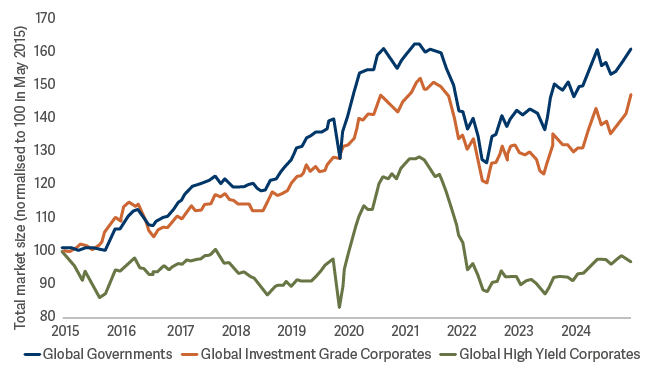
First and foremost, the high-yield bond market does not need additional demand to thrive. It has, in fact, shrunk over the past decade, whereas the opposite is the case for government debt and investment-grade credit. Government deficits have ballooned and investment-grade corporate bond issuance has ramped up significantly.
The high-yield bond market is in a completely different (and much more secure) place and has no need for a 'marginal buyer', stepping in to soak up excess bonds.
Global Government and Investment Grade Corporate bond markets have expanded significantly over the last decade; Global High Yield Corporate Bond market has not
Source: ICE BOFA
The second reason is that while the high-yield market has been contracting, large institutional investors have been increasing their allocations.
Historically, much of the market was dominated by 'tactical' investors such as hedge funds and mutual funds. However, these have been displaced in recent years by pension funds and insurers, which tend to take more of a buy-and-hold approach, meaning they have much longer time horizons. This 'stickiness' should shield the high-yield bond market from sudden swings in sentiment.
Doubling down on resilience
It is also worth pointing out that our Global High Yield Bond, Short-Dated Global High Yield Bond, High Income and Monthly Distribution Funds are more diversified and less exposed to the US currency than the wider market, with around half of our exposure in dollar-denominated bonds3.
What's more, we fully hedge all our dollar exposure, so if you own non-dollar share classes in our funds and the currency falls, your investments won't be affected.
We are bond experts, not currency traders. Trying to time currency movements can be akin to catching a falling knife, so we prefer to hedge currency risk and focus on generating alpha from high-conviction security selection.
Where currencies throw up opportunities
Now we've covered the currency risks in high yield, let's talk about the opportunities.
International companies often issue almost identical bonds from the same part of the capital structure and with the same maturity, but different yields depending upon the country in which they are issued.
One recent example is payments processor Shift4, which has a stranglehold over the US hospitality industry - if you go to a hotel in the US and settle your bill at reception, I can almost guarantee that a Shift4 logo will appear when you tap your card.
Shift4 recently bought a European business called Global Blue, which allows you to claim back VAT when you go through an airport. Now, because there’s a big European element to Global Blue’s business, it issued euro bonds to pay for the acquisition.
Yet these euro bonds have yields about 200bps above those of Shift4's dollar bonds4. There's no logical reason why they're trading there, apart from the fact that few euro investors have previously looked at Shift4 and need to be sold on the idea.
Meanwhile, we recently switched from euro to dollar bonds of German pharmaceutical Cheplapharm for a yield pickup of about 200bps4.
This is down to the siloed nature of US and European high yield, where investors only consider bonds in their home market. About 90%5 of high-yield bond funds have a regional, rather than a global approach, while we believe that a good chunk of the remaining 10%5 is made up of a couple of regional strategies that have been shunted together with little reference to one another.
This allows us to continuously make incremental gains without taking currency risk and sets us apart from our peers. When we say we’re global, we mean in both name and nature.
Notes and references
- https://www.msci.com/documents/10199/178e6643-6ae6-47b9-82be-e1fc565ededb
- Bloomberg as at 31/05/2025
- Artemis as at 30 April 2025
- Bloomberg/Artemis
- Bloomberg as at 31 January 2021
FOR PROFESSIONAL INVESTORS AND/OR QUALIFIED INVESTORS AND/OR FINANCIAL INTERMEDIARIES ONLY. NOT FOR USE WITH OR BY PRIVATE INVESTORS.
CAPITAL AT RISK. All financial investments involve taking risk and the value of your investment may go down as well as up. This means your investment is not guaranteed and you may not get back as much as you put in. Any income from the investment is also likely to vary and cannot be guaranteed.
This is a marketing communication. Before making any final investment decisions, and to understand the investment risks involved, refer to the fund prospectus (or in the case of investment trusts, Investor Disclosure Document and Articles of Association), available in English, and KIID/KID, available in English and in your local language depending on local country registration, available in the literature library.
Risks specific to Artemis Funds (Lux) – Global High Yield Opportunities
- Market volatility risk The value of the fund and any income from it can fall or rise because of movements in stockmarkets, currencies and interest rates, each of which can move irrationally and be affected unpredictably by diverse factors, including political and economic events.
- Currency hedging risk The fund hedges with the aim of protecting against unwanted changes in foreign exchange rates. The fund is still subject to market risks, may not be completely protected from all currency fluctuations and may not be fully hedged at all times. The transaction costs of hedging may also negatively impact the fund’s returns.
- Bond liquidity risk The fund holds bonds which could prove difficult to sell. As a result, the fund may have to lower the selling price, sell other investments or forego more appealing investment opportunities.
- Higher-yielding bonds risk The fund may invest in higher-yielding bonds, which may increase the risk to capital. Investing in these types of assets (which are also known as sub-investment grade bonds) can produce a higher yield but also brings an increased risk of default, which would affect the capital value of the fund.
- Credit risk Investments in bonds are affected by interest rates, inflation and credit ratings. It is possible that bond issuers will not pay interest or return the capital. All of these events can reduce the value of bonds held by the fund.
- Derivatives risk The fund may invest in derivatives with the aim of profiting from falling (‘shorting’) as well as rising prices. Should the asset’s value vary in an unexpected way, the fund value could reduce.
- Leverage risk The fund may operate with a significant amount of leverage. Leverage occurs when the economic exposure created by the use of derivatives is greater than the amount invested. A leveraged portfolio may result in large fluctuations in its value and therefore entails a high degree of risk including the risk that losses may be substantial.
- Charges from capital risk Where charges are taken wholly or partly out of a fund's capital, distributable income may be increased at the expense of capital, which may constrain or erode capital growth.
- Emerging markets risk Compared to more established economies, investments in emerging markets may be subject to greater volatility due to differences in generally accepted accounting principles, less governed standards or from economic or political instability. Under certain market conditions assets may be difficult to sell.
- Income risk The payment of income and its level is not guaranteed.
- Counterparty risk Investments such as derivatives are made using financial contracts with third parties. Those third parties may fail to meet their obligations to the fund due to events beyond the fund's control. The fund's value could fall because of loss of monies owed by the counterparty and/or the cost of replacement financial contracts.
- ESG risk The fund may select, sell or exclude investments based on ESG criteria; this may lead to the fund underperforming the broader market or other funds that do not apply ESG criteria. If sold based on ESG criteria rather than solely on financial considerations, the price obtained might be lower than that which could have been obtained had the sale not been required.
Risks specific to Artemis Funds (Lux) – Short-Dated Global High Yield Bond
- Market volatility risk The value of the fund and any income from it can fall or rise because of movements in stockmarkets, currencies and interest rates, each of which can move irrationally and be affected unpredictably by diverse factors, including political and economic events.
- Currency hedging risk The fund hedges with the aim of protecting against unwanted changes in foreign exchange rates. The fund is still subject to market risks, may not be completely protected from all currency fluctuations and may not be fully hedged at all times. The transaction costs of hedging may also negatively impact the fund’s returns.
- Bond liquidity risk The fund holds bonds which could prove difficult to sell. As a result, the fund may have to lower the selling price, sell other investments or forego more appealing investment opportunities.
- Higher-yielding bonds risk The fund may invest in higher-yielding bonds, which may increase the risk to capital. Investing in these types of assets (which are also known as sub-investment grade bonds) can produce a higher yield but also brings an increased risk of default, which would affect the capital value of the fund.
- Credit risk Investments in bonds are affected by interest rates, inflation and credit ratings. It is possible that bond issuers will not pay interest or return the capital. All of these events can reduce the value of bonds held by the fund.
- Derivatives risk The fund may invest in derivatives with the aim of profiting from falling (‘shorting’) as well as rising prices. Should the asset’s value vary in an unexpected way, the fund value could reduce.
- Charges from capital risk Where charges are taken wholly or partly out of a fund's capital, distributable income may be increased at the expense of capital, which may constrain or erode capital growth.
- Emerging markets risk Compared to more established economies, investments in emerging markets may be subject to greater volatility due to differences in generally accepted accounting principles, less governed standards or from economic or political instability. Under certain market conditions assets may be difficult to sell.
- Income risk The payment of income and its level is not guaranteed.
- ESG risk The fund may select, sell or exclude investments based on ESG criteria; this may lead to the fund underperforming the broader market or other funds that do not apply ESG criteria. If sold based on ESG criteria rather than solely on financial considerations, the price obtained might be lower than that which could have been obtained had the sale not been required.
Important information
The intention of Artemis’ ‘investment insights’ articles is to present objective news, information, data and guidance on finance topics drawn from a diverse collection of sources. Content is not intended to provide tax, legal, insurance or investment advice and should not be construed as an offer to sell, a solicitation of an offer to buy, or a recommendation for any security or investment by Artemis or any third-party. Potential investors should consider the need for independent financial advice. Any research or analysis has been procured by Artemis for its own use and may be acted on in that connection. The contents of articles are based on sources of information believed to be reliable; however, save to the extent required by applicable law or regulations, no guarantee, warranty or representation is given as to its accuracy or completeness. Any forward-looking statements are based on Artemis’ current opinions, expectations and projections. Articles are provided to you only incidentally, and any opinions expressed are subject to change without notice. The source for all data is Artemis, unless stated otherwise. The value of an investment, and any income from it, can fall as well as rise as a result of market and currency fluctuations and you may not get back the amount originally invested.